In the fiercely competitive D2C landscape, a compelling product title isn’t merely descriptive; it’s your brand’s crucial first impression, designed to halt scrolls and ignite interest on a crowded digital shelf.
Leveraging an ai product titles generator offers a transformative advantage, allowing direct-to-consumer brands to swiftly craft engaging names that resonate deeply with their target audience. This advanced technology goes beyond basic keyword suggestions, employing sophisticated algorithms to examine current market trends, specific brand voice, and consumer psychology for optimal impact.
For D2C businesses launching a new sustainable beauty product or an innovative smart home gadget, this means rapid iteration and testing of uniquely catchy titles. The result is improved discoverability, higher conversion potential from day one, and streamlined content creation without sacrificing customer connection.
Why Product Titles Matter in Direct-to-Consumer Brands
In the vibrant and competitive world of Direct-to-Consumer brands, a product title is more than a label.
It acts as:
-
Your brand’s first handshake
-
A concise value proposition
-
A critical gateway to clicks and conversions
Customers scroll fast. Attention is limited. A strong title promises relevance, sparks curiosity, or clearly signals value. For D2C brands that rely on direct engagement and owned channels, titles play a decisive role in driving click-through rates and sales.
The challenge is consistency.
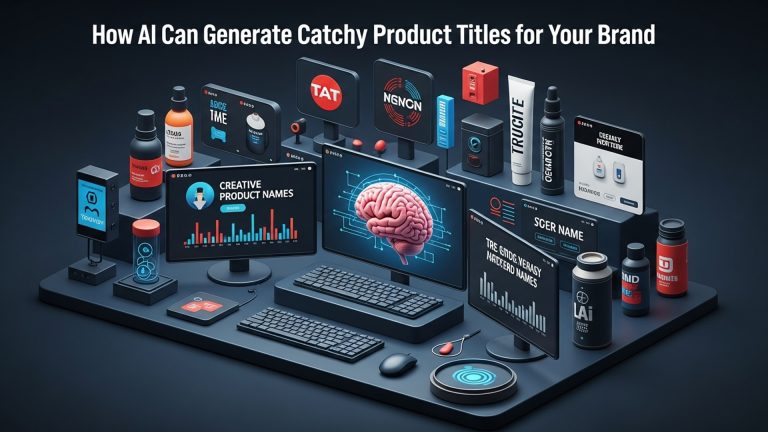
Creating titles that are catchy, descriptive, SEO-friendly, brand-aligned, and unique at scale is difficult with manual brainstorming alone. This is where an ai product titles generator fundamentally changes the process.
How AI Generates Catchy Product Titles
An ai product titles generator is powered by Artificial Intelligence, Natural Language Processing, and generative models trained on massive language datasets.
Natural Language Processing (NLP)
NLP allows systems to understand and generate human language. In the context of product titles, NLP helps analyze:
-
Product context and features
-
Audience intent and emotional triggers
-
Patterns in high-performing titles
-
Length, tone, and sentiment that drive engagement
Machine Learning (ML)
Machine learning models learn from performance data. By reviewing millions of product titles and engagement signals, AI identifies correlations between wording and outcomes such as click-through rate and conversions.
Over time, the system improves its ability to predict which title structures are most likely to perform for specific products and audiences.
Generative AI Models
Generative models such as GPT create new title variations based on your inputs. These models do not simply remix existing titles. They synthesize original phrasing that aligns with your product details, tone, and keywords.
The result is a wide range of title options created quickly and consistently.
How D2C Brands Use AI Product Title Generators Effectively
Using an ai product titles generator is not only about speed. It is about structured creativity and data-backed decision-making.
Step 1: Provide Clear Inputs
The quality of AI-generated titles depends on input clarity.
Key inputs typically include:
Product details
What the product is and what it does
Key features
Materials, technology, or standout attributes
Primary benefits
Problems solved or value delivered
Target audience
Demographics, interests, and motivations
Brand voice
Playful, premium, minimal, sustainable, or tech-forward
Keywords
Search terms customers actively use
Desired style
Short and punchy, descriptive, benefit-driven, or aspirational
Example Input Prompt
Generate 10 catchy product titles for a D2C vegan skincare product.
Product: Hydrating facial serum
Key features: Hyaluronic Acid, Vitamin C, plant-based, cruelty-free, organic
Benefits: Deep hydration, brighter skin, reduced fine lines
Target audience: Eco-conscious women aged 25 to 45
Brand voice: Natural, effective, gentle
Keywords: Vegan serum, vitamin C serum, natural glow
Step 2: Review and Refine AI Outputs
AI produces variety. Human judgment selects quality.
Evaluate suggested titles based on:
-
Clarity
-
Catchiness
-
SEO relevance
-
Brand alignment
-
Uniqueness
Efficiency Comparison
| Aspect | Manual Title Creation | AI Title Generator |
|---|---|---|
| Speed | Hours or days | Seconds |
| Idea diversity | Limited | Extensive |
| SEO integration | Manual | Automated |
| Consistency | Variable | High |
| Cost | High | Low |
Strategies to Maximize Performance
Human Review Is Essential
AI generates options. Humans refine meaning.
Final edits ensure:
-
Emotional alignment
-
Cultural relevance
-
Brand personality consistency
Small wording changes often make the difference between average and high-performing titles.
A/B Test Everything
D2C brands benefit from direct feedback loops.
Test titles across:
-
Product pages
-
Paid ads
-
Email campaigns
-
Social media listings
Track:
-
Click-through rate
-
Conversion rate
-
Time on page
-
Bounce rate
Performance data should guide future AI prompts.
Integrate Titles Into Your SEO Strategy
AI supports SEO but does not replace strategy.
Best practices include:
-
Feeding researched keywords into AI prompts
-
Using long-tail, intent-driven phrases
-
Reviewing competitor title patterns
-
Balancing search intent with brand tone
Well-structured titles improve both visibility and relevance.
Real-World D2C Impact
Brands adopting AI-driven title generation are accelerating launches and improving conversion rates.
By testing AI-generated options and selecting top performers, D2C brands commonly report:
-
Higher click-through rates
-
Faster go-to-market timelines
-
More consistent branding across catalogs
AI enables rapid experimentation while maintaining control through human validation.
Limitations and Best Practices
Current Limitations
-
AI lacks true intuition
-
Niche humor and subtle brand nuance may require refinement
-
Overuse without oversight can lead to generic outputs
Human Oversight Remains Critical
Successful D2C teams:
-
Define brand strategy and tone
-
Curate and refine AI outputs
-
Analyze performance data
-
Continuously improve prompts
AI works best as a co-pilot, not an autopilot.
Looking Ahead: AI Product Titles in the Future
Emerging developments include:
-
Personalized titles per user segment
-
Image-aware AI that reviews visuals alongside text
-
Real-time adaptation based on market trends
These advancements will further strengthen how D2C brands connect products with customers.
Conclusion
AI-powered product title generation unlocks speed, scale, and creative range for D2C brands.
Used correctly, it enhances brainstorming, supports SEO, and enables continuous optimization. Human insight remains essential for refinement, emotional resonance, and brand alignment.
A strong title is often the first step in a customer journey. With AI as a structured creative partner, D2C brands can ensure every product starts that journey with maximum impact.
More Articles
Boost Your Sales with AI Powered Product Page Optimization Strategies
Write Engaging Product Descriptions Effortlessly Using AI Tools for More Sales
Elevate Your Product Catalog with AI Images for Better Engagement
How AI Image Generation Boosts Your Ecommerce Store Sales Effectively
Improve Your Business with AI-Driven Decision Making Strategies

FAQs
What’s the big deal with using AI for creating product titles?
It’s a game-changer for speed and creativity! AI can quickly churn out a massive number of unique, attention-grabbing title ideas that you might never have thought of otherwise. This helps your products stand out in a crowded market and saves you a ton of brainstorming time.
How does AI actually come up with these catchy titles?
Think of it like a super-smart brainstormer. You feed it details about your product – its features, benefits, target audience, keywords. even your desired brand tone. The AI then uses its advanced language models to review patterns, combine words creatively. suggest titles that are relevant, persuasive. memorable.
Can AI make titles that fit my specific brand voice?
Absolutely! You can ‘train’ or prompt the AI with examples of your brand’s existing voice, whether it’s quirky, luxurious, practical, or humorous. The more context you provide about your brand identity and the desired tone, the better the AI gets at generating titles that sound authentically you.
Is it just about being ‘catchy’ or does AI do more for product titles?
It’s definitely more than just catchy. AI can optimize titles for search engines by including relevant keywords, highlight key benefits, create a sense of urgency. even test different emotional appeals. It’s about combining pure creativity with strategic marketing impact.
What kind of info does AI need from me to work its magic?
The more, the merrier! Give it product features, the problems it solves, who it’s for, any specific keywords you want to target, your brand’s tone. even examples of titles you like or dislike. Good input always leads to great output.
Will AI replace human copywriters for creating product titles?
Not really replace. definitely enhance! AI is fantastic for generating a high volume of initial ideas and variations. Human copywriters then step in to refine, add nuance, ensure perfect brand alignment. make the final selection, bringing their unique creativity and strategic insight to the table. It’s a powerful partnership.
Are there any downsides or things to watch out for when using AI for titles?
While incredibly helpful, AI can sometimes generate titles that are a bit generic, nonsensical, or even culturally insensitive if not properly guided. Always review and refine the suggestions, as AI lacks true human understanding and intuition. It’s a powerful tool. not a complete replacement for human judgment and oversight.