
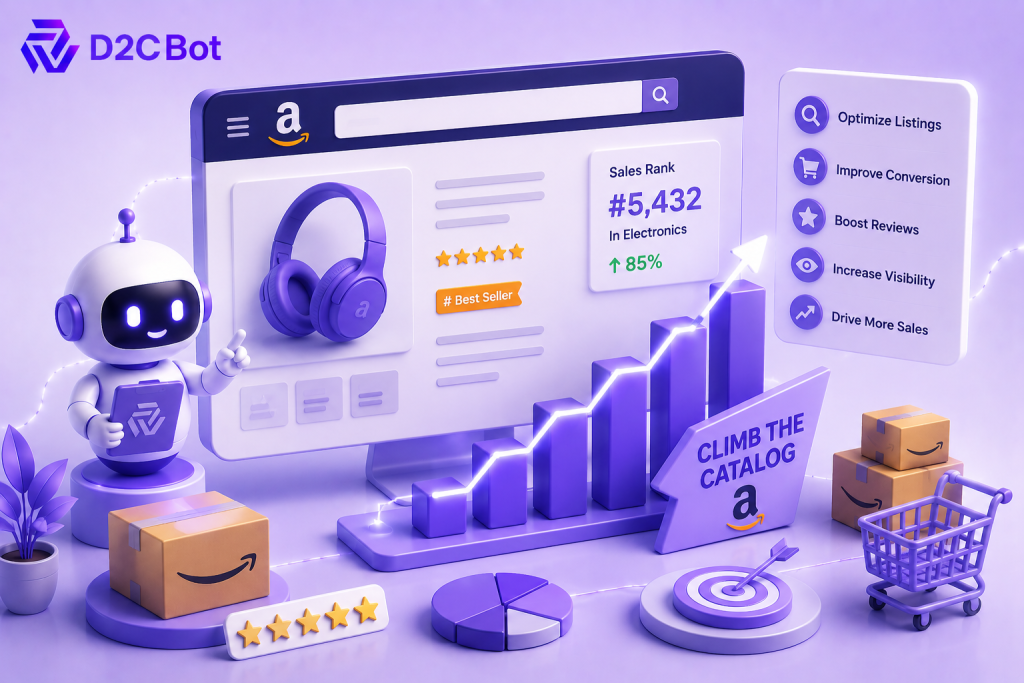
Succeeding on Amazon requires more than simply listing products and waiting for orders. Because the marketplace algorithm evaluates real-time sales velocity and conversion metrics, knowing how to improve amazon sales rank is critical for long-term growth.
Managing your Amazon Best Sellers Rank (BSR) is an ongoing process rather than a quick, one-off adjustment. When products rank higher in category search results, organic traffic increases, generating a flywheel effect that strengthens overall brand presence. Sustainable success comes down to listing quality, customer experience, and consistent optimization. By systematically refining product copy, keyword alignment, image assets, and conversion triggers, marketplace sellers can build lasting visibility. Understanding the interplay of these key factors helps ecommerce teams maximize visibility, drive higher conversion rates, and achieve predictable sales expansion on Amazon.
What Is Amazon Sales Rank and Why Does It Matter?
Amazon Best Sellers Rank reflects how well an item sells relative to all other products within its specific category. Updated hourly, this metric provides a direct snapshot of recent sales history alongside historical sales velocity.
Achieving a stronger sales rank directly expands organic visibility across marketplace search results. Higher-ranking products win consumer trust more easily, as buyers routinely interpret strong positioning as an indicator of product quality and seller reliability.
Because organic visibility drives traffic without proportional increases in ad spend, maintaining a competitive sales rank directly improves profitability. However, intense marketplace competition means that neglecting product updates can cause immediate drops in placement, making continuous listing refinement essential for revenue stability.
How to Improve Amazon Sales Rank
Sellers seeking clear strategies on how to improve amazon sales rank must focus on the core ranking factors driving the A9 algorithm: conversion rate and sales velocity. The marketplace algorithm prioritizes items that generate immediate revenue.
To achieve sustainable improvements, brands must combine technical keyword optimization with high-converting visual assets. Continuous optimization ensures your product listings remain fully aligned with high-intent customer search queries.
A data-driven approach involves auditing customer search patterns, updating backend keywords, and refining product bullet points regularly. Rather than chasing short-term hacks that risk marketplace penalties, focus on long-term strategy. Delivering clear value propositions, managing stock availability, and optimizing listing assets creates a compounding growth cycle that steadily improves sales rank across your catalog.
Optimize Your Product Listings
Thorough product optimization serves as the foundation for search indexation and customer conversions. Every element of your page must communicate product utility clearly while targeting relevant customer search terms.
Product titles must strike a balance between high-volume keywords and human readability, incorporating brand names, key features, materials, and sizes. Bullet points should address core customer pain points, highlighting distinct benefits rather than simple technical specifications.
In addition, comprehensive descriptions and populated backend search terms allow Amazon algorithms to index your items for long-tail query variations. High-resolution product images, main infographics, and lifestyle shots remove buying hesitation, ensuring your amazon seo setup drives both indexing depth and click-through performance across desktop and mobile devices.
Improve Conversion Rate to Strengthen Sales Rank
Search traffic alone will not sustain product rankings if incoming visitors fail to purchase. Elevating your conversion rate tells Amazon algorithms that your listing provides the ideal answer to consumer search intent.
Competitive pricing structures, explicit discount framing, and clear fulfillment terms directly influence buying decisions. Featuring prominent customer reviews and maintaining high star ratings reassure prospective buyers during critical evaluation moments.
Brand owners should leverage A+ Content to present detailed comparison charts, brand stories, and expanded visual media. Optimizing your storefront layout for mobile screens reduces purchase friction, instills strong purchase confidence, and accelerates checkout actions, directly lifting sales volume and strengthening your overall ranking position.
Monitor Performance and Refine Your Strategy
Maintaining top market rankings requires proactive catalog monitoring and iterative optimization. Organic search positions shift continuously as new marketplace competitors enter your category and customer search behavior evolves.
Regular keyword tracking allows teams to identify declining index positions before sales drop off sharply. Analyzing competitor listings reveals emerging visual trends, price changes, and positioning shifts that demand quick adjustments.
Stock management is equally vital; running out of inventory resets your hard-earned sales velocity, severely damaging historical rankings. Regularly refreshing low-performing listings with updated copy, enhanced backend terms, and updated lifestyle imagery keeps your product catalog relevant, protecting long-term organic presence.
How D2CBot Supports Amazon Listing Optimization
D2CBot equips ecommerce managers and agency teams with structured AI workflows designed specifically for marketplace catalog optimization. Rather than struggling with manual copy edits, D2CBot automates title generation, bullet point drafting, backend keyword allocation, and A+ Content outlines across your catalog.
By integrating structured optimization rules, D2CBot simplifies catalog updates while keeping team members in full control of brand standards.
| Weak Amazon Listing | Optimized Amazon Listing |
| Missing target terms and poor keyword targeting | Comprehensive keyword targeting across titles and backend fields |
| Generic text with uninspired product content | Benefit-driven product content structured for fast reading |
| Low-quality visuals lacking detailed infographics | High-resolution images featuring callouts and lifestyle context |
| Confusing product layouts creating friction | Intuitive design building strong customer experience and trust |
| Low click-through rates and poor conversion potential | Optimized pricing, reviews, and media driving high conversion potential |
| Stagnant search visibility and declining rank | Compounding sales velocity yielding positive sales rank impact |
Amazon Sales Rank Improvement Checklist
Execute these action items to systematically elevate your product page performance:
- Conduct thorough keyword research to identify high-intent backend and frontend search terms.
- Format main titles using brand, line, key material, and primary feature attributes.
- Structure five bullet points focusing on customer benefits and immediate problem-solving.
- Upload high-resolution main images meeting Amazon background and sizing specifications.
- Publish A+ Content showcasing comparison tables, detailed specifications, and lifestyle media.
- Audit pricing strategies to ensure competitive placement within your target category.
- Monitor product review trends and address negative buyer feedback patterns promptly.
- Maintain strict inventory forecasting to prevent out-of-stock keyword index drops.
Conclusion
Understanding how to improve amazon sales rank requires a balanced commitment to listing quality, conversion optimization, and continuous marketplace monitoring. Relying on static listings causes brands to fall behind as marketplace algorithms prioritize active, fast-converting products. By systematically sharpening product titles, Bullet points, visual assets, and backend terms, sellers can capture high-intent search traffic and turn interest into consistent sales velocity.
Use D2CBot to optimize Amazon listings, streamline content workflows, and support long-term marketplace growth.
More Articles
- https://d2cbot.com/blog/content-marketing/best-ecommerce-blog-content-generator-d2c-brands/
- https://d2cbot.com/blog/seo-tips/shopify-app-sprawl-problem/
- https://d2cbot.com/blog/content-automation/ai-faq-generator-product-pages/
- https://d2cbot.com/blog/website-tools/free-faq-generator-for-website/
FAQs
Amazon Sales Rank is primarily driven by recent sales velocity, historical order volumes, conversion rates, competitive pricing, and current stock availability within a specific product category.
Audit your product listings quarterly. However, make immediate updates whenever keyword positions drop, customer acquisition costs rise, new competitors enter the market, or conversion rates decline.
Yes, effective amazon seo improves keyword indexation and search visibility, bringing more qualified shoppers to your page, which increases sales volume and directly improves your sales rank.
Clear, benefit-focused product content, high-quality images, and informative A+ layouts remove buyer doubts, helping prospective shoppers make faster purchase decisions and directly boosting page conversion rates.
Main images, keyword-optimized product titles, benefit-driven bullet points, competitive pricing, and verified customer reviews carry the strongest influence over click-through rates, conversions, and ranking positions.