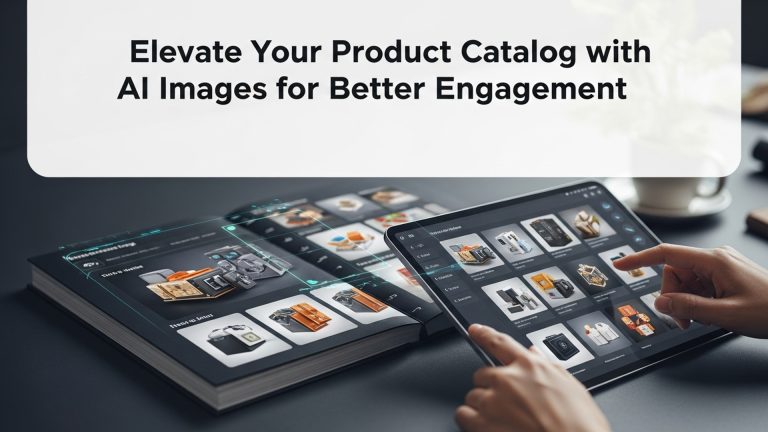
In today’s hyper-visual digital landscape, captivating product imagery is no longer an option but a necessity. Leveraging cutting-edge AI images for product catalog creation is rapidly becoming the gold standard for brands aiming to deeply engage their audience.
Generative AI, powered by advanced diffusion models, now enables the rapid production of hyper-realistic visuals, from diverse product variations and customizable backdrops to entirely new conceptualizations previously constrained by expensive photography or limited resources.
This transformative capability allows businesses to iterate on visual narratives at unprecedented speed, delivering personalized and contextually relevant imagery that drastically enhances user interaction, reduces bounce rates. ultimately drives higher conversions by presenting products in their most compelling light.
The Revolution of Visual Commerce
Why AI Images for Product Catalogs Are a Game Changer
In today’s highly competitive digital marketplace, a product’s visual presentation can strongly influence consumer perception and purchasing decisions. Stale, uninspired, or inconsistent imagery within an e-commerce platform often leads to reduced engagement, higher bounce rates, and ultimately lost sales. This is where the transformative power of artificial intelligence comes into play, particularly through advanced generative models that create high-quality AI images for product catalogs.
By leveraging these tools, businesses can not only revolutionize their visual assets but also streamline workflows, reduce costs, and deliver richer customer experiences at scale.
What Generative AI Means for Product Catalogs
Generative AI refers to a class of artificial intelligence systems capable of producing new, original content, including images, that closely resemble human-created work. In the context of product catalogs, this enables brands to:
-
Visualize products that do not yet physically exist
-
Place products into diverse, contextually relevant environments
-
Create consistent, high-quality imagery without traditional photoshoots
This capability goes far beyond simple image editing. It enables the creation of entirely new visual narratives on demand, reshaping how products are presented online.
How AI Generates Product Imagery
Diffusion Models
Modern AI image generation is primarily powered by diffusion models. These models learn to reverse a noise process, starting from random static and gradually refining it into a detailed image guided by a text prompt. This method enables highly realistic textures, lighting, and depth, making it ideal for product visualization.
Popular tools built on this technology include Midjourney, DALL-E, and Stable Diffusion.
Prompt Engineering
The quality of AI-generated images depends heavily on the prompt provided. Prompt engineering involves clearly describing:
-
Product attributes
-
Environment and setting
-
Lighting and camera angle
-
Style and mood
For example:
A sleek minimalist smart speaker on a polished oak desk, soft natural morning light, modern living room background, high-resolution professional studio look.
Clear prompts lead to more accurate and visually compelling results.
AI Upscaling and Enhancement
AI can also enhance existing images by increasing resolution, sharpening details, and improving clarity. This ensures every image in your product catalog looks crisp and professional, even when starting from lower-quality assets.
Key Benefits of AI Images for Product Catalogs
Cost Efficiency
Traditional product photography requires photographers, studios, models, props, and post-production. AI-generated imagery eliminates many of these expenses, allowing businesses to produce hundreds of visuals at a fraction of the cost.
Speed and Scalability
Launching a large catalog or multiple product variants can take weeks with traditional methods. AI enables image generation in minutes or hours, accelerating time to market and supporting rapid iteration and testing.
Creative Freedom
AI removes physical constraints. Products can be shown in any environment, lighting condition, or scenario, from everyday settings to aspirational lifestyles, without logistical complexity.
Personalization and Localization
Images can be tailored to different customer segments or regions. A brand can show the same product styled differently for various markets, cultures, or seasons, all from the same base asset.
Visual Consistency
AI can be guided by strict brand rules for lighting, composition, and tone, ensuring a cohesive look across the entire catalog regardless of scale.
Practical Use Cases in E-Commerce
-
Virtual try-on previews for apparel and accessories
-
Pre-launch product visualization before manufacturing
-
A/B testing imagery to optimize conversions
-
3D-style renders from simple product inputs
-
Automated social media visuals derived from catalog assets
For example, an apparel brand can quickly test whether lifestyle imagery outperforms studio-style shots, using real performance data rather than assumptions.
Traditional Photography vs AI Image Generation
| Aspect | Traditional Photography | AI Image Generation |
|---|---|---|
| Cost | High and resource-intensive | Significantly lower |
| Speed | Slow and sequential | Fast and iterative |
| Scalability | Limited | Highly scalable |
| Creative Flexibility | Physically constrained | Virtually unlimited |
| Consistency | Hard to maintain | Easy to standardize |
| Skill Requirements | Photography and staging | Prompt engineering and review |
| Authenticity | Real-world capture | Synthetic but highly realistic |
Best Practices for Successful Adoption
Invest in Prompt Quality
Clear, detailed prompts produce better results. Iteration is essential.
Maintain Ethical Standards
Audit outputs for bias and avoid misrepresenting product features. Transparency builds trust.
Enforce Quality Control
Not every AI-generated image will be usable. Human review ensures brand accuracy and alignment.
Integrate With Existing Systems
Plan how AI-generated images fit into your e-commerce platform, asset management system, and marketing workflows.
Use AI Beyond Generation
Explore background removal, restoration, and automated tagging to further enhance catalog efficiency.
Actionable Steps to Get Started
-
Start with a small product category and experiment
-
Compare AI images against existing visuals using performance metrics
-
Develop a visual style guide for AI-generated assets
-
Test multiple tools to find the best fit for your brand
-
Monitor conversion rates, engagement, and bounce rates
Conclusion
AI images for product catalogs are no longer an experimental novelty. They are a strategic advantage in modern visual commerce. This technology enables brands to create diverse, high-quality imagery faster and more affordably than ever before, while maintaining consistency and creative control.
A practical starting point is focusing on your highest-impact products and experimenting with alternative contexts, angles, or seasonal themes. AI makes these variations accessible without the cost or time burden of traditional photography.
The result is a richer, more engaging catalog that adapts to audience preferences, supports data-driven optimization, and ultimately converts more browsers into buyers. Brands that embrace AI-driven visuals today are not just keeping up with the market. They are shaping the future of digital commerce.
More Articles
How AI Image Generation Boosts Your Ecommerce Store Sales Effectively
Revolutionize Your Online Store with Ecommerce Visual Content AI Today
Transform Your Store Using AI Image Generation for Ecommerce Success
How to Create Product Images with AI for Online Stores

FAQs
What exactly does ‘elevating your product catalog with AI images’ mean?
It means using artificial intelligence to generate high-quality, appealing images for your products. Instead of traditional photoshoots, AI can create diverse visuals, place your product in various settings, or even generate entirely new lifestyle shots, making your catalog more dynamic and engaging for customers.
How do AI-generated images actually boost engagement?
They boost engagement by offering more visual variety and personalization. AI can create images that resonate with specific customer segments, show products in aspirational contexts, or highlight key features in unique ways. This richer visual storytelling makes customers more likely to click, explore. ultimately purchase.
Is it complicated to start using AI for product visuals?
Not at all! Many platforms are designed to be user-friendly. You typically provide existing product photos or even just descriptions. the AI does the heavy lifting. It’s often much simpler and faster than coordinating traditional photoshoots, letting you focus on other aspects of your business.
Will these AI images look fake or too generic?
Modern AI image generation has come a long way. With the right tools and prompts, AI can produce incredibly realistic and unique images that are hard to distinguish from professional photography. The goal is to enhance authenticity, not detract from it, by showcasing products in compelling, natural-looking scenarios.
Can AI imagery save my business time and money?
Absolutely! Think about the costs and time involved in professional photography – studio rental, models, photographers, post-production. AI can drastically reduce these expenses and deliver high-quality images much faster, allowing you to update your catalog more frequently and efficiently.
How quickly can I get new images using AI?
It’s incredibly fast! Depending on the complexity and platform, you can often generate multiple new images or variations within minutes or hours, compared to days or weeks for traditional methods. This speed lets you react quickly to trends or marketing needs, keeping your catalog fresh.
What kind of products benefit most from AI-generated visuals?
Almost any product can benefit. particularly those needing diverse lifestyle shots, products that are hard to photograph in various settings, or items where visual context significantly influences purchase decisions (e. g. , furniture, fashion, electronics, home goods). It’s also great for showcasing customizable products.