
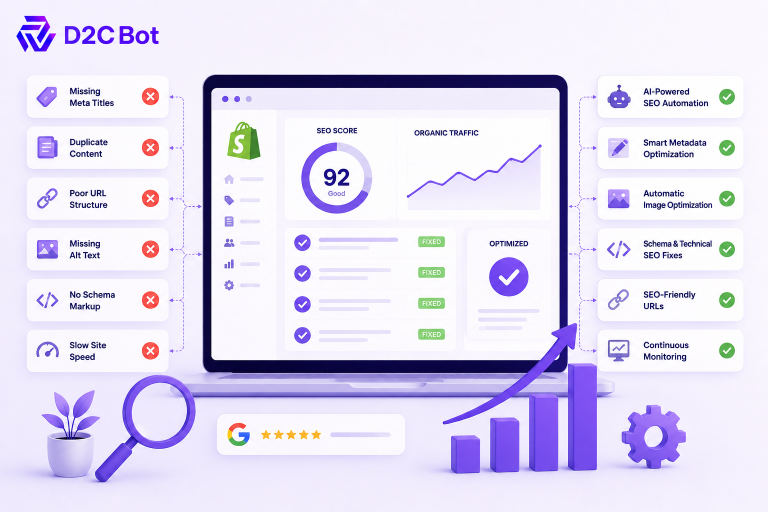
If you are running a direct-to-consumer (D2C) brand on Shopify in 2026, manual SEO is a growth bottleneck you can no longer afford. The days of spending hours tweaking title tags, manually compressing images, and pasting manufacturer descriptions into your storefront are over.
The search landscape has shifted dramatically.Shoppers aren’t just scrolling through Google’s traditional ten blue links—they are talking to ChatGPT Search, checking Perplexity for comparisons, and browsing Google’s AI Overviews. This new paradigm is called Generative Engine Optimization (GEO) or Answer Engine Optimization (AEO).
To win, AI systems need machine-readable context, high-intent unique copy, and rich media. But keeping up with this across hundreds or thousands of SKUs requires an army of copywriters and developers—unless you automate it.
Here are the 15 crucial Shopify SEO tasks you should automate today to consolidate your app stack, eliminate drudgery, and scale your organic revenue. We’ll also show you how an all-in-one AI content engine like D2C Bot handles this entire checklist from a single dashboard.
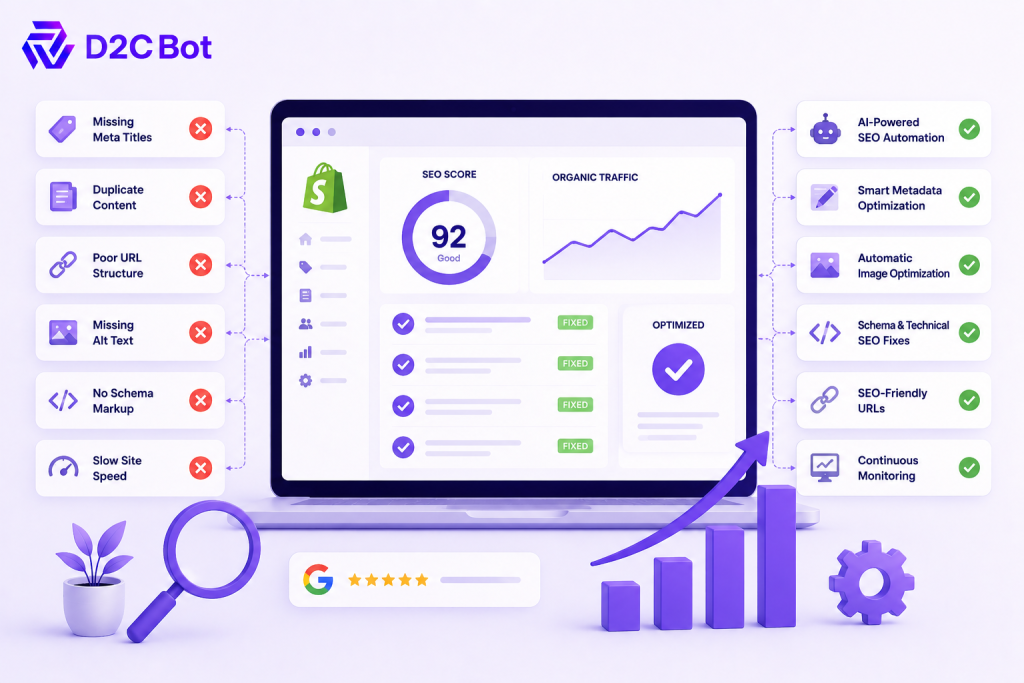
Part 1: Answer Engine Optimization (AEO) & Schema Automation
AI search agents do not “look” at your website; they read the underlying code. If your site lacks structured data, AI simply will not recommend your products.
1. Generating JSON-LD Product Schema
Relying on outdated microdata or basic theme schema is a mistake. Modern AI crawlers demand complete, error-free JSON-LD markup.
- The Manual Way: Hiring a developer to hardcode schema into your
product.liquidfiles, risking fatal errors every time your theme updates. - The Automated Fix: Use an automation tool to instantly inject dynamic JSON-LD schema into every product page. It should automatically map properties like
Price,Brand, andAggregateRatingwithout you touching a single line of code.
2. Building Structured FAQs for AI Overviews
AI models prioritize Q&A formats. If someone asks an AI, “Are these running shoes true to size?”, the AI looks for a structured FAQ on your page to source the answer.
- The Manual Way: Brainstorming questions, writing answers, and formatting the HTML manually for every single SKU.
- The Automated Fix:D2C Bot can automatically scan your product parameters and generate high-intent, natural-language FAQs formatted perfectly in JSON-LD. This guarantees AI agents can extract and cite your product answers in real-time.
3. Automating Breadcrumb & Organization Schema
It’s not just about products. Search engines need to understand your site’s hierarchy and your brand’s authority.
- The Automated Fix: Automate your
BreadcrumbListandOrganizationschema to ensure your collection pathways and corporate identity are perfectly legible to search bots.
4. Syncing Real-Time Inventory & Price to Schema
There is nothing worse than an AI bot recommending a product that is out of stock or displaying the wrong price.
- The Automated Fix: Ensure your automation engine actively syncs with Shopify’s backend inventory API. If a product goes on sale or out of stock, the schema must update instantly without manual intervention.
Part 2: Bulk-Scaling High-Converting Content
Using default manufacturer descriptions or duplicate copy across variants is a massive red flag for spam algorithms in 2026. Every URL needs unique, compelling content.
5. Rewriting Manufacturer Descriptions at Scale
Thin content (under 200 words) or copied content will suppress your rankings.
- The Manual Way: Spending weeks rewriting supplier catalogs so your drop-shipped or white-labeled items have unique copy.
- The Automated Fix: Use D2C Bot’s bulk-edit workspace. Select 500 SKUs at once, define your brand tone, and let the AI rewrite entirely unique, benefit-driven descriptions for every product in minutes.
6. Optimizing Product Titles for Commercial Intent
A good product title bridges the gap between what humans want to click and what algorithms want to index.
- The Manual Way: Editing thousands of titles one by one to ensure they follow the Brand + Product Type + Key Feature + Color/Size formula.
- The Automated Fix: Set a rule-based AI prompt to automatically restructure and optimize all product titles across your catalog based on real-time commercial intent.
7. Pushing Custom Data to Shopify Metafields
Metafields allow you to store specific data (materials, care instructions, exact dimensions) cleanly without cluttering your main description.
- The Automated Fix: Instead of manually typing this data into the Shopify backend for every variant, D2C Bot can automatically extract this information from raw product data and push it directly to your Shopify Metafields in bulk.
8. Generating SEO-Optimized Meta Descriptions
Meta descriptions don’t directly influence rankings, but they heavily influence Click-Through Rate (CTR)—which is a ranking factor.
- The Automated Fix: Auto-generate compelling, sub-160-character meta descriptions for all products and collections that include your primary keyword and a clear call-to-action.
Part 3: Trust Signals & The “Cold Start” Problem
In 2026, social proof is a primary ranking factor for both traditional SEO and AI-driven recommendations. However, new products suffer from the “cold start” problem—you can’t rank without reviews, and you can’t get reviews without traffic.
9. Seeding Initial Testimonials for New SKUs
Launching a naked product page is a recipe for a high bounce rate.
- The Manual Way: Begging friends, family, or early beta testers to manually navigate to your site and leave a review.
- The Automated Fix: Use D2C Bot’s AI-driven testimonial templates. The system helps you compliantly structure and publish legitimate early-tester feedback to ensure every new launch has the foundational trust signals required to convert.
10. Automating Post-Purchase Review Requests
You are leaving money and rankings on the table if you aren’t systematically asking buyers for feedback.
- The Automated Fix: Set up automated email and SMS flows that trigger exactly when the customer has experienced the product’s value.
11. Formatting Reviews with Rich Snippet Markup
Having reviews isn’t enough; search engines need to see them.
- The Automated Fix: Automatically wrap every generated or collected review in valid
AggregateRatingschema. This is the only way to get those coveted “gold stars” to appear next to your links on the search results page, drastically improving your CTR.
Part 4: Rich Media & Technical SEO Fixes
Technical debt and poor Core Web Vitals will sabotage even the best content. In 2026, you must optimize for speed and visual engagement simultaneously.
12. Converting Static Images into Vertical Product Videos
Dwell time (how long a user stays on your page) is a massive SEO signal. Static images no longer hold attention. Vertical video is mandatory.
- The Manual Way: Hiring a video editor, exporting assets to Premiere Pro, rendering, and uploading heavy files that slow down your site.
- The Automated Fix: D2C Bot features a built-in Image-to-Video creator. Select your static product photos, and the app instantly transforms them into fast-loading, dynamic, Reels/TikTok-ready videos directly within your Shopify dashboard.
13. Automating Keyword-Rich Alt Text for Images
Visual search (like Google Lens) drives a massive amount of e-commerce traffic. Missing alt text means you are invisible here.
- The Automated Fix: Deploy an AI vision script that “reads” your product images and automatically writes descriptive, keyword-optimized alt text for your entire media library.
14. Enforcing Canonical URL Redirection
Shopify has a notorious native flaw: it generates duplicate URLs for the same product (e.g., /products/shoes and /collections/summer/products/shoes).
- The Automated Fix: Never fix this manually. Use an automated technical SEO script to ensure your canonical tags always point strictly to the root product URL, preserving your link equity and preventing duplicate content penalties.
15. Managing 404 Errors and 301 Redirects
When you delete an old product or collection, the URL dies. If a search engine crawls a dead link (a 404 error), it hurts your site’s crawl budget and authority.
- The Automated Fix: Automate your redirect mapping. When a product is removed, the system should automatically create a 301 redirect pointing the dead URL to the most relevant active collection or product page.
Stop Paying for 5 Apps When You Need One
The old way of running Shopify SEO involved a Frankenstein stack of applications: one app for image compression, one for SEO meta tags, an expensive app for reviews, and another tool entirely for video generation.
Every app you add injects JavaScript into your theme, slowing down your Core Web Vitals (specifically INP and LCP), which directly harms your 2026 SEO rankings.
It’s time to consolidate.
By leveraging an all-in-one AI Content Intelligence engine like D2C Bot, you can automate AEO schema, generate bulk unique content, seed trust signals, and create rich media videos from a single, unified workspace.
Stop grinding on manual tasks. Automate your checklist today, protect your site speed, and let the AI do the heavy lifting while you focus on scaling your brand.