
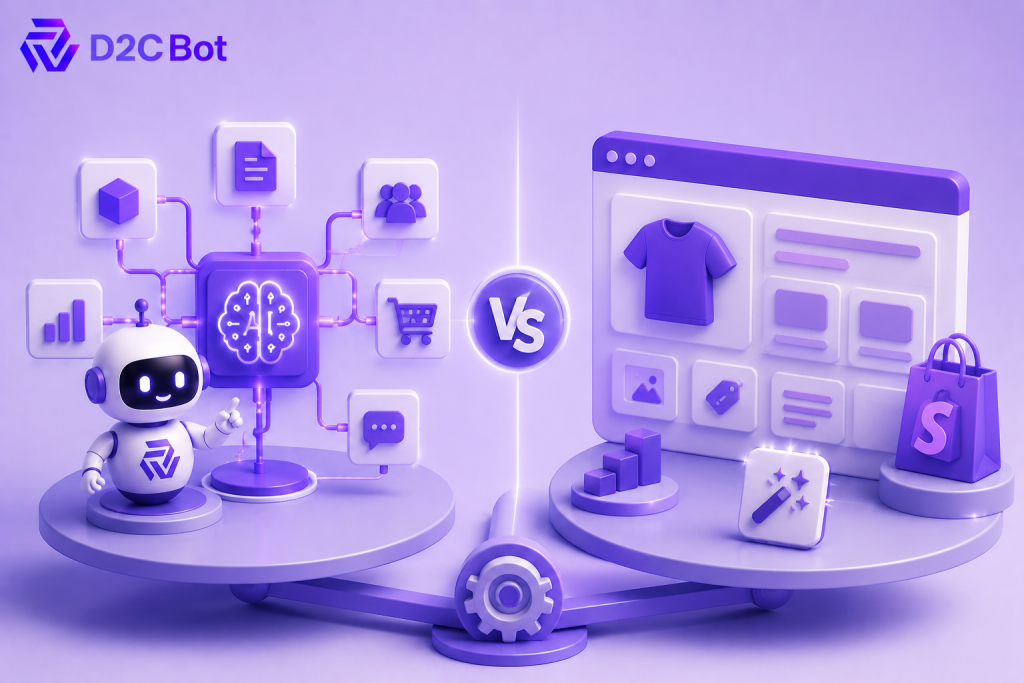
Ecommerce teams increasingly rely on artificial intelligence to accelerate content production, optimize search engine visibility, and manage expanding product catalogs. As digital storefronts scale, maintaining consistent copy across hundreds of product detail pages, collection hubs, and marketing channels becomes a major operational challenge. When evaluating tools to streamline these tasks, merchants often compare standalone workflow platforms with native store features, assessing copy.ai workflows vs native shopify ai apps to determine which solution best suits their growth strategy.
Choosing between a dedicated AI workflow engine and built-in Shopify capabilities requires evaluating team structure, catalog complexity, and cross-channel marketing requirements. While native Shopify features offer seamless inline generation within the store administrator panel, external workflow platforms provide multi-step automation and cross-platform orchestration. Understanding the trade-offs between integrated convenience and configurable workflow automation allows ecommerce operations managers, D2C founders, and marketing teams to build a balanced technology stack aligned with their specific content requirements.
Understanding the Difference Between Workflow AI and Native Shopify AI
Comparing copy.ai workflows vs native shopify ai apps requires examining their underlying architectural designs and primary operational objectives. Built-in store AI features focus on immediate, single-point execution directly within the ecommerce admin dashboard. These native tools help merchants generate product descriptions, draft email subject lines, or create image alt text directly on the page where the content lives.
In contrast, dedicated workflow automation engines operate as orchestration layers across entire business processes. Rather than generating text one field at a time, workflow platforms allow teams to chain together web scraping, research agents, database tables, conditional logic, and bulk copy generation. This approach connects content creation directly to broader go-to-market strategies, enabling multi-channel output, structured review steps, and complex data enrichment.
Copy.ai Workflows: Strengths and Ideal Use Cases
Copy.ai has evolved from a basic text generator into a robust go-to-market platform powered by configurable workflows and autonomous AI agents. It allows marketing and operations teams to codify complex content pipelines into repeatable, automated sequences.
The platform excels in environments requiring multi-step research, bulk generation, and cross-channel campaign orchestration. For example, a team can build a single workflow that pulls raw supplier data, researches competitor keywords, drafts formatted product descriptions, generates matching social media ads, and prepares email marketing copy simultaneously.
Copy.ai also features central data tables, customizable brand voice profiles, and collaborative workspaces. This makes it particularly effective for mid-market and enterprise D2C brands that manage multi-person content teams, execute account-based campaigns, and require advanced prompt engineering across non-ecommerce tools.
Native Shopify AI: Strengths and Ideal Use Cases
Shopify has deeply integrated AI capabilities, known as Shopify Magic, directly across its core storefront architecture and admin ecosystem. These native features provide merchants with instant AI assistance without requiring external API setups, third-party software subscriptions, or complex tool integrations.
The principal strength of native Shopify AI lies in its zero-friction accessibility and direct context awareness. Merchants can automatically generate product descriptions, draft customer support responses in Shopify Inbox, write email subject lines, and generate image alt text right inside their store admin panel.
Because native AI tools inherit product titles, tags, inventory status, and collection structures directly from the store database, they require minimal setup. This makes native Shopify AI an excellent fit for solo entrepreneurs, small D2C teams, and catalog managers who need fast, point-and-click copy generation without leaving their primary ecommerce management interface.
Feature-by-Feature Comparison
When weighing copy.ai workflows vs native shopify ai apps, reviewing specific operational capabilities helps clarify how each platform handles everyday ecommerce tasks:
- Content Generation: Native Shopify AI produces quality single-page copy using direct product tags and preset tones. Copy.ai enables multi-asset generation, creating blog posts, ad variations, and long-form guides alongside catalog descriptions.
- Workflow Automation: Native AI executes tasks on a page-by-page basis. Copy.ai supports visual drag-and-drop workflow builders, conditional branching, and autonomous AI agents for end-to-end task execution.
- Bulk Operations: Shopify handles individual and batch admin tasks, whereas Copy.ai processes large data tables to generate and format thousands of content fields programmatically.
- Collaboration & Customization: Native tools offer simple tone selectors and inline text editors. Copy.ai includes workspace permissioning, centralized asset libraries, and fully customizable prompt logic.
Which Solution Fits Different Ecommerce Teams?
Selecting the right platform depends largely on catalog scale, organizational structure, and operational complexity. Small Shopify stores and early-stage D2C startups often gain the highest return from native Shopify AI. The absence of additional subscription costs, combined with instant accessibility within the admin panel, allows lean teams to maintain product pages without adding software overhead.
Conversely, growing D2C brands, large-catalog retailers, and multi-channel ecommerce agencies frequently outgrow basic inline generators. When marketing operations involve launching hundreds of SKUs monthly, distributing content across external channels, and maintaining strict brand governance, workflow-first solutions like Copy.ai provide the structural flexibility required to scale output efficiently.
Where Workflow-First Platforms Like D2CBot Fit
While general GTM platforms like Copy.ai serve broad sales and marketing functions, specialized ecommerce workflow platforms focus specifically on storefront operations. Platforms like D2CBot bridge the gap between simple native tools and complex multi-purpose workflow builders by providing purpose-built automation designed specifically for online retail.
Specialized ecommerce platforms combine structured workflow logic with native store connectivity. Teams can generate, review, optimize, and publish product descriptions, blogs, FAQs, meta tags, and multilingual content through tailored workflows that incorporate human review checkpoints before publishing live.
| Evaluation Area | Copy.ai Workflows | Native Shopify AI |
| Workflow Automation | Advanced multi-step visual workflow engine with AI agents | Direct inline generation without multi-step chaining |
| Store Integration | Requires API connectors, webhooks, or third-party apps | Built directly into the native Shopify admin panel |
| Bulk Content Support | High capacity via centralized data tables and automation | Ideal for single-item or page-level updates |
| Team Collaboration | Multi-user workspaces, shared libraries, and roles | Standard Shopify admin user permissioning |
| Ease of Implementation | Moderate setup required to build custom workflows | Immediate zero-configuration rollout out of the box |
| Best-Fit Use Case | Multi-channel teams managing complex GTM campaigns | Merchants needing fast, frictionless inline content drafting |
AI Workflow Evaluation Checklist
Review these core operational factors before selecting an AI content solution for your storefront:
- Map out your average monthly product launch volume and catalog updates.
- Determine whether content is published solely to Shopify or across multiple sales channels.
- Assess whether your team requires human editorial approval checkpoints before publishing.
- Calculate total software costs, comparing free native capabilities against platform subscriptions.
- Evaluate internal technical capacity for building and maintaining custom prompt logic.
- Check required language support and localization capabilities for international storefronts.
- Review existing brand voice guidelines to ensure the platform can maintain visual and tonal consistency.
- Confirm whether the system supports bulk export and import functions across large inventory files.
Conclusion
Deciding between copy.ai workflows vs native shopify ai apps ultimately comes down to your store’s operational footprint, catalog size, and workflow requirements. Native Shopify AI provides an accessible, cost-effective solution for merchants looking to draft quality copy directly inside their store admin panel without added complexity. Meanwhile, general workflow engines like Copy.ai empower larger teams to orchestrate multi-step, cross-channel campaigns across complex data environments. By evaluating your team’s specific content bottlenecks, publishing workflows, and growth targets, you can deploy the ideal AI combination to maximize operational efficiency and scale sustainable revenue.
Evaluate your ecommerce content workflow to determine which AI approach best supports your team’s productivity, scalability, and long-term growth.
More Articles
- https://d2cbot.com/blog/shopify/climb-the-catalog-how-to-improve-your-amazon-sales-rank-in-2026/
- https://d2cbot.com/blog/e-commerce-tools/how-ai-helps-ecommerce-teams-scale-product-content-faster/
- https://d2cbot.com/blog/shopify-marketing/top-5-product-page-mistakes-that-quietly-kill-shopify-conversion-rate/
- https://d2cbot.com/blog/seo/the-complete-shopify-seo-automation-checklist-for-2026/
FAQs
Neither tool is universally superior; Copy.ai offers advanced multi-step workflow automation for cross-channel marketing, while Shopify AI provides seamless, zero-cost content generation directly inside your store admin panel
For complex, multi-step operations involving research, bulk data processing, and cross-channel publishing, dedicated workflow platforms excel. For fast, page-level storefront updates, native Shopify AI is more efficient.
Shopify AI can draft descriptions and alt text for large catalogs page by page or through select admin tools, but managing complex bulk enrichment often benefits from dedicated workflow tools.
Businesses should adopt workflow automation when manual content creation, multi-channel distribution, bulk catalog updates, and team review processes consume excessive operator hours every week.
Teams should evaluate platforms based on catalog size, monthly publishing volume, team collaboration requirements, integration needs, ease of implementation, and total operational cost rather than feature counts alone.