If you’ve dabbled with AI writing tools, you’ve probably asked yourself this critical question: Is AI generated content good for SEO, or am I wasting my time?
The short answer: Yes, AI-generated content can be excellent for SEO—but only when used correctly.
The longer answer involves understanding Google’s evolving algorithms, quality standards, and the fine line between AI-assisted content creation and lazy automation. In 2026, the digital marketing landscape has matured significantly, and the rules around AI generated content and SEO are clearer than ever.
This guide will cut through the confusion and give you evidence-based insights on whether AI generated content for SEO actually works, what Google really thinks about it, and how to use it effectively without risking penalties.
What Google Actually Says About AI Generated Content
Let’s start with the facts, not the myths.
Google’s official stance, updated multiple times through 2024 and 2025, is crystal clear: they don’t penalize content based on how it’s created. Their quality ranking systems don’t care whether a human, an ai seo content generator, or a team of experts produced your content.
What Google does care about is quality, helpfulness, and whether your content satisfies user intent.
In their Search Central documentation, Google explicitly states: “Our focus on the quality of content, rather than how content is produced, is a useful guide that has helped us deliver reliable, high quality results to users for years.”
However—and this is crucial—Google’s helpful content system does target content that appears to exist primarily for search engine rankings rather than helping people. Mass-produced, low-value pages get demoted regardless of whether AI or humans created them.
The takeaway? AI seo content generators are tools, not shortcuts. Used strategically with human oversight, they enhance your SEO efforts. Used recklessly to pump out thin content at scale, they’ll tank your rankings.
The Advantages of AI Generated Content for SEO
When implemented properly, AI generated content for SEO offers several compelling advantages that smart digital marketers in India and globally are already leveraging:
Speed and Scalability
An ai seo content generator can produce a well-structured 1,500-word draft in minutes—work that might take a human writer 3-4 hours. For agencies managing multiple clients or websites covering hundreds of topics, this efficiency is transformative.
However, speed only matters if quality remains high. The best approach uses AI for rapid drafting, then applies human expertise for refinement, fact-checking, and adding unique insights.
Comprehensive Topic Coverage
AI tools excel at structuring comprehensive content that covers topics thoroughly. They can identify subtopics, related questions, and content gaps that might take hours of manual research to uncover.
For seo and ai generated content strategies, this means better coverage of user intent, which directly impacts rankings. Google rewards content that thoroughly answers queries and anticipates follow-up questions.
Consistency Across Content
Maintaining a consistent tone, style, and quality across dozens or hundreds of articles is challenging for human writers. AI tools can maintain brand voice guidelines and structural consistency, ensuring every piece meets baseline standards.
Data-Driven Optimization
Modern ai seo content generators can analyze top-ranking content for target keywords, identifying common structural elements, semantic keywords, and content patterns. This data-driven approach takes the guesswork out of optimization.
Cost Efficiency
For startups and small agencies with limited budgets, AI tools dramatically reduce content production costs. A single SEO specialist with an ai seo content generator can produce the output that previously required a team of writers.
The Disadvantages and Risks of AI Content for SEO
Despite the advantages, AI generated content and SEO strategies face real challenges that you need to understand and mitigate:
Lack of Genuine Experience and Expertise
Google’s EEAT (Experience, Expertise, Authoritativeness, Trustworthiness) framework emphasizes firsthand experience—something AI fundamentally cannot provide. An AI can describe how to optimize a Google Ads campaign, but it can’t share the experience of managing ₹10 lakh monthly budgets for Indian e-commerce clients.
This limitation is particularly problematic for YMYL (Your Money, Your Life) topics like health, finance, and legal advice, where Google applies stricter quality standards.
Generic, Undifferentiated Content
Without careful editing, AI produces content that sounds remarkably similar to thousands of other AI-generated articles on the same topic. This “sameness” problem means your content won’t stand out, won’t attract natural backlinks, and won’t build brand authority.
Generic content also struggles with engagement metrics. If users quickly return to search results because your content didn’t uniquely answer their question, Google interprets this as a quality signal—and not a good one.
Factual Accuracy Concerns
AI tools sometimes present outdated information, make logical errors, or even fabricate statistics and citations. Publishing factually incorrect content damages trust, invites negative user signals, and can trigger manual quality reviews.
Detection and Potential Future Penalties
While Google claims not to penalize AI content specifically, their algorithms are getting better at identifying low-effort, mass-produced content patterns. If your entire site consists of barely-edited AI drafts, you’re vulnerable to algorithmic demotions even if you’re not technically violating guidelines.
How to Make AI Generated Content Good for SEO: Best Practices
The question isn’t whether to use AI for SEO content—it’s how to use it effectively. Here’s the proven framework:
Start with Strategic Planning, Not Random Generation
Don’t just feed keywords into an ai seo content generator and hope for the best. Begin with thorough keyword research, competitor analysis, and user intent mapping. Understand what your audience actually needs before generating content.
Use AI for Drafts, Not Final Products
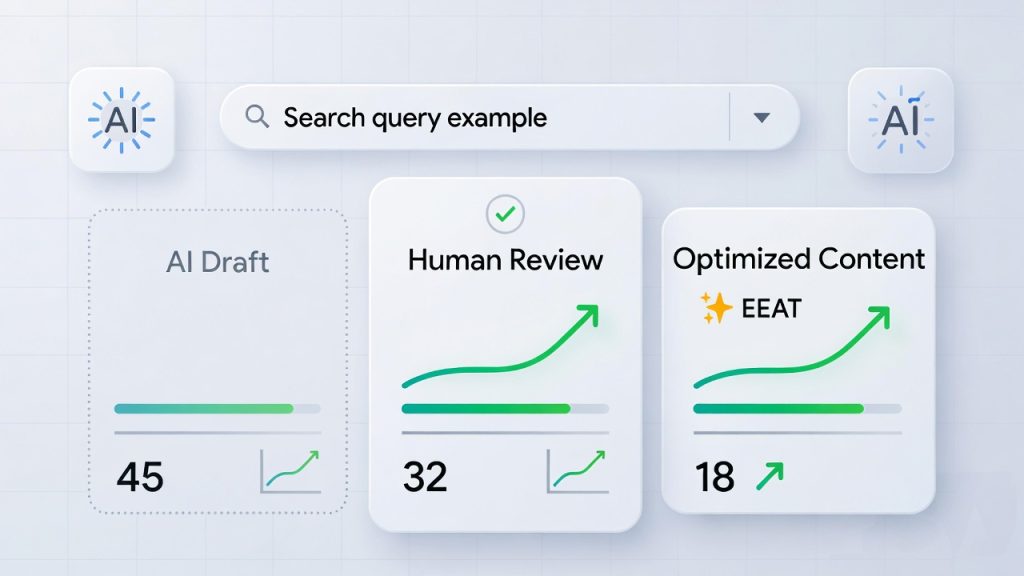
Think of AI as an extremely fast research assistant and first-draft writer. Generate the structure, compile information, and create a foundation—then invest serious time editing, refining, and enhancing.
Top-performing content typically requires 2-3x more editing time than generation time. This ratio ensures quality while maintaining efficiency.
Add Unique Value That AI Cannot Provide
Inject elements that only humans with real experience can contribute:
- Personal case studies and client examples
- Original research or proprietary data
- Industry insights from your expertise
- Specific examples relevant to Indian markets or your niche
- Contrarian viewpoints or nuanced analysis
Implement Rigorous Fact-Checking
Verify every statistic, check publication dates on sources, and confirm that advice aligns with current best practices. For seo and ai generated content, outdated SEO advice is worse than no advice at all.
Optimize for EEAT Signals
Include detailed author bios with credentials, link to authoritative sources, cite recent studies, and demonstrate deep subject matter expertise. Make it obvious that a knowledgeable human reviewed and enhanced the content.
Focus on User Experience
Structure content for easy scanning with clear headings, short paragraphs, bullet points, and visual elements. Optimize page speed, mobile responsiveness, and readability. The technical SEO aspects matter as much as content quality.
Build Genuine Topical Authority
Rather than creating isolated articles, develop content clusters that thoroughly cover topics from multiple angles. Interlink strategically to demonstrate comprehensive expertise in your niche.
Real-World Examples: AI Content That Ranks
Several Indian digital marketing agencies and global brands are successfully using AI generated content for SEO:
Case Study 1: A Mumbai-based SaaS company used Claude to generate 50 blog post drafts, then had their marketing team add customer quotes, product screenshots, and specific use cases. Result: 35 posts ranked in top 10 within 3 months, driving 40% increase in organic traffic.
Case Study 2: An affiliate marketing site used ChatGPT for product comparison articles but differentiated by adding hands-on testing data, original photos, and detailed pro/con analysis based on real usage. Their AI-assisted content outranked purely human-written competitor articles.
Case Study 3: A digital marketing agency in Bangalore created an ai seo content generator workflow combining Jasper for drafts, human editors for refinement, and subject matter experts for fact-checking. They scaled from 10 to 60 monthly articles without quality decline, improving client rankings across the board.
The common thread? AI handled efficiency; humans provided differentiation and expertise.
The Future of AI Content and SEO
As we progress through 2026, the relationship between AI generated content and SEO will continue maturing. Google’s algorithms will likely get better at distinguishing high-effort, human-enhanced AI content from low-effort mass production.
The winners will be those who view AI as a productivity multiplier, not a replacement for expertise. The most successful content strategies will combine AI efficiency with human creativity, experience, and strategic thinking.
The question “is AI generated content good for SEO?” is already becoming obsolete. The better question is: “How good is YOUR AI-assisted content creation workflow?”
Conclusion: AI Content Can Be Great for SEO (With the Right Approach)
So, is AI generated content good for SEO? Absolutely—when you use it as a tool within a quality-focused content strategy, not as an autopilot solution.
The key is maintaining high editorial standards, adding genuine human value, and never publishing AI drafts without substantial enhancement. Use ai seo content generators to handle the heavy lifting of research compilation and structure, then apply your expertise to create truly helpful, differentiated content.
Done right, AI-assisted content creation is one of the most powerful competitive advantages available to digital marketers in 2026. Done wrong, it’s a fast track to algorithmic penalties and declining organic visibility.
The tools are available. The strategies are proven. The choice is yours: will you use AI to create genuinely helpful content at scale, or fall into the trap of low-effort mass production?