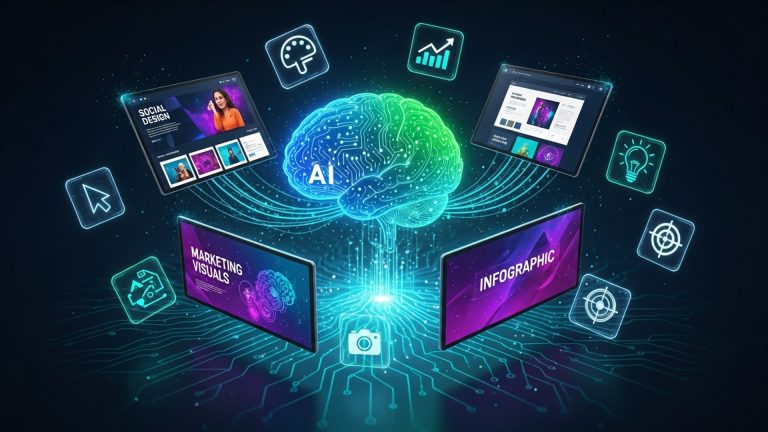
The relentless demand for fresh, compelling content challenges marketers daily. the landscape of AI marketing visuals is revolutionizing how brands connect with audiences. Generative AI tools, from Midjourney to DALL-E 3, now empower campaigns with uniquely tailored imagery and dynamic creative assets at unprecedented speed.
This shift transcends mere automation; it’s about democratizing high-quality visual production and enabling hyper-personalized campaigns that resonate deeply. By leveraging advanced AI image generation capabilities like control nets, inpainting.
outpainting, marketers can iterate on concepts with precision, transforming abstract ideas into tangible, impactful visual narratives that bypass traditional production bottlenecks and captivate audiences instantly.
The Revolution of AI in Marketing Visuals
The landscape of digital marketing is constantly evolving, and at its forefront stands the transformative power of artificial intelligence. In an era where visual content dominates attention spans, the ability to rapidly produce high-quality, engaging AI marketing visuals has become a critical differentiator for campaigns aiming for superior performance.
AI image generation tools are no longer futuristic concepts. They are practical, accessible instruments that empower marketers to create compelling visual narratives at unprecedented scale and speed. This article explores how these tools are reshaping visual content creation and how marketers can integrate them effectively into their strategies.
Understanding AI Image Generation for Marketing
At its core, AI image generation, often referred to as generative AI or text-to-image AI, uses sophisticated algorithms to create original images from textual descriptions called prompts. This technology relies on deep learning models trained on vast datasets of images and associated text.
These models learn visual patterns, artistic styles, and semantic relationships, allowing them to generate new content that aligns closely with user intent and specifications.
Core Technologies Behind AI Marketing Visuals
Generative Adversarial Networks (GANs)
GANs consist of two neural networks, a generator and a discriminator. The generator creates images while the discriminator evaluates their realism. Through continuous feedback, image quality improves iteratively.
Diffusion Models
Diffusion models generate images by reversing a noise process. Starting from random noise, the model gradually refines the image based on the prompt. These models are currently leading the field due to their high fidelity and creative control.
Large Language Models (LLMs)
Although primarily text-based, LLMs support image generation by interpreting complex prompts and converting human language into structured parameters that image models can process accurately.
What AI Image Generation Enables for Marketers
AI-powered image generation allows marketers to:
-
Create unique visual assets without traditional photography or design workflows
-
Experiment with multiple styles, concepts, and aesthetics rapidly
-
Personalize visuals for different audience segments
-
Reduce production time and creative costs significantly
Traditional Visual Creation vs AI-Powered Visual Creation
| Feature | Traditional Visual Creation | AI-Powered Visual Creation |
|---|---|---|
| Cost | High due to photographers, designers, and licenses | Low to moderate through subscriptions |
| Time to Market | Weeks or months | Minutes to hours |
| Scalability | Limited by resources | High and near-instant |
| Originality | Often dependent on stock assets | High potential for custom visuals |
| Customization | Time-consuming and expensive | Prompt-based and flexible |
| Skill Requirement | Professional design expertise | Prompt engineering and visual judgment |
| Iteration Speed | Slow and costly | Fast and efficient |
This comparison highlights why AI visuals are becoming indispensable in modern marketing workflows.
Leading AI Tools for Marketing Visual Creation
Midjourney
Known for artistic and imaginative outputs, ideal for branding and creative campaigns.
DALL·E 3
Strong prompt understanding and balanced realism, suitable for conceptual and commercial visuals.
Stable Diffusion
Highly customizable and open source, offering fine-grained control for brands with strict visual guidelines.
Canva Magic Media
Integrated AI generation within a beginner-friendly design platform.
Adobe Firefly
Commercially focused AI tools integrated into Creative Cloud applications for image manipulation and expansion.
When choosing a tool, marketers should consider creative style, control needs, workflow compatibility, and budget.
Crafting Effective Prompts for AI Marketing Visuals
The effectiveness of AI-generated visuals depends heavily on prompt quality.
Prompt Writing Best Practices
-
Be specific and descriptive
-
Define artistic style and aesthetic intent
-
Specify composition and camera perspective
-
Include emotional tone and atmosphere
-
Use negative prompts to exclude unwanted elements
-
Iterate and refine based on outputs
Example Prompt
A high-resolution product shot of a smart home device with minimalist design and glowing LED accents, placed on a modern wooden table in a sunlit living room. Soft background blur, natural lighting, professional product photography style, ultra-detailed, 16:9 aspect ratio.
Practical Applications of AI Marketing Visuals
Social Media Content
Generate multiple post variations for different platforms and campaigns.
Website and Landing Pages
Create custom hero images and banners aligned with brand messaging.
Advertising Campaigns
Test multiple creative styles rapidly for paid media optimization.
Email Marketing
Personalize visuals for segmented audiences to improve engagement.
Brand Identity Exploration
Experiment with visual directions before committing to final designs.
Ethical Considerations and Best Practices
While AI visuals offer efficiency and scale, responsible usage is essential.
Key Considerations
-
Maintain transparency when appropriate
-
Monitor for bias and representation issues
-
Understand copyright and licensing terms
-
Avoid misleading or deceptive imagery
-
Ensure brand consistency across all outputs
Measuring and Optimizing AI-Generated Visual Performance
Optimization Methods
-
Conduct A/B testing across visuals and messaging
-
Track performance metrics such as CTR and conversions
-
Analyze audience feedback and engagement patterns
-
Refine prompts based on data-driven insights
-
Stay updated with evolving AI capabilities
Continuous optimization ensures AI visuals remain effective and aligned with business goals.
Conclusion
AI-powered marketing visuals are not a replacement for human creativity but a powerful extension of it. The true advantage lies in rapid iteration, personalization, and scalability. Marketers who treat AI as a creative assistant rather than an automated shortcut gain the most value.
Start with a strong creative concept, refine prompts thoughtfully, and let data guide optimization. As visual expectations continue to rise, AI image generation provides a decisive edge for brands aiming to stay relevant, engaging, and competitive.
More Articles
Master AI Image Creation for Stunning Visuals Every Time
Revolutionize Your Online Store with Ecommerce Visual Content AI Today
Transform Your Store Using AI Image Generation for Ecommerce Success
Boost Your Sales With AI Social Media Creatives for Ecommerce

FAQs
Why should I bother using AI for my marketing visuals?
AI tools dramatically speed up the creation of stunning visuals, saving you loads of time and resources. They help you generate fresh, unique content that grabs attention, leading to better engagement and campaign performance without needing a massive design team.
Do I need to be a design expert to use AI tools for visuals?
Not at all! Most AI visual creation tools are super user-friendly, designed for people without deep graphic design skills. They often come with intuitive interfaces, templates. simple prompts to guide you, making professional-looking visuals accessible to everyone.
How do AI tools make visuals more engaging for my audience?
AI can examine trends, grasp what resonates with your target audience. even personalize visual elements. It helps generate diverse design variations, optimize images for different platforms. create dynamic content that cuts through the noise and captures viewer interest more effectively than generic stock photos.
What kind of AI tools are best for creating marketing visuals?
Look for tools that offer text-to-image generation (like Midjourney or DALL-E), AI-powered image editing and enhancement (such as Adobe Firefly or Canva’s AI features), background removal, object manipulation. even basic video creation capabilities. Many platforms integrate these features for a seamless workflow.
Can AI help me keep my brand’s visual style consistent across campaigns?
Absolutely! Many advanced AI tools can be trained on your brand’s specific guidelines, including color palettes, fonts, logos. imagery styles. This ensures that every visual generated, no matter how unique, stays perfectly aligned with your established brand identity, maintaining a cohesive look and feel.
Is it expensive to start using AI for marketing visuals, especially for small businesses?
It doesn’t have to be. While some premium AI platforms have subscription fees, many offer free tiers or affordable pricing plans that are very accessible for small businesses and individual marketers. The efficiency gains often mean it’s a very cost-effective investment compared to hiring designers or buying extensive stock photo licenses.
What’s the biggest mistake to avoid when using AI for marketing visuals?
The biggest pitfall is treating AI as a ‘set it and forget it’ solution. Always review and refine AI-generated visuals. Ensure they accurately convey your message, avoid any unintended biases or stereotypes. maintain a human touch. AI is a powerful assistant. human oversight and creative direction are still crucial for truly impactful campaigns.