
Creating content that ranks on Google is harder than ever. Competition intensifies daily. User expectations rise constantly. And Google’s algorithms grow increasingly sophisticated at distinguishing genuinely helpful content from shallow, manipulative pages.
Yet simultaneously, AI content generation tools have become remarkably powerful—capable of producing coherent, well-structured articles in minutes that would have taken human writers hours.
This creates a fascinating tension at the heart of modern SEO: Can AI generated content for SEO truly compete with traditional human-written content? And more importantly, how do you create AI-assisted content that Google rewards rather than penalizes?
The answer, based on thousands of ranking pages analyzed in 2026, is nuanced but encouraging: AI-generated content absolutely can rank—but only when created following specific principles that align with Google’s quality guidelines and user expectations.
This comprehensive guide reveals exactly how to create, optimize, and scale AI generated content for SEO that ranks, converts, and builds lasting organic visibility.
The Current State of AI Content in Search Results
Before diving into strategy, let’s examine the reality: AI-generated content already dominates certain search results.
A study analyzing top 100 results for 1,000 informational keywords found that approximately 40-60% of ranking content shows clear signs of AI assistance—whether fully AI-generated or AI-drafted with human enhancement.
This isn’t spread evenly across all niches, however:
High AI Content Rankings: How-to guides, product comparisons, definition articles, listicles, and basic informational content
Lower AI Content Rankings: Expert analysis, original research, medical advice, financial guidance, and other YMYL (Your Money Your Life) topics requiring demonstrated expertise
The pattern is clear: AI generated content and SEO success correlates directly with the level of expertise and firsthand experience required by the topic.
For topics where comprehensive information coverage matters more than unique expert insights, AI content performs excellently. For topics requiring genuine expertise or experience, AI needs substantial human enhancement to compete.
Google’s Official Position: What Actually Matters
Google’s guidance on ai seo content generator usage has evolved significantly. Their current position, stated explicitly in Search Central documentation:
What Google Doesn’t Care About: How your content is produced (human, AI, or hybrid)
What Google Does Care About: Whether your content helps people and satisfies search intent
Specifically, Google’s helpful content system evaluates:
- Primary Purpose: Is the content created primarily to help people, or primarily to rank in search engines?
- Expertise Demonstrated: Does the content show firsthand knowledge or genuine expertise?
- Value Added: Does it provide substantial value beyond what’s already available?
- User Satisfaction: Do people find it helpful, comprehensive, and trustworthy?
This means AI generated content for SEO must pass the same quality threshold as human content—nothing more, nothing less.
The challenge isn’t creating content that “looks” human-written; it’s creating content that genuinely helps users better than competing pages.
The EEAT Framework: Your AI Content Quality Checklist
Google’s EEAT (Experience, Expertise, Authoritativeness, Trustworthiness) quality framework is critical for understanding what makes seo and ai generated content succeed or fail.
Experience: The AI Content Weakness
AI fundamentally cannot claim firsthand experience. It hasn’t used products, managed campaigns, or implemented strategies. This is the biggest challenge for AI content in competitive niches.
Solution: Inject real experience during editing:
- Add specific case studies from your work
- Include data from campaigns you’ve managed
- Reference actual challenges you’ve encountered and overcome
- Provide screenshots, process documentation, or results from real implementations
Example: Instead of “Email marketing can improve customer retention,” write “When we implemented a weekly newsletter for our e-commerce client in Mumbai, we saw 23% improvement in repeat purchases over 6 months—here’s exactly what we did differently.”
Expertise: Making AI Sound Like an Expert
AI can compile expert information but can’t replace genuine subject matter expertise. Strong AI generated content for SEO requires demonstrating deep knowledge.
Solution: Enhance AI drafts with expert-level insights:
- Explain the “why” behind recommendations, not just the “what”
- Address edge cases and exceptions that surface-level content misses
- Provide nuanced analysis that shows deep understanding
- Reference technical details that only experts would know
Example: Instead of “Use header tags properly,” write “While H1-H6 tags aren’t direct ranking factors, they help Google’s algorithms understand content structure and semantic relationships—which is why we always ensure H2 tags reflect primary keyword variations while H3 tags capture long-tail semantic keywords.”
Authoritativeness: Building Credibility Signals
AI-generated content lacks inherent authority, but you can add authoritative signals during optimization.
Solution: Strengthen credibility systematically:
- Include detailed author bios with credentials
- Link to authoritative sources (government sites, research papers, industry publications)
- Reference data from respected sources (Statista, Pew Research, Google’s own documentation)
- Cite specific studies and statistics with publication dates
Trustworthiness: Ensuring Accuracy and Transparency
AI sometimes makes factual errors or presents outdated information. Trust erosion from inaccuracies kills SEO performance.
Solution: Implement rigorous verification:
- Fact-check every statistic and claim
- Verify publication dates on all referenced sources
- Update outdated information (SEO best practices change constantly)
- Remove uncertain claims where verification isn’t possible
- Add “last updated” dates to maintain freshness signals
The 7-Step Framework for Creating Rankable AI Content
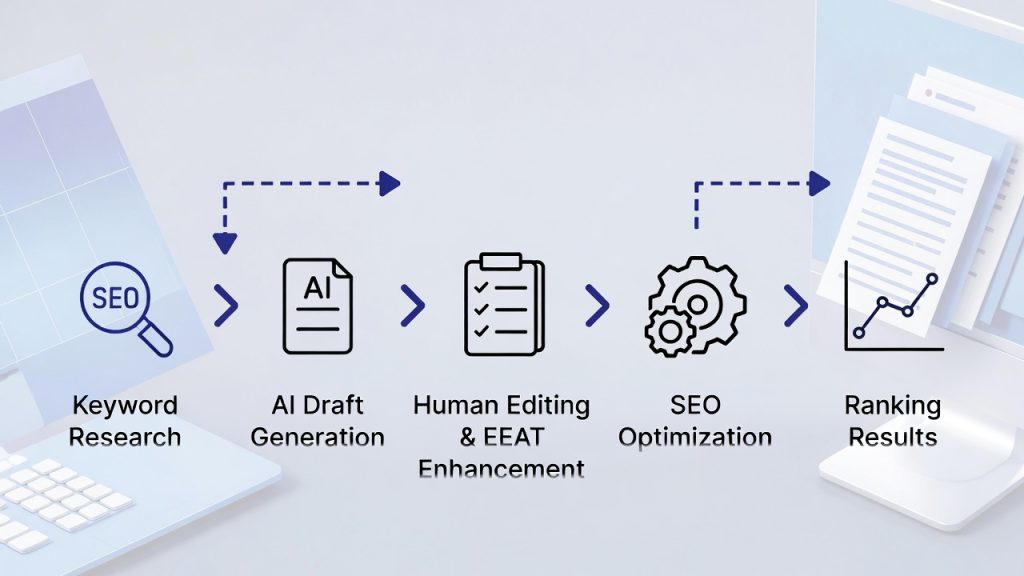
Here’s the proven process for AI generated content for SEO that consistently ranks:
Step 1: Strategic Keyword and Intent Research
Don’t just target keywords—understand the specific user intent behind them.
For “ai seo content generator,” are users looking to:
- Understand what these tools are?
- Compare specific tools?
- Learn how to use them effectively?
- Determine if they’re worth the investment?
Match your content precisely to dominant intent. Use tools like SE Ranking or Ahrefs to analyze top-ranking pages and identify what angle wins.
Step 2: Competitive Content Analysis
Analyze the top 10 results for your target keyword:
- What topics do they all cover?
- What unique angles do top-3 results take?
- What’s missing from current results?
- What’s the average content length?
- What EEAT signals are present?
Create a brief that addresses everything competitors cover PLUS something they don’t—a unique dataset, fresher information, better examples, or deeper analysis.
Step 3: AI-Assisted Draft Generation
Use your chosen ai seo content generator to create a comprehensive first draft based on your brief.
Critical: Include explicit instructions for:
- Target keyword and variations
- Required sections and topics
- Tone and style preferences
- Word count targets
- Specific examples or types of content to include
Example Prompt:
Create a comprehensive guide on [TOPIC] targeting "[PRIMARY KEYWORD]"

Audience: Indian and global digital marketers, intermediate expertise
Length: 1,200-1,300 words
Tone: Professional yet approachable, avoid generic AI phrasing
Structure: Clear H2/H3 headings, 2-3 sentence paragraphs max

Must Include:
- Specific examples from digital marketing campaigns
- Data or statistics (with note to verify)
- Practical implementation steps
- Common mistakes to avoid
- Real-world use cases

Keywords to include naturally:
- [Secondary keyword 1]
- [Secondary keyword 2]
- [Secondary keyword 3]
Step 4: Human Enhancement and Expertise Injection
This is where mediocre AI content becomes exceptional:
Enhancement Checklist:
- Add 2-3 specific case studies or examples
- Include original data or insights
- Inject personal experience or client stories
- Remove generic AI phrases (“it’s important to note,” “in today’s digital landscape”)
- Add personality and brand voice
- Include contrarian or nuanced perspectives
- Ensure every section provides unique value
Aim to enhance 30-40% of the AI-generated content with human insights. This ratio provides efficiency while ensuring differentiation.
Step 5: Fact-Checking and Verification
Verify everything that can be verified:
- Check statistics against original sources
- Confirm current best practices haven’t changed
- Update any outdated information
- Remove or flag uncertain claims
- Verify links to external resources
For AI generated content and SEO success, accuracy builds trust—both with users and algorithms.
Step 6: SEO Optimization
Optimize the enhanced content:
- Ensure primary keyword appears in first 100 words
- Include primary keyword in H1, at least one H2, and meta title
- Verify natural keyword density (1-2% for primary keyword)
- Add semantic keywords and related terms
- Craft compelling meta description
- Optimize images with descriptive alt text
- Add internal links to related content
- Consider schema markup for enhanced SERP features
Step 7: Quality Assurance Review
Before publishing, review against Google’s helpful content guidelines:
- Does this content help people or just rank in search?
- Does it demonstrate expertise and experience?
- Will readers leave satisfied?
- Is it better than competing pages?
- Are EEAT signals strong?
If you can’t confidently answer “yes” to these questions, enhance further before publishing.
Advanced Strategies: Beyond Basic AI Content
Content Depth Over Breadth
Don’t create 100 shallow articles. Create 20 comprehensive, thoroughly researched pieces that become the definitive resource on their topics.
AI generated content for SEO succeeds when depth and quality compensate for any AI-related limitations.
Strategic Content Clusters
Build topic clusters where a comprehensive pillar page links to multiple supporting articles, all interlinked strategically. This topical authority signals expertise to Google more effectively than isolated articles.
Continuous Updating and Improvement
AI makes it economical to regularly update content. Refresh top-performing articles quarterly with:
- New statistics and examples
- Updated best practices
- Additional sections on emerging topics
- Improved EEAT signals
Google rewards freshness, especially for topics where information changes frequently.
Multimedia Enhancement
Add elements AI cannot create:
- Original screenshots and images
- Custom data visualizations
- Video explanations embedded
- Interactive elements or calculators
- Downloadable templates or resources
These additions differentiate your content and improve engagement metrics.
Common Mistakes That Kill AI Content Rankings
Mistake 1: Publishing Unedited AI Drafts
AI drafts need substantial human enhancement. Publishing raw AI output virtually guarantees poor performance in competitive niches.
Mistake 2: Ignoring User Intent
Perfectly optimized content for the wrong intent won’t rank. Always match content to what users actually want when searching that keyword.
Mistake 3: Thin Content at Scale
Creating 50 mediocre articles won’t outperform 10 exceptional ones. Quality beats quantity in modern SEO.
Mistake 4: Neglecting Technical SEO
Great content on a slow-loading, mobile-unfriendly site won’t rank well. Technical foundations matter alongside content quality.
Mistake 5: Missing EEAT Signals
Content lacking expertise, authoritativeness, and trust signals struggles regardless of optimization. Systematically strengthen EEAT in every piece.
Measuring Success: Metrics That Matter
Track these metrics to evaluate your seo and ai generated content performance:
Ranking Metrics:
- Position changes for target keywords
- Impressions and clicks in Google Search Console
- Featured snippet captures
Engagement Metrics:
- Time on page (target: 2+ minutes for long-form)
- Bounce rate (target: <60% for informational content)
- Pages per session from organic entry
- Scroll depth
Conversion Metrics:
- Newsletter signups from content
- Lead form submissions
- Product page visits from blog traffic
Authority Metrics:
- Backlinks acquired naturally
- Social shares and engagement
- Traffic growth trajectory
Adjust your strategy based on which types of AI generated content for SEO perform best for your specific situation.
The Future of AI Content and Search
AI content generation will only improve. Google’s ability to evaluate content quality will also advance. The winners will be those who use AI to enhance efficiency while maintaining uncompromising quality standards.
The question isn’t whether AI-generated content can rank—it demonstrably can. The question is whether you’ll invest the effort to make your AI-assisted content genuinely better than competitors, or whether you’ll fall into the trap of quantity-over-quality that Google’s algorithms are designed to suppress.
Conclusion: AI Amplifies Expertise, It Doesn’t Replace It
AI generated content for SEO succeeds when it amplifies human expertise, not when it attempts to replace it. The most successful content strategies in 2026 combine AI efficiency with human creativity, experience, and strategic insight.
Use ai seo content generators to handle research compilation, structure creation, and initial drafting. Then invest serious human effort into enhancement, verification, and adding unique value that only expertise provides.
Done correctly, this hybrid approach delivers the best of both worlds: the scale and efficiency of AI with the quality and differentiation of expert human content.
The tools exist. The strategies are proven. The only question is: will you implement them with the quality standards required for success, or chase the mirage of automated content that ranks without effort?
Choose wisely. Your organic visibility depends on it.