In the fiercely competitive landscape of online retail, captivating visuals are no longer a luxury but a fundamental necessity for engaging customers and driving sales. The transformative power of ai image generation for ecommerce now offers businesses an unprecedented opportunity to create stunning, high-quality product imagery and lifestyle shots at scale, drastically cutting down production time and costs. This technological leap, powered by advanced generative AI models, empowers retailers to rapidly iterate on visual concepts, personalize product presentations for diverse audiences. even dynamically adapt visuals to current trends without expensive photoshoots. By mastering these innovative tools, e-commerce stores can unlock new levels of creative freedom and operational efficiency, ensuring their digital storefronts consistently stand out and convert browsers into loyal customers.
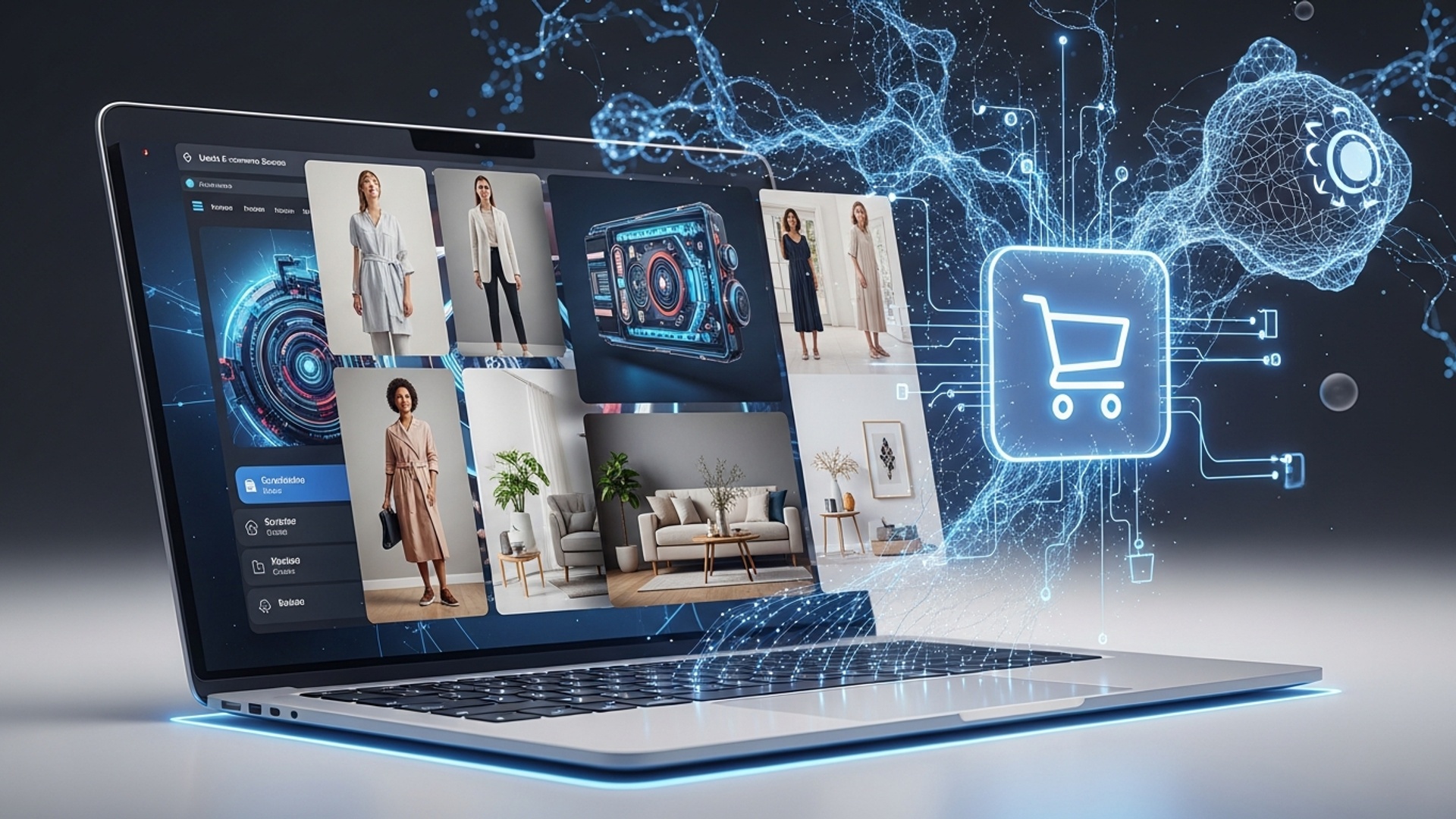
The Transformative Power of AI Image Generation for E-commerce
In today’s intensely competitive digital marketplace, compelling visuals are no longer optional. Instead, they function as the primary driver of engagement, trust, and conversions. For online store owners seeking differentiation, AI image generation for ecommerce represents a transformative shift in how product visuals are conceptualized and produced.
As consumer expectations rise, brands must deliver high-quality imagery at scale. Fortunately, AI-powered visual tools now enable businesses to generate unique, engaging content with unprecedented speed and efficiency. Consequently, visual production is evolving from a logistical bottleneck into a strategic advantage.
Understanding AI-Generated Visuals: From Concept to Conversion
AI-generated visuals include images, videos, and 3D assets created through advanced artificial intelligence systems. Most modern tools rely on diffusion models and, historically, generative adversarial networks. These systems learn from massive image datasets and then produce entirely new visuals based on structured text prompts.
For e-commerce brands, this capability translates into:
-
Product photography
-
Lifestyle imagery
-
Virtual try-ons
-
Campaign visuals
-
Digital storefront assets
Because AI interprets detailed prompts, brands can control lighting, composition, mood, and styling without conducting physical shoots.
Core Technologies Behind AI Visual Creation
Understanding the underlying systems clarifies why this technology is so powerful.
Diffusion Models
These models begin with visual noise and gradually refine it into a coherent image guided by a text prompt. As a result, they offer high levels of realism and stylistic control.
Generative Adversarial Networks
GANs use two networks working in opposition, one generating images and the other evaluating them. Over time, this competition improves image authenticity.
Prompt Engineering
Equally important is prompt engineering. By carefully describing the desired scene, brands guide the AI toward specific aesthetic outcomes.
For example, instead of hiring a full production team, a boutique jewelry brand can input:
“Silver pendant on white marble surface, soft natural lighting, minimalist aesthetic, shallow depth of field.”
Within minutes, multiple production-ready images are generated. Therefore, production timelines shrink dramatically while creative flexibility expands.
Practical Applications of AI Image Generation in E-Commerce
The value of AI image generation for ecommerce becomes clearer when examining real-world applications.
Enhanced Product Photography and Virtual Staging
First, AI enables dynamic product photography without physical constraints.
Brands can:
-
Place products in infinite virtual environments
-
Swap seasonal backgrounds instantly
-
Showcase multiple color variations without inventory
-
Generate diverse digital models for apparel
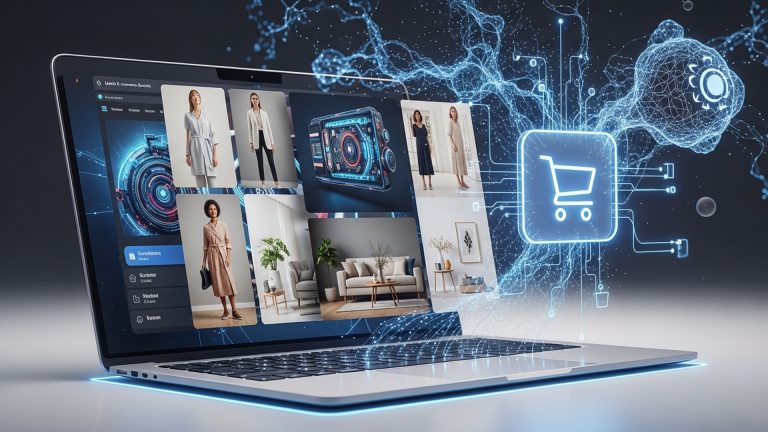
Consider a furniture retailer implementing AI staging. Rather than displaying sofas against plain backdrops, they generate scenes within modern apartments, rustic homes, and urban lofts. Consequently, customer engagement increases because shoppers visualize products in realistic settings.
In documented cases, staged visuals have led to double-digit increases in both engagement and conversions.
Personalized Shopping and Virtual Try-Ons
Beyond static imagery, AI enhances interactive shopping experiences.
For instance:
-
Apparel brands enable virtual try-ons
-
Eyewear companies simulate frame fits
-
Beauty brands personalize product previews
Because customers see products in context, purchase confidence rises. As a result, return rates often decrease.
Furthermore, AI can generate personalized product imagery aligned with a shopper’s browsing history. This level of customization strengthens emotional connection and improves conversion probability.
Accelerated Marketing Content Production
Marketing teams frequently face tight timelines. However, AI dramatically compresses creative cycles.
Brands can:
-
Generate dozens of ad variations for testing
-
Produce localized campaign visuals
-
Maintain consistent social media output
-
Rapidly iterate promotional creatives
For example, a fashion brand might generate 100 ad variants in a single day. By testing variations immediately, the team identifies high-performing creatives faster, which lowers customer acquisition costs.
Consequently, campaign agility becomes a competitive differentiator.
Traditional Photography vs AI-Generated Visuals
To appreciate the operational shift, consider this comparison:
| Feature | Traditional Photography | AI-Generated Visuals |
|---|---|---|
| Cost | High production expenses | Subscription-based, lower cost |
| Speed | Weeks to months | Minutes to hours |
| Scalability | Limited by logistics | Virtually unlimited |
| Customization | Physically constrained | Infinite variations |
| Consistency | Dependent on crew | Prompt-controlled consistency |
| Sustainability | Resource-intensive | Fully digital workflow |
While traditional photography still holds value for certain use cases, AI often delivers superior scalability and flexibility, particularly for growing brands.
How to Implement AI Image Generation in Your Store
Adopting AI does not require a complete operational overhaul. Instead, follow structured steps.
1. Define Visual Priorities
Begin by identifying which assets generate the greatest business impact. Focus on high-traffic product pages or core marketing creatives first.
2. Select the Appropriate Platform
Choose tools aligned with your needs. Some platforms specialize in product photography workflows, while others focus on general generative imagery.
When evaluating tools, consider:
-
Commercial licensing
-
Batch generation capabilities
-
Editing flexibility
-
Integration with your e-commerce system
3. Develop Strong Prompt Engineering Skills
Detailed prompts produce superior outputs. Include:
-
Product description
-
Lighting style
-
Mood
-
Composition
-
Background elements
For example:
“Organic skincare serum bottle, amber glass, soft morning sunlight, marble countertop, clean luxury aesthetic, shallow depth of field.”
The more precise the description, the stronger the result.
4. Integrate into Existing Workflows
Next, determine how AI complements current production. In some cases, AI replaces lifestyle shoots. In others, it supplements traditional photography for campaign variations.
5. Test and Optimize
Finally, measure performance. Conduct A/B tests comparing AI visuals with traditional imagery. Track:
-
Click-through rate
-
Add-to-cart rate
-
Conversion rate
-
Time on product page
Data should guide long-term implementation decisions.
The Future of Visual Commerce
As AI continues evolving, realism, personalization, and automation will become even more refined. Brands that adopt early gain several advantages:
-
Faster time to market
-
Lower production costs
-
Greater creative experimentation
-
Increased adaptability to trends
Because online retail is inherently visual, competitive differentiation increasingly depends on scalable content creation.
Conclusion
AI image generation is not merely a creative shortcut. Instead, it represents a structural upgrade in how e-commerce brands produce and deploy visuals.
By combining efficiency, scalability, and personalization, AI empowers brands to create compelling imagery without traditional constraints. Consequently, businesses can test more ideas, launch faster, and adapt to changing consumer preferences with agility.
If you are beginning your AI journey, start with your largest visual bottleneck. Replace one lifestyle shoot with AI-generated alternatives. Test performance. Measure engagement. Then iterate.
Ultimately, brands that integrate AI strategically will not just keep pace with the market. They will define the next era of visual commerce.
To further comprehend the practical application of these tools, consider exploring Create Stunning AI Product Images Instantly for Your Ecommerce Brand.
More Articles
How SaaS AI Image Generators Revolutionize Visual Content Creation
Transform Your Ecommerce Social Media Creatives with AI for Better Engagement
Boost Your Online Sales Create Stunning Product Images With An AI Tool
Boost Your Online Store Sales With Essential Ecommerce Conversion Optimization Strategies
Unlock Your Business Potential Discover the Real Benefits of AI Automation

FAQs
What exactly does ‘AI Generated Visuals for E-commerce’ mean?
It means using artificial intelligence to create stunning product images, lifestyle shots, banners. other marketing visuals for your online store. Instead of traditional photography or graphic design, AI tools can generate these visuals quickly and efficiently, often just from text descriptions or existing product photos.
How can AI-generated images actually boost my sales?
High-quality, diverse visuals grab customer attention and build trust. AI allows you to quickly create a huge variety of appealing images – showing your product in different settings, with various models, or even animated – which can lead to higher engagement, better conversion rates. ultimately, more sales.
Do I need to be a tech wizard or a designer to use these tools?
Not at all! Most AI visual generation tools are designed with user-friendliness in mind. You typically just need to provide some basic input, like your product photo or a text description. the AI does the heavy lifting. No complex design skills or coding knowledge required.
What kinds of visuals can AI create for my products?
The possibilities are vast! AI can generate professional product shots on clean backgrounds, realistic lifestyle images showing your product in use, seasonal banners, social media content, virtual try-ons. even adapt visuals for different target audiences or marketing campaigns.
Is this really more cost-effective than hiring a photographer?
Absolutely. While traditional photography produces excellent results, it often involves significant costs for equipment, studio time, models. editing. AI tools can generate a multitude of visuals for a fraction of the cost and time, making professional-grade imagery accessible even for small businesses.
Can AI visuals help my brand stand out from competitors?
Definitely! With AI, you can experiment with unique styles, themes. scenarios that might be too expensive or time-consuming to achieve with traditional methods. This allows you to create highly distinctive and memorable visuals that truly reflect your brand’s personality and appeal to your specific audience.
What if the AI generates something I don’t quite like? Can I make changes?
Yes, absolutely. AI visual tools usually offer options to refine or regenerate images based on your feedback. You can often adjust prompts, select different styles, or even use editing tools within the platform to tweak the visuals until they perfectly match your vision. It’s an iterative process!