In the hyper-competitive landscape of ecommerce, scaling seo & marketing fast is no longer a luxury—it’s an operational necessity for survival. As paid customer acquisition costs reach record highs, D2C brands are realizing that organic visibility is the only sustainable engine for compounding growth, predictable traffic, and long-term profitability.
The mechanics of digital growth have fundamentally shifted. Traditional siloed strategies where content and advertising operate in a vacuum are being replaced by unified systems powered by AI-driven automation, semantic search algorithms, and programmatic catalog optimization.
This guide breaks down the core pillars of scaling your organic presence, the workflows you need to deploy, and the tools that can accelerate your trajectory from launch to enterprise scale.
Why Unifying Your Marketing & SEO is Critical for Growth
Building an enduring brand requires aligning your performance marketing strategies directly with your organic search footprint. When these two elements work in tandem, your store generates compounding returns on every piece of content you publish, ensuring that traffic translates directly into sustainable revenue.
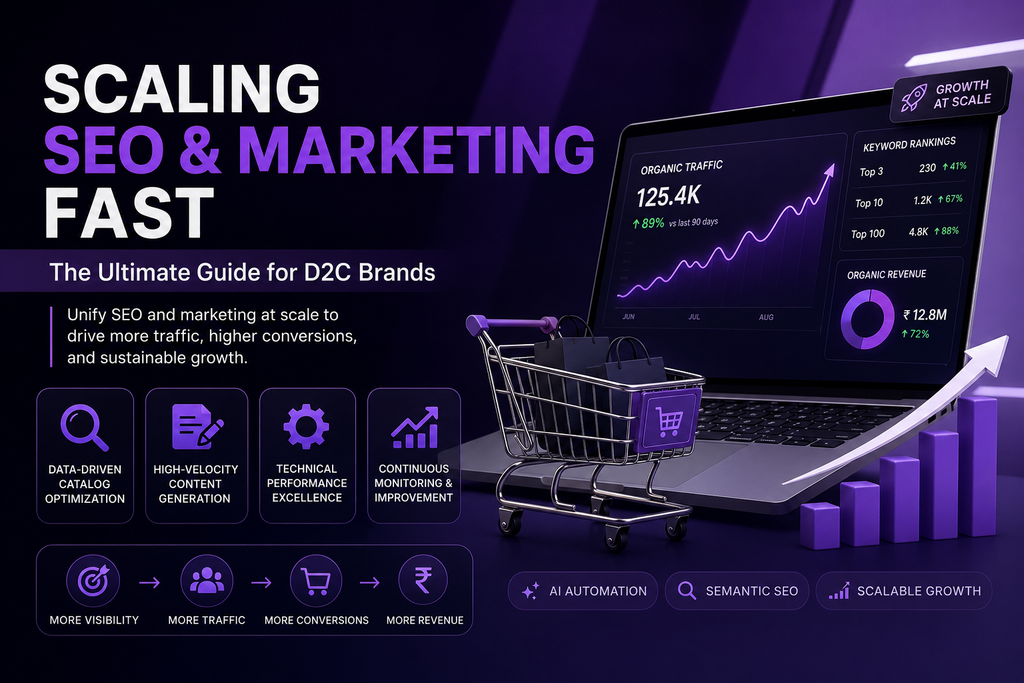
1. Data-Driven Catalog Optimization
Modern product discovery relies heavily on structured data. Ensuring your entire catalog is optimized for search engines allows your products to surface naturally in high-intent commercial queries.
- Automating bulk product descriptions with keyword-rich structures
- Synchronizing metadata across all active SKUs dynamically
- Leveraging schema markup for rich search snippets
- Optimizing image alt-text to capture visual search traffic
2. High-Velocity Content Generation
Content is the fuel for organic growth. Producing targeted, high-quality articles at scale builds the topical authority necessary to dominate your specific product category.
- Producing topical blog clusters that capture upper-funnel intent
- Generating multilingual assets to unlock international markets
- Creating dynamic landing pages that cater to long-tail search queries
- Building robust FAQ sections that satisfy conversational AI engines
3. Frictionless Technical Performance
Search algorithms ruthlessly penalize slow, broken websites. Maintaining a flawless technical foundation ensures crawlers can index your catalog efficiently without wasting crawl budget.
- Compressing high-resolution images to pass Core Web Vitals
- Eliminating broken links and redirect chains automatically
- Structuring URL hierarchies to preserve internal link equity
- Minimizing third-party app scripts that degrade page load speed
As noted by Shopify’s ecommerce growth benchmarks, stores that integrate their technical SEO tightly with their promotional marketing workflows consistently outpace competitors in organic traffic acquisition.
The Blueprint for Modern SEO Marketing Strategies
Moving fast requires an operational blueprint that prioritizes automation over manual data entry. The most successful D2C brands treat their search visibility as an automated product feature rather than a weekly chore.
1. Semantic Keyword Mapping
Understanding exactly how your customers search is step one. By mapping intent to specific stages of the buying journey, you prevent overlapping pages from competing against each other.
- Identifying intent-driven long-tail phrases for niche categories
- Mapping product variants to highly specific search queries
- Avoiding keyword cannibalization across overlapping collections
- Tracking semantic search trends to stay ahead of consumer shifts
2. AI-Powered Workflow Automation
Manual copywriting simply cannot scale with a rapidly growing catalog. Implementing AI-driven systems allows you to generate, optimize, and publish content at lightning speed.
- Using generative models to draft localized product copy instantly
- Setting up automated review and FAQ generation for deeper engagement
- Deploying AI agents to monitor and adjust meta tags on the fly
- Translating core content into multiple languages for global reach
3. Continuous Performance Monitoring
You cannot scale what you do not measure. Establishing automated reporting loops ensures you can react to algorithmic updates and traffic drops before they impact your bottom line.
- Tracking organic impressions against paid search performance data
- Auditing index coverage regularly within Google Search Console
- Testing rich snippet rendering for updated product catalogs
- Monitoring backlink profiles to identify lost or toxic inbound links
According to HubSpot’s marketing automation framework, teams that leverage automated content scaling significantly reduce their time-to-market for new product lines while maintaining consistent brand messaging.
How to Implement Scaling SEO & Marketing Successfully
Translating theory into practice requires a phased, methodical approach. Follow these technical steps to rapidly scale your store’s visibility without breaking your existing site architecture.
1. Audit Your Current Baseline
Begin by diagnosing your existing organic footprint. Run a comprehensive crawl to identify duplicate content, missing meta descriptions, and orphaned collection pages that are dragging down your search performance. Check out our [internal link: post about scaling ecommerce traffic] for a deeper dive into baseline audits.
2. Standardize Your Catalog Metadata
Implement a consistent naming convention for your product titles, URLs, and image alt tags. Ensure every product page includes nested JSON-LD schema to communicate pricing, availability, and authentic customer reviews directly to search engines.
3. Deploy Automated Content Pipelines
Integrate an AI-driven content generation tool to bulk-update product descriptions and generate editorial blog posts. This reduces the manual copywriting bottleneck and ensures every new SKU goes live fully optimized on day one.
4. Launch Editorial Content Clusters
Publish targeted buying guides and educational articles that link directly to your high-margin product pages. This internal linking strategy distributes authority across your domain, boosting the visibility of your commercial pages. For more on maximizing page value, read our [internal link: conversion rate optimization guide].
5. Monitor and Iterate Automatically
Set up automated alerts for 404 errors and out-of-stock products. Use an automated system to redirect discontinued SKUs to relevant categories, preserving the link equity you’ve worked hard to build.
Common Challenges and How to Overcome Them
Scaling rapidly often introduces technical debt and operational friction. Here is how top operators navigate the most common pitfalls associated with rapid growth.
1. Duplicate Content at Scale
When generating thousands of product pages, standard Shopify filters often create duplicate URLs. Solve this by implementing strict canonical tags that point search engines to the primary product or collection page, deliberately ignoring parameterized URL variations.
2. Maintaining Brand Voice with Automation
Using AI to scale content can sometimes result in generic or repetitive copy. Overcome this by customizing your generation tools with specific brand guidelines, tone parameters, and targeted vocabulary that reflects your brand’s unique identity.
3. Image Bloat Slowing Down Page Speed
Fast-growing catalogs often suffer from massive, unoptimized images that tank site speed. Implement automated image compression workflows to serve next-gen formats (like WebP) without sacrificing visual quality, ensuring you pass Core Web Vitals comfortably.
Conclusion
Scaling your brand’s organic presence doesn’t have to mean hiring a massive in-house content team or waiting months for an agency to deliver results. By aligning your performance marketing strategies with automated technical search foundations, you can accelerate your growth trajectory dramatically.
In practice, I’ve seen brands unlock incredible compounding revenue by simply automating their catalog optimization and focusing on high-velocity editorial content. The competitive advantage today goes to those who can execute search strategies at scale with minimal manual friction.
If you are ready to remove the bottlenecks in your workflow and automate your store’s organic growth effortlessly, Start for Free with D2C Bot today.
FAQs
Sounds complicated. Is it hard to implement on a standard Shopify store?
Not at all. While the underlying search mechanics are sophisticated, most technical optimizations—like structured data and URL canonicalization—can be solved with modern tools and clean theme development without rewriting your entire codebase.
How long does it typically take to see results from these optimizations?
Technical fixes, such as resolving crawl errors or adding schema markup, often show positive indexing results within 2 to 4 weeks. Broader ranking improvements and compounding organic traffic growth typically mature across 3 to 6 months of consistent execution.
Will installing multiple SEO apps slow down my store’s loading speed?
Yes, stacking multiple single-purpose apps often injects bloated JavaScript libraries that hurt Core Web Vitals. It is far better to rely on integrated, lightweight solutions that handle optimization natively without dragging down performance.
How do I handle SEO for seasonal or temporary product collections?
Avoid creating and deleting new URLs every season. Instead, maintain permanent evergreen collection URLs (such as `/collections/summer-sale`) and update the featured inventory, copy, and visual assets dynamically throughout the year.
Does blogging on Shopify actually help product page rankings?
Absolutely. High-quality editorial content establishes topical authority in your niche, attracts high-value backlinks, and provides prime opportunities to pass internal link equity directly down to commercial collection and product pages.