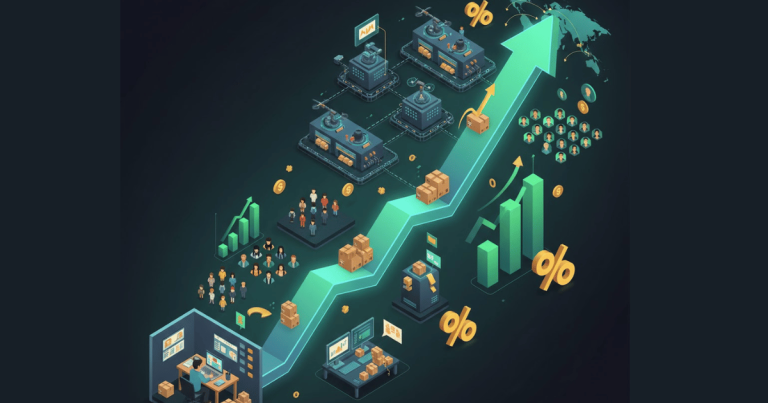
Scaling D2C businesses means systematically growing revenue, customers, and operations while maintaining or improving profitability and customer experience. Successful D2C brands maintain customer acquisition costs below 30% of lifetime value while continuously improving operational efficiency to reach $100 million in revenue within 5-7 years.
67% of D2C brands cite profitable growth as their primary challenge. Companies that successfully scale from millions to hundreds of millions share common approaches to maintaining unit economics, preserving brand identity, and building infrastructure that supports exponential growth.
Brands like Warby Parker grew from startup to $3 billion valuation, and Casper scaled to a public company. They demonstrate that sustainable growth requires balancing customer acquisition with retention, technology investments with profitability, and rapid expansion with operational excellence.
Understanding D2C Scaling Fundamentals
Scaling D2C businesses involves systematically growing revenue, customers, and operations while maintaining or improving profitability and customer experience.
Unlike traditional businesses that scale through wholesale relationships or retail expansion, D2C brands must build direct customer relationships at exponentially increasing volumes.
The scaling landscape has evolved significantly. Recent data indicates the median D2C brand takes 3-4 years to reach $10 million in revenue. Those that establish strong foundations can reach $100 million within 2-3 additional years.
This exponential growth curve requires fundamentally different approaches than linear business models.
Core Components of Scalable D2C Operations
Unit Economics Optimization
Continuously improve the relationship between customer acquisition cost, average order value, contribution margin, and lifetime value.
Scaling without profitable unit economics is just burning cash faster. Every growth decision must consider economic sustainability.
Technology Infrastructure
Invest in scalable e-commerce platforms, data systems, and automation tools before growth demands force reactive decisions.
Technology debt compounds painfully during rapid growth. Build infrastructure that handles 10x your current volume.
Supply Chain Resilience
Build flexible manufacturing and fulfillment capabilities that can handle 5-10x volume increases without quality degradation.
Supply chain failures during growth spurts destroy customer trust and brand reputation permanently.
Team Development
Hire strategically for capabilities you’ll need 12-18 months ahead. Build organizational capacity before hitting growth ceilings.
People constraints limit growth as much as capital constraints. Hire ahead of need, not in reaction to crisis.
Financial Management
Maintain healthy cash flow and unit economics while investing growth capital strategically in high-return opportunities.
Cash flow problems kill more scaling businesses than any other single factor.
Brand Consistency at Scale
Preserve brand identity and customer experience quality even as operations grow increasingly complex.
Scaling shouldn’t mean diluting what made your brand special. Systematize excellence.
Why Strategic Scaling Determines Long-Term Success

Capital Efficiency
Strategic scaling generates higher returns on invested capital. This reduces dilution and improves exit valuations dramatically.
Venture capital isn’t free money—it’s expensive money. Use it efficiently or pay the price in equity.
Market Leadership
Brands that scale fastest often capture disproportionate market share and mind share. This creates winner-take-most dynamics in many categories.
Being second or third to scale often means being permanently disadvantaged.
Operational Leverage
Proper scaling creates economies of scale in marketing, operations, and technology that improve margins over time.
Initial investments in systems and processes pay dividends through lower costs at scale.
Competitive Moats
Scale itself becomes a competitive advantage through brand recognition, supplier relationships, and data assets.
Technical Framework for Scaling D2C
Growth Modeling
Build detailed financial models that project customer acquisition, retention, revenue, and costs under various growth scenarios.
Models help you make informed decisions rather than guessing about growth investments.
Channel Diversification
Systematically expand beyond initial acquisition channels to reduce platform risk and lower blended CAC.
Single-channel dependency creates vulnerability to algorithm changes and policy shifts.
Retention Infrastructure
Implement sophisticated lifecycle marketing, loyalty programs, and subscription models that maximize customer lifetime value.
Retention improvements compound faster than acquisition improvements for scaling businesses.
Data Analytics Capabilities
Invest in analytics infrastructure that provides real-time visibility into key metrics and enables data-driven decisions.
Flying blind during rapid growth guarantees expensive mistakes.
Process Documentation
Document all critical processes and systems. This enables delegation and consistent execution as teams grow.
Undocumented tribal knowledge creates bottlenecks and quality issues during scaling.
Real-World Scaling Strategies Across Categories
Geographic Expansion
Glossier systematically entered new markets only after establishing strong brand presence and operational capabilities in existing markets.
Geographic expansion requires localized operations, not just translated websites.
Category Extension
Away expanded from luggage into travel accessories and apparel, leveraging brand equity to enter adjacent categories successfully.
Brand strength makes category extensions easier, but each new category still requires product-market fit validation.
Retail Integration
Warby Parker opened physical stores strategically to reduce customer acquisition costs and improve brand experience.
Physical retail can complement D2C when economics work and brand experience improves.
Wholesale Partnerships
Allbirds selectively partnered with premium retailers like Nordstrom to increase brand exposure while maintaining control.
Wholesale isn’t evil when used strategically rather than as primary distribution.
Strategic vs. Aggressive Scaling: Critical Trade-offs
Understanding different approaches highlights critical trade-offs:
- Growth Rate: Steady 100-200% annually vs. 300-500% annually with higher risk
- Profitability: Maintain positive unit economics vs. accept losses for market share
- Capital Requirements: Moderate external funding vs. heavy venture backing
- Risk Level: Controlled and sustainable vs. high risk with potential for high reward
- Exit Potential: Predictable valuations vs. higher multiples or complete failure
- Operational Quality: Maintained standards vs. often degraded during rapid growth
Actionable Scaling Tactics
Master One Channel First
Achieve proficiency and scale in one acquisition channel before diversifying. Ensure solid foundation before building higher.
Spreading resources across multiple channels before mastering one dilutes effectiveness everywhere.
Build Retention Before Acquisition
Invest heavily in customer retention mechanisms before massively scaling acquisition. Ensure customers stay once acquired.
Pouring water into a leaky bucket wastes resources and destroys economics.
Implement Cohort Analysis
Track customer cohorts rigorously to identify improving or degrading unit economics before they impact business health.
Cohort analysis reveals problems months before aggregate metrics show issues.
Hire Ahead of Need
Recruit key roles 6-12 months before absolutely necessary. Prevent growth bottlenecks from talent gaps.
Reactive hiring during crisis leads to expensive mistakes and poor culture fits.
Automate Repetitive Processes
Invest in automation for customer service, fulfillment, and marketing operations before manual processes become unmanageable.
Automation investments pay for themselves quickly during growth phases.
Maintain Cash Reserves
Keep 6-12 months of operating expenses in reserves to weather inevitable challenges during rapid growth.
Cash reserves provide options when unexpected problems arise during scaling.
The Path to Sustainable D2C Growth
Scaling D2C businesses successfully requires balancing aggressive growth ambitions with operational discipline and unit economics sustainability.
As the D2C landscape matures and customer acquisition costs continue rising, brands that scale profitably will outlast and outperform those that prioritize growth at any cost.
From real-world experience, a deliberate approach to scaling—focusing on profitability in year two rather than maximizing top-line growth—enabled reaching $50 million in revenue with positive cash flow.
This gave strategic flexibility that venture-dependent competitors lacked. The patience to build proper infrastructure before scaling pays dividends through higher margins, better customer experiences, and ultimately higher valuations.
Start Scaling Strategically Today
Don’t let investor pressure or competitive fear drive scaling decisions that compromise long-term viability. Build your business on solid unit economics and scale channels that work profitably.
Stay focused on unit economics as your north star metric. Invest in capabilities that will serve you for years rather than quick fixes. Remember that sustainable scaling creates more value than unsustainable hypergrowth.
Maintain operational excellence even during rapid growth. Let strategic scaling become your path to building a D2C business that endures and thrives for decades.
Start today and prove that smart beats fast when it comes to building valuable D2C businesses.