The debate isn’t new. Every automation tool faces the same question: does it actually work, or does it create more problems?
AI product description generators have reached a stage where the output is good enough to publish with minimal editing. That wasn’t the case two years ago. Tools like ChatGPT and other AI writing platforms now produce structured, readable ecommerce copy in seconds.
However, “good enough” does not automatically mean better. Manual writing still offers advantages that machines cannot replicate.
The real question is not which one wins. Instead, it is which approach fits your catalog size, budget, and quality standards.
Here’s what actually matters when comparing AI product description generators to manual writing.
Speed and Scale
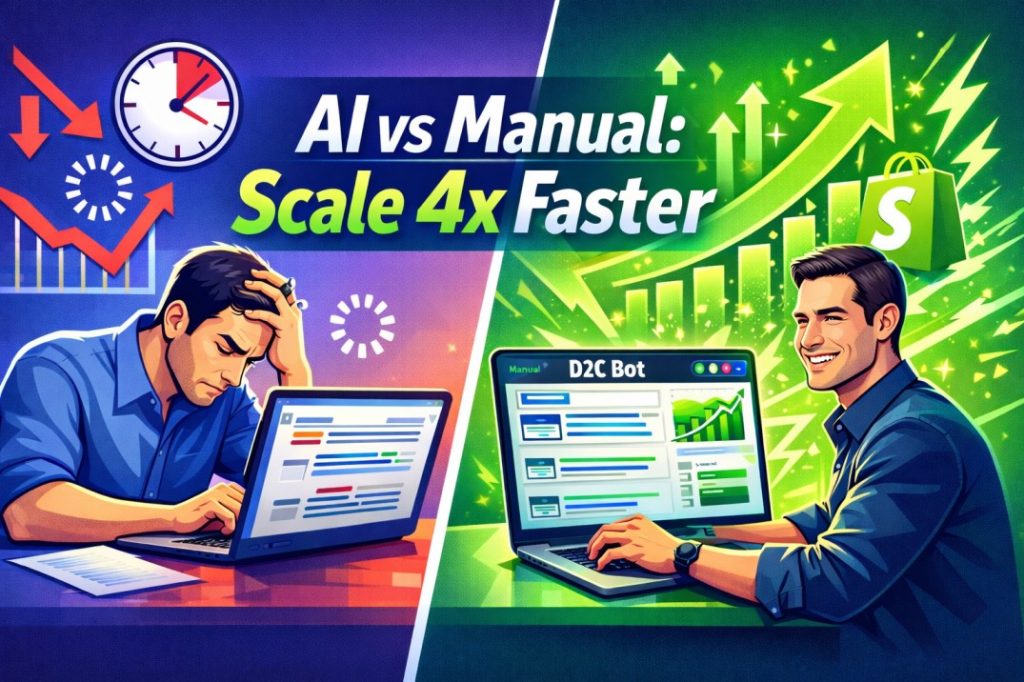
AI wins on speed. There is no real debate here.
A product description that takes a writer 15 to 30 minutes can be generated in under a minute using AI. For catalogs with hundreds or thousands of SKUs, that difference makes full coverage possible.
Manual writing works well for small catalogs. Ten products can be written internally. Even a hundred products remain manageable with a dedicated writer or small team.
Beyond that point, manual writing becomes a bottleneck. Product launches slow down. Seasonal updates get delayed. Descriptions remain incomplete because time runs out.
AI removes that constraint entirely. With the right workflow, you can generate descriptions for your entire catalog in a single afternoon. Many ecommerce brands integrate automation systems such as D2CBot to streamline content generation at scale.
Consistency Across Products
Consistency is harder than it appears.
Human writers develop habits over time. They repeat sentence structures, favor certain phrases, and gradually drift in tone. Even strong brand guidelines cannot eliminate stylistic variation completely.
By contrast, AI generators maintain tone and structure across thousands of descriptions. Once voice settings and templates are configured, every output follows the same framework.
That uniformity strengthens brand perception. Customers notice inconsistency, even if they cannot explain it.
Still, there is a tradeoff. AI consistency can feel repetitive if not edited carefully. Descriptions may start sounding similar. Human writers introduce variation that prevents content from feeling automated.
Cost Comparison
Manual writing costs more per description. The numbers are straightforward.
Freelance writers typically charge between $0.10 and $0.50 per word depending on experience. A 100-word product description therefore costs $10 to $50. Multiply that by a thousand products, and the total ranges from $10,000 to $50,000.
In contrast, AI writing tools often charge between $30 and $100 per month for large-scale generation. Even at the higher tier, annual costs are significantly lower than manual writing.
However, editing time must be considered. AI-generated descriptions require review for tone, clarity, and accuracy. Fact-checking is essential.
For small teams, that editing workload reduces cost savings. For larger operations with dedicated editors, AI remains far more economical.
Quality and Persuasion
Quality remains the strongest argument for manual writing, although the gap continues to narrow.
Experienced copywriters understand persuasion. They know how to emphasize benefits over features, introduce emotional triggers, and structure descriptions that guide readers toward purchase decisions.
AI understands patterns. It learns from existing ecommerce content and replicates structure. However, it does not genuinely understand human psychology. The intuition developed through years of writing cannot be fully replicated by algorithms.
That said, modern AI tools now produce descriptions that rival average freelance output. They may not outperform senior copywriters, but they often exceed junior-level writing and generic templates.
For standard ecommerce products, AI quality is typically sufficient. For luxury goods, technical products, or narrative-driven branding, manual writing still delivers stronger persuasive impact.
Customization and Brand Voice
Brand voice is where human writers maintain an advantage.
A skilled writer captures subtle tonal shifts and adapts messaging precisely to brand guidelines. They understand nuance and context beyond surface-level instruction.
AI tools have improved significantly in this area. Most allow custom tone settings, example-based learning, and style training. By feeding the system your strongest product descriptions, you can guide output toward brand alignment.
The results are close but rarely perfect. AI descriptions often reach 90 percent alignment. The final refinement typically requires manual editing.
If brand voice defines your competitive edge, manual writing provides greater control. If speed and coverage are higher priorities, AI performs adequately.
Accuracy and Fact-Checking
Accuracy is the most serious risk associated with AI writing.
AI models sometimes invent product features when details are incomplete. These fabricated details may appear convincing but can create customer dissatisfaction and trust issues.
Human writers usually request clarification when information is missing. AI systems do not ask questions. Instead, they generate plausible assumptions.
Therefore, every AI-generated description must be reviewed by someone familiar with the product. Verification is non-negotiable.
Manual writers can still make errors, but they are less likely to invent entirely new features. As a result, error rates tend to be lower in manual workflows.
SEO Performance
Both AI and manual writing can deliver strong SEO performance. The difference lies in execution.
Many AI tools include built-in SEO features. They suggest keywords, structure headings for readability, and maintain keyword density. Tools such as Surfer SEO integrate optimization guidance directly into content creation.
However, AI sometimes over-optimizes. Keyword-heavy descriptions lose natural flow, which affects user experience. Search engines increasingly prioritize engagement and readability.
Human writers balance optimization with clarity. They weave keywords naturally into persuasive copy.
AI excels at technical SEO speed. Humans excel at strategic SEO nuance.
Flexibility for Complex Products
Simple products are ideal for AI. Standard features and straightforward benefits are easy to structure automatically.
Complex products require deeper explanation. Technical specifications need clarity. Compatibility details matter. Use cases vary across customer segments.
AI often simplifies when additional depth is necessary. It may overlook technical nuances that influence purchasing decisions.
Human writers research thoroughly, interpret specifications, and tailor messaging to specific buyer personas. For highly differentiated or complex products, manual writing remains superior.
When to Use AI
AI is most effective when:
- Your catalog includes more than 100 products
- Products follow standardized formats
- Speed and cost efficiency are priorities
- An editing workflow exists
- Brand voice matters but is not hyper-specific
Most mid-market ecommerce brands fall into this category. AI handles bulk generation while teams focus on refinement and strategy.
When to Use Manual Writing
Manual writing is preferable when:
- Your catalog includes fewer than 50 products
- Products are highly technical or specialized
- Brand storytelling drives differentiation
- Luxury positioning demands premium tone
- Budget allows for experienced copywriters
Brands competing on experience and brand perception benefit more from manual writing investment.
The Hybrid Approach
In practice, most brands do not need to choose one method exclusively.
Use AI for the majority of your catalog. Standard items, new arrivals, and lower-priority products can rely on AI-generated descriptions with light editing.
Reserve manual writing for:
- Best-sellers and hero products
- Technically complex items
- Products with unique positioning
- Campaign-driven collections
This hybrid approach balances efficiency with quality control.
Conclusion
AI product description generators and manual writing serve different operational realities. AI excels at speed, scalability, and cost efficiency. Manual writing delivers stronger nuance, storytelling, and accuracy for complex or brand-critical products.
The most effective strategy aligns tools with business priorities. By combining AI-driven efficiency with human editing and judgment, ecommerce brands produce descriptions that are consistent, scalable, and persuasive without compromising trust or brand integrity.
FAQs
Are AI-generated product descriptions as effective as human-written ones?
For standard products, yes. AI descriptions often perform equally well in conversion tests when properly edited. For complex or luxury products, human writers still deliver better results due to nuance and brand voice control.
Can customers tell when a product description is AI-generated?
Not usually, especially after editing. AI-generated content that’s been reviewed for accuracy and tone reads naturally. Poor AI content with no editing does feel robotic and generic.
How much editing do AI product descriptions typically need?
Most AI descriptions need 2 to 5 minutes of editing for fact-checking, tone adjustments, and removing repetitive phrases. Simple products require less editing; complex products need more review.
Will Google rank AI-generated descriptions lower than manual ones?
No. Google evaluates content quality, not creation method. AI descriptions that are unique, accurate, and useful rank well. Low-quality content performs poorly regardless of whether it’s AI or human-written.
What’s the biggest mistake brands make with AI product descriptions?
Publishing without fact-checking. AI invents features and details that sound plausible but aren’t true. Always verify claims before publishing, especially for technical specifications.