
Business automation isn’t new. Companies have been automating repetitive tasks for decades.
What changed is the scope. AI automation now handles work that previously required human judgment, not just mechanical repetition.
Customer service, data analysis, content creation, inventory management, hiring processes—all of these now run with minimal human intervention.
The shift isn’t about replacing people. It’s about eliminating bottlenecks that slow growth and drain resources.
AI automation benefits appear fastest in operations that involve high volume, clear patterns, and predictable outcomes.
Here’s what AI automation actually delivers for businesses in 2026.

Cost Reduction Without Quality Loss
Labor costs dominate most business budgets. AI reduces those costs without sacrificing output quality.
Customer support is the clearest example. AI chatbots now handle 60 to 80 percent of common inquiries without human agents. Response times drop from hours to seconds. Customer satisfaction often improves because answers arrive faster.
According to McKinsey’s research on AI adoption, companies implementing AI automation see significant improvements in customer experience metrics while reducing operational costs.
The agents who remain focus on complex issues that require empathy and problem-solving. Their work becomes more valuable, not redundant.
Data entry, invoice processing, and report generation follow the same pattern. AI handles volume work accurately. Humans review exceptions and make strategic decisions.
With D2C Bot’s automation capabilities, ecommerce businesses can automate product descriptions, meta tags, and content optimization – reducing manual work by up to 30-50 percent in the first year.
Speed and Efficiency Gains
AI operates continuously without breaks, fatigue, or delay.
Tasks that took days now complete in hours. Processes that required multiple handoffs now run end-to-end automatically.
Marketing teams generate campaign assets in minutes instead of weeks using AI-powered content tools. Sales teams receive lead scoring and qualification instantly. Operations teams monitor inventory and trigger reorders without manual checks.
Speed creates competitive advantage. Faster response times win customers. Faster iteration cycles improve products. Faster decision-making captures opportunities.
The efficiency gain isn’t marginal. Most automated workflows run 5x to 10x faster than manual equivalents.
Scalability Without Proportional Resource Growth
Traditional scaling requires hiring more people, expanding office space, and increasing overhead.
AI automation decouples growth from headcount. You can double output without doubling staff.
A customer service team of 10 people might handle 500 inquiries daily. Add AI automation, and the same team handles 2,000 inquiries. Revenue scales faster than costs.
This applies across functions:
- Marketing scales content production without hiring writers – D2C Bot helps scale product content across entire catalogs
- Sales scales outreach without adding reps
- Operations scales order processing without expanding warehouses
- Finance scales reporting without growing accounting teams
Businesses report handling 200 to 400 percent more volume with only 20 to 30 percent staff increases.
Data-Driven Decision Making
AI processes data at scales humans can’t match.
It identifies patterns in customer behavior, inventory trends, pricing dynamics, and operational inefficiencies that would take analysts months to uncover manually.
Decisions shift from intuition-based to evidence-based. AI shows you what’s actually happening, not what you assume is happening.
Harvard Business Review reports that companies using AI for data-driven decision-making see measurable improvements in accuracy and speed, though human oversight remains critical.
Retail businesses optimize pricing based on real-time demand signals. Manufacturing companies predict equipment failures before they occur. Marketing teams adjust campaigns based on performance data updated hourly.
Better data leads to better decisions. Better decisions drive better outcomes.
Error Reduction and Consistency
Humans make mistakes. Fatigue, distraction, and inconsistency create errors that cost time and money.
AI doesn’t get tired. It doesn’t lose focus. It applies the same logic consistently across thousands of transactions.
Invoice processing errors drop from 5 percent to under 0.5 percent. Data entry accuracy improves from 95 percent to 99.5 percent. Customer communication maintains brand voice across every interaction.
D2C Bot ensures consistency across product descriptions, meta titles, and SEO tags – eliminating the variations that occur with manual content creation.
Error reduction saves more than just correction costs. It prevents downstream problems like customer complaints, compliance violations, and reputation damage.
Most businesses see error rates drop 80 to 95 percent in automated processes.
24/7 Operations Without Shift Management
AI operates around the clock without overtime, shift scheduling, or burnout concerns.
Customer support runs continuously. Lead qualification happens at 3 AM. Inventory monitoring never stops. Reports generate on weekends.
Global businesses benefit most. Customers in different time zones receive instant responses regardless of local business hours.
Continuous operation also accelerates workflows. Tasks don’t wait for the next business day. They complete immediately.
This creates a competitive edge over businesses still operating on traditional schedules.
Customer Experience Improvements
AI personalization makes every customer interaction feel tailored.
Recommendation engines suggest products based on individual behavior. Chatbots remember previous conversations and preferences. Email campaigns adjust content based on engagement patterns.
Customers don’t care that AI powers the experience. They care that interactions feel relevant and helpful.
Research from Salesforce on AI and personalization shows that 73% of customers expect companies to understand their unique needs and expectations.
Personalization increases conversion rates by 15 to 30 percent. Customer lifetime value improves by 20 to 40 percent. Retention rates climb as experiences improve.
AI also speeds up problem resolution. Customers get answers faster. Issues get routed to the right teams immediately. Satisfaction scores improve.
Employee Satisfaction and Focus
Contrary to fear-based narratives, employees often prefer working with AI automation.
Nobody enjoys repetitive data entry, manual report generation, or answering the same customer question 50 times daily. AI eliminates that work.
Employees shift to higher-value tasks that require creativity, strategy, and problem-solving. Job satisfaction increases when work feels meaningful rather than mechanical.
Teams report higher morale, lower burnout, and better retention when automation removes tedious tasks.
The transition requires change management, but the outcome benefits both business and employees.
Common AI Automation Use Cases
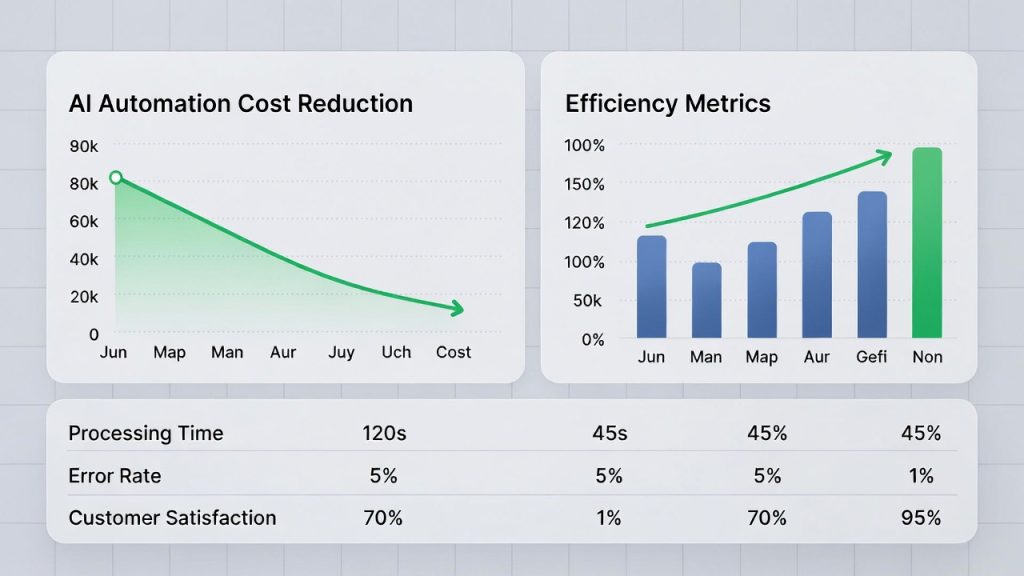
AI automation delivers results across every business function.
Customer Service:
- Chatbots handle FAQs and routine inquiries
- Ticket routing and prioritization
- Sentiment analysis and escalation triggers
Marketing:
- Content generation for ads, emails, and social posts
- A/B testing and campaign optimization
- Lead scoring and qualification
Sales:
- CRM data entry and updates
- Follow-up email sequences
- Meeting scheduling and calendar management
Operations:
- Inventory monitoring and reorder triggers
- Quality control and defect detection
- Supply chain optimization
Finance:
- Invoice processing and payment reconciliation
- Expense categorization and reporting
- Fraud detection and compliance monitoring
Human Resources:
- Resume screening and candidate matching
- Interview scheduling and coordination
- Onboarding task automation
Each function sees measurable improvements within weeks of implementation.
Implementation Strategy
Successful AI automation follows a clear process.
Start with high-volume, repetitive tasks. Don’t automate complex, judgment-heavy work first. Build confidence with simple wins.
Identify processes where:
- Volume is high
- Rules are clear
- Outcomes are measurable
- Current performance is slow or inconsistent
Pilot one process before scaling. Measure results. Adjust based on learnings. Then expand to additional workflows.
For ecommerce businesses, starting with product content optimization provides immediate, measurable results while building team confidence in AI capabilities.
Involve employees early. Explain how automation benefits them. Train them on new systems. Address concerns directly.
Most implementations take 2 to 6 months from pilot to full deployment depending on complexity.
Measuring AI Automation ROI
Track specific metrics to validate automation value.
Key performance indicators include:
- Time saved per task
- Cost reduction per department
- Error rate changes
- Customer satisfaction scores
- Employee productivity increases
- Revenue per employee improvements
Most businesses achieve positive ROI within 3 to 9 months. Cost savings alone often justify the investment. Productivity and revenue gains add additional value.
Document baseline metrics before automation. Compare post-implementation performance against those baselines to prove impact.
Challenges and Limitations
AI automation isn’t perfect. Challenges exist.
Initial setup requires time and resources. Integration with existing systems can be complex. Employees need training. Change management takes effort.
AI also makes mistakes. It misinterprets edge cases. It can’t handle truly novel situations. Human oversight remains essential.
Data quality matters. AI trained on poor data produces poor results. Clean, accurate data is a prerequisite for effective automation.
Budget for ongoing maintenance and optimization. AI systems require monitoring, updates, and periodic retraining.
When AI Automation Makes Sense
AI automation delivers strong ROI when:
- Your business has high-volume repetitive tasks
- Current processes are slow, inconsistent, or error-prone
- Growth is constrained by manual workload capacity
- Customer experience suffers from slow response times
- Data exists to train AI systems effectively
Smaller businesses with low transaction volumes may not see immediate value. The setup investment outweighs benefits until volume reaches certain thresholds.
Start small. Automate one high-impact process. Scale based on results.
Conclusion
AI automation for business is no longer a future advantage but a present-day operating standard in 2026. It enables businesses to reduce costs, move faster, and scale operations without proportional increases in headcount. By eliminating repetitive tasks, automation allows teams to focus on strategy, creativity, and higher-value work.
For direct-to-consumer brands, D2C Bot provides accessible AI automation that delivers immediate results in content creation and product optimization. When implemented thoughtfully, it improves customer experience, employee satisfaction, and overall performance, making the speed and quality of adoption a true competitive advantage.
Related Resources:
- Product Page Optimization Strategies
- Free AI Product Description Generator
- How AI-Driven Decision Making Boosts Business
FAQs
How much does AI automation cost for a business?
Costs range from $500 to $10,000+ monthly depending on tools, scale, and complexity. Many platforms offer tiered pricing based on usage. D2C Bot pricing starts with a free tier for businesses to test automation benefits. Most businesses achieve positive ROI within 6 to 12 months through cost savings and productivity gains.
Will AI automation eliminate jobs in my company?
AI typically shifts jobs rather than eliminates them. Employees move from repetitive tasks to higher-value work requiring judgment and creativity. Some roles change, but most businesses maintain or grow headcount while dramatically increasing output.
How long does it take to implement AI automation?
Simple automation (chatbots, email workflows) can deploy in weeks. Complex integrations (ERP systems, multi-department processes) take 3 to 6 months. For ecommerce content automation, D2C Bot can be implemented in under a week. Start with quick wins, then expand to more complex automation over time.
Do I need technical expertise to implement AI automation?
Many modern AI tools offer no-code or low-code interfaces requiring minimal technical skills. Complex custom automation may need developer support. Most businesses use a mix of off-the-shelf tools and light customization.
What’s the biggest mistake businesses make with AI automation?
Automating broken processes. AI makes bad processes faster, not better. Fix and optimize workflows before automating them. Also, neglecting employee training and change management leads to resistance and poor adoption.