AI automation benefits are rapidly reshaping how modern businesses operate. Instead of relying on manual processes that consume time and resources, organizations now use intelligent systems to streamline daily tasks, reduce errors, and improve efficiency. As a result, teams can focus more on strategy and creativity rather than repetitive work.
From finance departments automating invoice reconciliation to retailers using AI-powered forecasting tools, automation is no longer limited to large enterprises. Thanks to cloud platforms and low-code solutions, even growing businesses can now access powerful automation tools. According to IBM, AI-enabled automation allows systems to sense, analyze, and learn from data, making operations more adaptive and resilient.
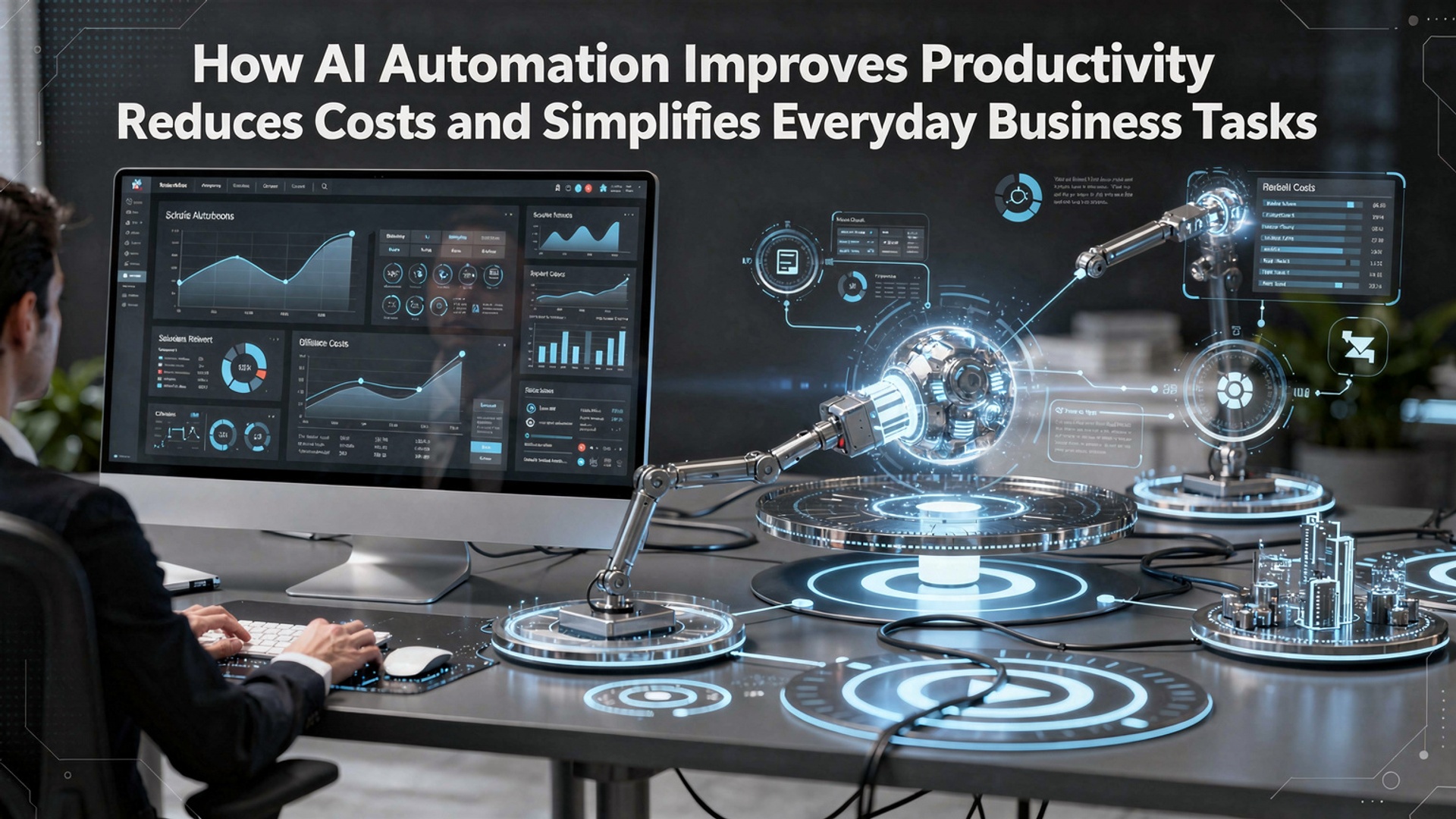
Understanding AI Automation in Business
AI automation refers to using artificial intelligence to perform tasks that traditionally required human involvement. These tasks range from basic data entry to advanced decision-making and language understanding.
Unlike traditional automation, AI-driven systems learn from data and improve over time. Core technologies include machine learning, natural language processing, robotic process automation, and computer vision. Together, they allow businesses to move beyond simple rule-based workflows and adopt intelligent automation that adapts to real-world conditions.
Key Technologies Powering AI Automation
Machine Learning (ML)
ML models analyze historical data to identify patterns and predict outcomes, making them essential for forecasting and fraud detection.
Natural Language Processing (NLP)
NLP enables systems to understand and respond to human language, powering chatbots and virtual assistants.
Robotic Process Automation (RPA)
RPA bots handle repetitive digital tasks, and when combined with AI, they enable smarter decision-based automation.
Computer Vision
This technology allows machines to interpret images and documents, often used in quality checks and document processing.
How AI Automation Benefits Improve Productivity and Efficiency
One of the most valuable AI automation benefits is improved workplace productivity. By automating repetitive tasks, employees gain more time for analytical and creative work.
A McKinsey Global Institute report found that organizations using AI automation saw productivity gains of 20–30% in operational roles (https://www.mckinsey.com/capabilities/operations/our-insights). For example, automating invoice processing can reduce handling time from minutes to seconds.
Key productivity gains include:
-
Faster task completion with fewer errors
-
24/7 operations without fatigue
-
Better employee focus on high-value work
Reducing Costs Through Intelligent Automation
In addition to productivity, cost reduction is a major driver of automation adoption. By minimizing manual work and errors, businesses significantly lower operational expenses.
Deloitte reports that intelligent automation can reduce back-office costs by up to 40% (https://www2.deloitte.com/global/en/pages/operations/articles/intelligent-automation.html). For instance, AI-powered chatbots can manage thousands of customer inquiries simultaneously, reducing the need for large support teams.
Cost-saving benefits include:
-
Lower labor costs for repetitive tasks
-
Fewer errors and rework expenses
-
Better resource allocation
Simplifying Everyday Business Tasks
AI automation benefits also extend to simplifying daily workflows. Tasks that once involved multiple steps can now run automatically in the background.
Common examples include automated email sorting, smart scheduling assistants, and AI-based expense management systems. Gartner recommends starting automation with high-volume tasks that deliver quick wins (https://www.gartner.com/en/information-technology/insights/automation).
Traditional Automation vs AI Automation
| Aspect | Traditional Automation | AI Automation |
|---|---|---|
| Decision-making | Rule-based | Data-driven |
| Scalability | Limited | Highly scalable |
| Error handling | Manual fixes | Self-improving |
| Learning | None | Continuous |
Real-World Use Cases Across Industries
-
Healthcare: Automated coding and diagnostics reduce admin work
-
Finance: Fraud detection and loan processing improve accuracy
-
Retail: Demand forecasting reduces waste
-
Manufacturing: Predictive maintenance lowers downtime
Ethical and Workforce Considerations
While AI automation benefits are significant, organizations must address ethics, security, and workforce impact. According to the OECD AI Principles, responsible AI requires transparency and human oversight (https://oecd.ai/en/ai-principles).
Key actions include:
-
Strong data governance
-
Bias monitoring
-
Employee reskilling programs
Conclusion
AI automation is no longer optional—it is a practical advantage. When repetitive tasks run quietly in the background, teams gain the freedom to focus on growth and innovation. The smartest approach is to start small, automate one bottleneck, measure results, and scale intentionally. Businesses that act early will benefit most as automation technologies continue to evolve.
More Articles
How AI-Driven Decision Making Is Transforming Everyday Business Strategies
How AI Copywriting Can Boost Sales for D2C Brands in Any Industry
How Product Tag Automation Saves Time for D2C Ecommerce Stores
Optimize SaaS Product for Growth: Practical Strategies That Scale
How AI Content Generators Help D2C Brands Save Time and Money

FAQs
What does AI automation actually mean for a business?
AI automation means using software powered by artificial intelligence to handle repetitive, data-heavy, or rule-based tasks with minimal human input. This can include things like processing invoices, sorting emails, scheduling work, generating reports, or answering common customer questions.
How does AI automation improve productivity on a daily basis?
AI automation speeds up tasks that normally take employees hours, completing them in minutes or seconds. By reducing manual work, teams can focus on higher-value activities like decision-making, problem-solving. customer engagement instead of routine admin tasks.
Can AI automation really reduce business costs?
Yes, AI automation can lower costs by reducing labor hours spent on repetitive tasks, minimizing human errors. improving resource usage. Over time, businesses often see savings from fewer mistakes, faster workflows. less need for manual oversight.
Is AI automation only useful for large companies?
No, small and medium-sized businesses can benefit just as much, if not more. AI automation helps smaller teams operate more efficiently, allowing them to compete with larger organizations without needing to hire additional staff.
What everyday business tasks can be simplified with AI automation?
Common tasks include data entry, appointment scheduling, customer support responses, inventory tracking, payroll processing. report generation. These tasks become faster, more accurate. easier to manage when automated.
Does AI automation replace employees?
AI automation is mainly designed to support employees, not replace them. It handles repetitive and time-consuming tasks so people can focus on creative, strategic. relationship-based work that requires human judgment.
How quickly can a business see results after adopting AI automation?
Many businesses notice improvements within weeks, especially in areas like task completion time and error reduction. Long-term benefits, such as cost savings and better scalability, continue to grow as the automation is refined and expanded.