Scaling a direct-to-consumer store manually quickly becomes unsustainable. Managing customer communications, product updates, and email campaigns across scattered channels causes operational bottlenecks. Adopting d2c business marketing automation tools in gurgaon helps ecommerce brands streamline consumer touchpoints without sacrificing quality. Implementing automated systems gives growth teams the infrastructure needed to personalize messaging and nurture long-term customer relationships efficiently.
Modern D2C brands rely on intelligent workflows to handle routine tasks automatically. Combining automated data pipelines with human strategic oversight helps marketing teams reduce manual work and deliver tailored shopping experiences. Evaluating d2c business marketing automation tools in gurgaon enables fast-growing businesses to boost productivity, eliminate operational friction, and drive sustainable growth across every marketing channel.
Why D2C Brands Need Marketing Automation
Direct-to-consumer commerce requires continuous interaction with shoppers across multiple channels. Relying on manual updates limits team productivity and increases human error. Deploying d2c business marketing automation tools in gurgaon helps merchants scale acquisition and retention campaigns seamlessly without expanding operational headcount.
Automated pipelines eliminate repetitive workloads, allowing marketing teams to focus on brand messaging, product innovation, and customer retention strategies. Connecting customer touchpoints through automated rules guarantees consistent campaign execution, faster response times, and improved store performance.
What Are D2C Business Marketing Automation Tools?
Evaluating d2c business marketing automation tools in gurgaon requires understanding how modern software platforms unify customer data, marketing workflows, and catalog operations. These software solutions connect directly with your online storefront, email systems, and customer management software.
Rather than running isolated campaigns, automated software triggers personalized messages based on real-time customer actions. Integrating customer relationship management tools with workflow automation allows brands to segment audiences dynamically, schedule content distribution, and leverage artificial intelligence for data analysis. This integrated technology framework empowers ecommerce teams to deliver relevant messages at optimal moments along the buying journey.
7 Marketing Workflows Every D2C Brand Should Automate
Building a scalable marketing engine requires converting manual marketing efforts into structured, trigger-based processes. Below are seven essential marketing workflows every growing D2C brand should automate.
1. Welcome Email Sequences
The welcome sequence introduces new subscribers to your brand story, core values, and top-rated products immediately after sign-up. Triggering automated welcome emails establishes strong initial engagement, while human marketers refine messaging and offers based on initial conversion performance.
2. Cart Abandonment Recovery
Shoppers frequently leave items in their digital carts without completing purchases. Automated recovery workflows send timely email or SMS reminders highlighting abandoned products, driving lost revenue back to your store while customer support handles specific buyer questions.
3. Post-Purchase Communication
The post-purchase journey shapes customer perception and long-term brand loyalty. Automated post-purchase campaigns deliver order confirmations, shipping updates, usage instructions, and review requests, while marketing teams periodically update content assets to ensure brand messaging remains fresh.
4. Customer Segmentation
Manually organizing customer lists into static target groups leads to generic messaging. Automated CRM systems categorize buyers dynamically using purchase history, site activity, and order value, allowing marketers to tailor promotional campaigns to distinct customer segments.
5. Product Recommendation Campaigns
Promoting relevant cross-sell and up-sell items increases average order value over time. Automated recommendation engines present personalized product suggestions based on past browsing behavior, while merchandisers set inventory guardrails to prevent out-of-stock items from appearing.
6. Content Publishing Workflows
Launching new collections across storefronts, blogs, and email channels requires coordinated execution. Content automation pipelines schedule, format, and publish product listings, SEO assets, and promotional copy, while editorial teams provide final brand approvals before public distribution.
7. Performance Reporting
Compiling campaign analytics manually across multiple marketing channels wastes valuable team hours. Automated analytics dashboards gather real-time performance data across conversion funnels, enabling growth managers to analyze key metrics and adjust acquisition strategies swiftly.
Common Marketing Automation Mistakes
While automation accelerates execution, poor implementation causes operational inefficiencies. A frequent mistake is over-automation, where brands send excessive, uncoordinated messages that frustrate subscribers and increase opt-out rates.
Relying on broad, unsegmented customer lists produces generic messaging that fails to resonate with buyers. Failing to review performance metrics leads to outdated campaign triggers running indefinitely. Brands also fail when they ignore direct customer feedback, missing opportunities to refine automated messaging paths. Maintaining regular audit schedules ensures automated campaigns stay aligned with evolving consumer expectations.
How AI Improves D2C Marketing Workflows
Integrating artificial intelligence into marketing workflows transforms standard automation into adaptive marketing systems. Leveraging AI tools allows brands to analyze consumer behavior data rapidly, generating predictive insights for tailored audience segmentation.
AI marketing capabilities streamline content creation by drafting product descriptions, promotional copy, and email variations in seconds. In thriving D2C hubs like Gurgaon, where vibrant ecommerce brand ecosystems rapidly adopt modern technology, teams leverage AI-driven automation to manage large product catalogs efficiently. Incorporating AI technology optimizes campaign timing, personalizes recommendations, and boosts overall team efficiency across marketing operations.
| Manual Marketing Workflow | Automated Marketing Workflow |
| Execution Speed | Slow, manual campaign scheduling |
| Message Consistency | Inconsistent messaging across channels |
| Customer Personalization | Generic broadcast emails |
| Required Team Effort | High manual labor hours |
| Business Scalability | Limited by team size |
| Performance Tracking | Delayed manual data entry |
Marketing Automation Readiness Checklist
Assess your store’s readiness to implement d2c business marketing automation tools in gurgaon using this 10-point checklist:
- Centralized customer database and CRM system connected.
- Store platform integrated with email marketing software.
- Documented customer journey maps for key buyer personas.
- Standardized product catalog attributes and metadata tags.
- Defined rules for cart recovery timing and message frequency.
- Segmented email lists based on purchase history and activity.
- Established brand voice guidelines for automated communications.
- Pre-designed email templates for transaction and marketing flows.
- Key performance metrics defined for lifecycle marketing campaigns.
- Designated team members assigned to review and update workflows.
How D2CBot Supports Marketing Automation
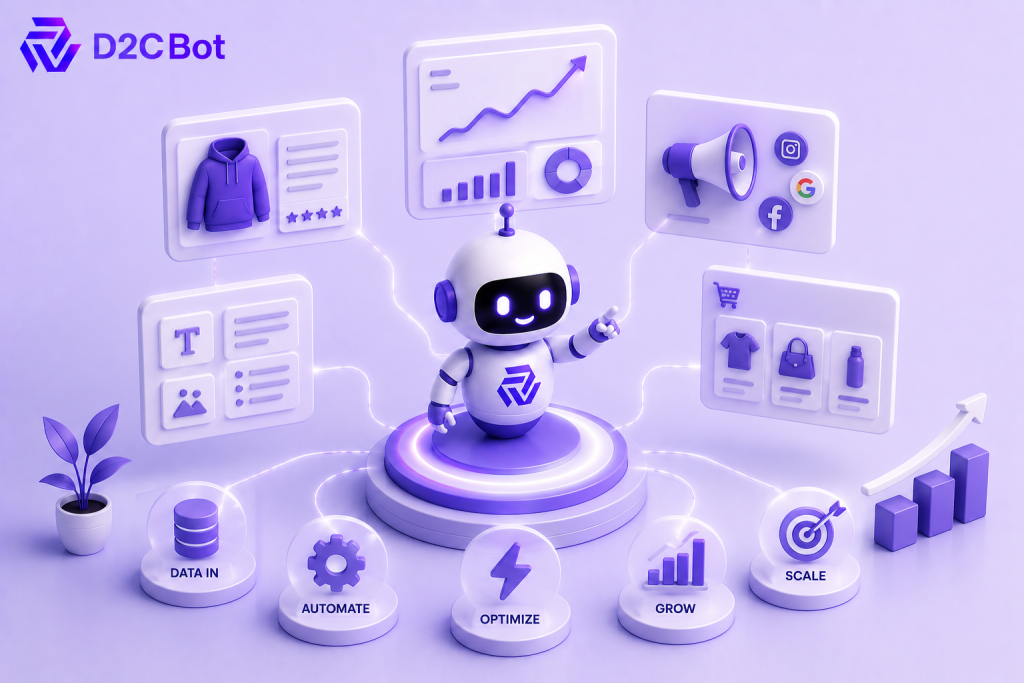
D2CBot serves as an intelligent workflow platform engineered to streamline ecommerce content and marketing operations. By connecting directly to your store, D2CBot simplifies catalog management, content production, and promotional asset generation.
The platform helps growth teams create SEO-optimized product descriptions, engaging FAQs, blog content, and marketing messaging using structured AI workflows. Rather than managing disconnected prompts and manual spreadsheets, D2CBot automates repetitive publishing workflows while preserving human editorial control. Selecting robust d2c business marketing automation tools in gurgaon allows brands to scale operations, maintain content consistency, and drive sustainable growth.
Conclusion
Building a successful ecommerce store requires combining efficient automation tools, smart data workflows, and human strategic oversight. Relying on manual updates limits brand growth and creates operational friction across marketing channels.
Implementing d2c business marketing automation tools in gurgaon empowers brands to deliver personalized customer experiences, streamline content publishing, and improve overall operational productivity. Automation handles repetitive execution, freeing your team to focus on brand building, product innovation, and customer relationship strategy. Adopting structured AI workflows helps ecommerce businesses create scalable systems that support long-term revenue growth.
Use D2CBot to build smarter marketing automation workflows that save time, improve customer engagement, and support sustainable ecommerce growth.
More Articles
- https://d2cbot.com/blog/ai-in-seo/turn-feedback-into-sales-the-ultimate-guide-to-ai-product-review-generators/
- https://d2cbot.com/blog/ai-in-seo/get-your-shopify-store-picked-by-chatgpt-ai-overviews/
- https://d2cbot.com/blog/seo-optimization/ecommerce-faq-schema-generator/
- https://d2cbot.com/blog/ai-software/how-to-choose-best-saas-ai-image-generator/
FAQs
D2C marketing automation uses software and data workflows to automate repetitive marketing tasks, such as sending emails, segmenting customers, managing catalogs, and tracking campaign performance across direct-to-consumer sales channels.
Brands should first automate high-impact customer touchpoints, including welcome email sequences, cart abandonment recovery messages, post-purchase order confirmations, and basic customer segmentation to improve retention and drive immediate revenue.
AI enhances marketing automation by analyzing buyer behavior, personalizing product recommendations, drafting campaign copy, optimizing send times, and predicting customer lifetime value to increase campaign efficiency.
No, automation does not replace marketers. It handles repetitive operational tasks, allowing marketing professionals to focus on creative strategy, brand positioning, audience research, and high-level business growth initiatives.
Growing D2C brands scale efficiently by implementing structured automation software, connecting CRM data pipelines, leveraging AI-powered content workflows, and maintaining human strategic oversight across all customer engagement touchpoints.