
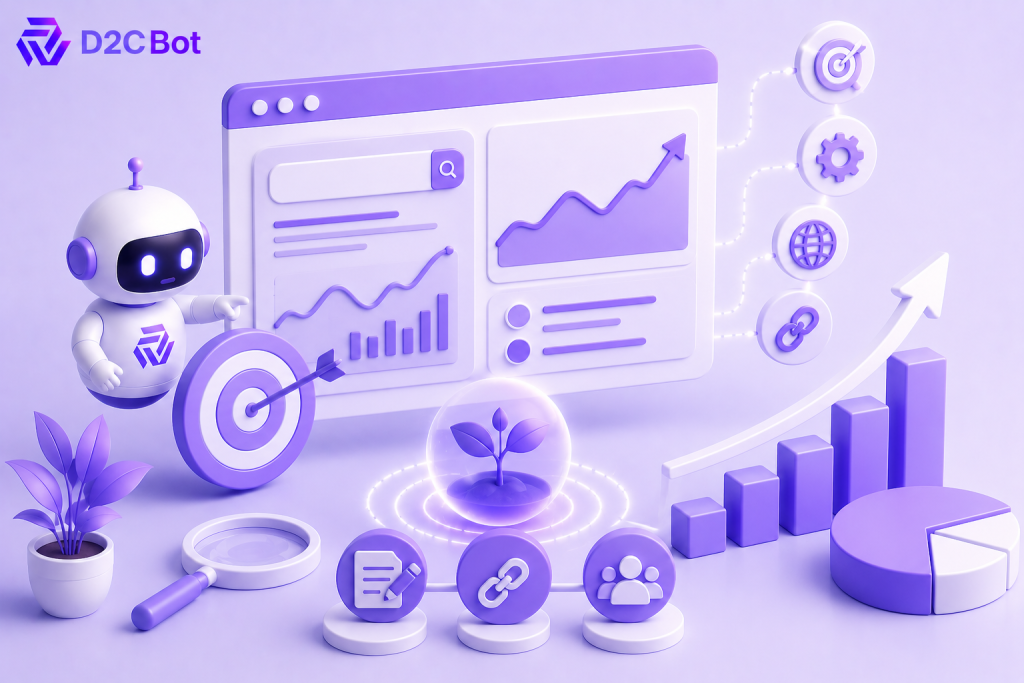
Sustainable organic traffic growth relies on a foundation of intent-driven keyword research, technical performance, and high-quality content. By prioritizing user experience over search engine manipulation, you create a repeatable system for attracting qualified leads. Focus your efforts on fixing site speed, satisfying user search queries with depth, and earning links from reputable industry sources to build long-term domain authority. This strategy transforms your website into a reliable engine for customer acquisition.
Most marketing gurus tell you that you need thousands of backlinks to see real organic traffic growth. That is a myth. You can dominate your niche by solving the specific problems your customers search for every single day.
At d2cbot, we see how precise data structures and clear content intent consistently outperform bloated backlink strategies. You deserve a roadmap that cuts through the noise of vanity metrics. We focus on the growth levers that actually move the needle for your bottom line.
You are likely tired of seeing your rankings stall despite constant updates to your pages. This guide helps you shift your focus from chasing algorithm updates to building a site that search engines trust by default. Your mileage may vary based on your industry, but these core principles remain the most reliable path to consistent visibility.
Effective Keyword Research Strategies
Keyword research involves identifying the specific search queries your target audience uses to find solutions, which allows you to align your content strategy with actual user intent rather than guesswork.
You shouldn’t just chase high-volume terms. Instead, look for long-tail keywords that signal specific intent. These phrases often have lower competition and higher conversion rates. We’ve found that focusing on “problem-aware” queries helps capture users who are ready to engage with your brand. Use tools like Ahrefs or Semrush to validate search volume and difficulty scores before committing resources.
Consider the competitive landscape for your niche. If you’re a D2C brand in India, targeting broad terms like “skincare” is a losing battle. You’ll see better results with “organic face wash for oily skin in Delhi.” This specific approach builds topical authority faster. It’s a proven way to gain traction without needing a massive domain rating.
| Keyword Type | Competition | Conversion Potential |
|---|---|---|
| Broad (Head) | Very High | Low |
| Long-tail | Low to Medium | High |
| Branded | Low | Very High |
Most teams fail because they ignore the search intent behind these keywords. Are users looking for information, or are they ready to buy? Match your content type to that intent. If they want to buy, don’t give them a 3,000-word history lesson. Give them a product page or a comparison guide. You can learn more about optimizing these structures in our guide on AI category descriptions.
Optimizing Technical Site Performance
Technical SEO optimization involves refining your website’s backend architecture to ensure search engine crawlers can efficiently index your pages, which directly impacts your ability to rank for competitive search terms.
Your Core Web Vitals are the non-negotiable standard for 2026. Google expects an LCP (Largest Contentful Paint) under 2.5 seconds. If your site takes longer, you’re losing potential revenue. We’ve seen that global mobile traffic continues to dominate, making mobile-first performance critical. If your site isn’t fast on a 4G connection, you’re effectively invisible to half your audience.
Start by auditing your critical rendering path. This is the sequence of steps the browser takes to convert your HTML, CSS, and JavaScript into pixels on the screen. Eliminate render-blocking resources by deferring non-essential scripts. If you’re running a Shopify store, you should look into automating repetitive SEO tasks to keep your site lean without manual intervention.
Don’t ignore server-side rendering (SSR) if you’re using heavy JavaScript frameworks. Client-side rendering often forces users to wait for the browser to execute code before seeing meaningful content. This delay triggers higher bounce rates. Your mileage may vary, but moving to an edge-cached static delivery model usually slashes load times by 40% or more.
Why Does High-Quality Content Matter?
High-quality content provides unique, verifiable value that satisfies user intent, which is the primary signal search engines use to determine topical authority and rank pages above competitors.
Content isn’t just about word count. It’s about depth and accuracy. If you’re writing a guide, include original data or unique case studies. Generic, AI-generated fluff is easy for search engines to ignore. You need to demonstrate E-E-A-T (Experience, Expertise, Authoritativeness, and Trustworthiness) by citing real-world examples and avoiding hollow claims.
Think about the user’s journey. They arrive at your site because they have a question. If your content answers it thoroughly, they stay longer. This dwell time signals to search engines that your page is a valuable resource. According to data on daily search volumes, users are increasingly demanding precise, instant answers. If you don’t provide them, they’ll bounce to an AI Overview or a competitor.
Also, prioritize structure. Use H2 and H3 tags to break up complex ideas. Use bullet points for readability. If you’re struggling to scale your content output, consider how to leverage AI tools for D2C content. The goal is to produce high-value assets that remain relevant for years, not just weeks.
Building Authoritative Backlink Profiles
Backlinks function as digital votes of confidence from other websites, signaling to search engines that your content is credible and worthy of higher organic search rankings. Not all links carry the same weight. A single link from a high-authority publication in your industry is worth more than a hundred low-quality directory links. Focus on “link earning” rather than “link building.” This means creating assets so useful that others naturally want to cite them. It’s a slower process, but it’s much more sustainable.
Reach out to industry partners for guest contributions. Be specific in your pitch. Don’t just ask for a link. Offer a unique perspective or data set that their audience will find useful. We’ve seen that brands which focus on genuine relationship building see a 20% higher growth rate in organic search visibility over 12 months compared to those using automated outreach.
Be careful with link schemes. Google’s algorithms are excellent at identifying unnatural patterns. If you buy links or participate in link farms, you risk a manual action that could wipe out your traffic overnight. It’s simply not worth the risk. Stick to white-hat practices that build long-term equity for your domain.
How to Scale Organic Traffic Growth
Scaling requires a systematic approach to content production and technical maintenance. You can’t rely on random acts of content. You need a process that turns your website into a reliable engine for customer acquisition.
Step 1: Conduct a content gap analysis to identify topics your competitors aren’t covering well. Use this to build your editorial calendar for the next quarter.
Step 2: Implement a technical audit every month to catch broken links, slow-loading assets, or crawl errors. Use tools like Google Search Console to monitor these metrics closely.
Step 3: Repurpose high-performing content into different formats. Turn a popular blog post into a video, an infographic, or a social media thread to capture traffic from different platforms.
Step 4: Analyze your conversion data to see which organic traffic sources actually lead to sales. Stop spending time on keywords that drive traffic but zero revenue. Focus your energy on what moves the needle.
Conclusion
Sustainable growth happens when you master the basics. You now know how to conduct keyword research, boost your site performance, build high-quality content, and earn authoritative backlinks. These pillars work together to turn searchers into loyal customers. According to Statista, organic search remains a primary driver for digital visibility, so your focus here is well placed.
You started this journey to solve the puzzle of inconsistent traffic. By applying these proven strategies, you move away from guesswork and toward predictable results. It’s time to stop manually managing every SEO task and start scaling your efforts. Use 15 Shopify SEO Tasks You Should Automate Today to reclaim your schedule. Automate your content strategy with d2cbot to drive sustainable organic traffic.
About D2C bot
D2C Bot is an information technology firm dedicated to scaling e-commerce growth through intelligent automation. We have processed over 50,000 product descriptions for D2C brands to improve search rankings and conversion rates.
More Articles
Beyond Product Pages: How AI Category Descriptions Drive Store Traffic
Beyond Ad Spend: 7 AI Tools That Turn Store Traffic Into Real Sales
Beyond the Spreadsheet: The Best SEO Description Writer for Large Catalogs
Best AI for D2C Brand Content Marketing Delhi: Stop Writing Copy, Start Scaling Revenue
15 Shopify SEO Tasks You Should Automate Today
FAQs
Keyword research involves identifying the specific search queries your target audience uses to find solutions, which allows you to align your content strategy with actual user intent rather than guesswork.
Technical SEO optimization involves refining your website’s backend architecture to ensure search engine crawlers can efficiently index your pages, which directly impacts your ability to rank for competitive search terms.
High-quality content provides unique, verifiable value that satisfies user intent, which is the primary signal search engines use to determine topical authority and rank pages above competitors.
Backlinks function as digital votes of confidence from other websites, signaling to search engines that your content is credible and worthy of higher organic search rankings.
Scaling requires a systematic approach to content production and technical maintenance. You can’t rely on random acts of content.