
Managing a growing online storefront requires balancing a complex matrix of logistics, marketing, inventory, and customer support. When an inventory catalog expands from fifty items to thousands of stock-keeping units (SKUs), a significant operational bottleneck emerges: drafting high-converting product descriptions. Manually writing unique, persuasive, and search-optimized copy for every single product variant drains internal resources and severely delays critical inventory launch windows.
To remain competitive in fast-moving digital marketplaces, brands must move away from slow manual writing processes. Utilizing an ai product description generator has transitioned from an experimental luxury to a fundamental operational necessity for scaling businesses. Automating this catalog creation process allows ecommerce teams to launch seasonal drops, handle massive marketplace migrations, and update item variants rapidly without sacrificing copywriting depth or search engine optimization strategy.
What Is an AI Product Description Generator?
An ai product description generator is a specialized software application engineered to draft marketing copy, technical specifications, and metadata for online store catalogs automatically. Unlike generic language models or basic text editing tools, these systems are fine-tuned on commercial transactional data, consumer purchase psychology, and digital marketing frameworks to produce copy that explicitly drives conversions.
Modern online stores rely heavily on structured catalog attributes to display products correctly. A dedicated product description generator processes these baseline input attributes—such as fabric type, dimensions, color variants, and target brand tone—and transforms them into structured, publication-ready paragraphs, bulleted benefit lists, and optimized search headers. The final text reads as if written by a seasoned conversion copywriter, maintaining complete brand consistency across thousands of active products simultaneously.
Why Product Descriptions Matter for Ecommerce SEO
Search engines do not view your online storefront the way human shoppers do; they rely entirely on contextual, semantic text strings to understand the utility of what you are selling. High-quality product descriptions serve as the primary source of crawlable data for search engine bots, helping establish immediate topical authority and indexing relevance for high-intent search queries.
When algorithmic bots crawl an ecommerce site, they analyze product titles, headings, and body descriptions to match specific pages with active user search intents. Thin content or duplicated manufacturer descriptions signal low value to indexing algorithms, dragging down overall store visibility. Unique text rich in contextual synonyms ensures that your product detail pages rank for lucrative long-tail keywords. Furthermore, clear, benefit-driven product descriptions bridge the gap between initial shopper curiosity and the checkout process, directly lowering site bounce rates while increasing conversion performance.
How AI Product Description Generators Work
The backend mechanics driving modern ecommerce ai content software involve sophisticated natural language processing engines trained on retail copywriting structures. Instead of pulling random phrases from public databases, these applications follow a structured, programmatic pipeline to build highly accurate product pages.
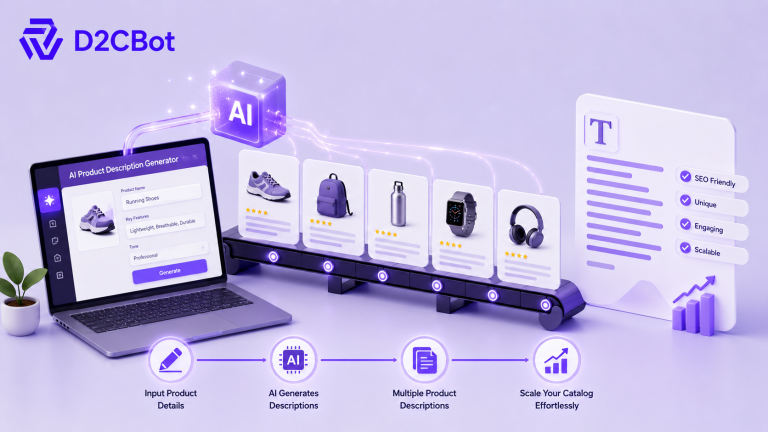
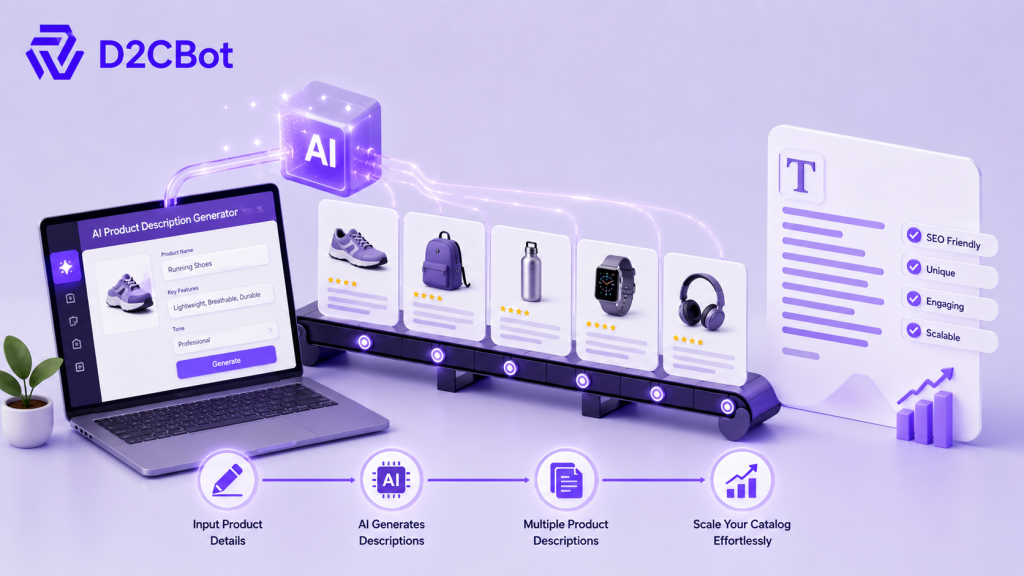
The standard automated copywriting workflow follows a transparent sequence:
- Data Input: The merchant provides baseline item attributes, either via direct integration with a store backend or by manual input of basic product titles and specs.
- Parameter Analysis: The system parses specific data inputs, including target keywords, selected brand voice profiles (e.g., professional, luxurious, playful), and required text lengths.
- Text Synthesis: The application applies proven retail marketing structures, such as the Features-Advantages-Benefits (FAB) or Attention-Interest-Desire-Action (AIDA) frameworks.
- Semantic Output: The software outputs clean semantic formatting containing appropriate HTML markdown tags, such as structural headers and bold feature lists, making the copy ready for instant deployment.
Benefits for Shopify & Ecommerce Businesses
Implementing automated catalog generation workflows yields immediate operational advantages, transforming how retail marketing and merchandising teams manage extensive inventories daily.
- Accelerated Launch Windows: Instead of waiting weeks for manual copywriting teams to draft copy for a new product drop, brands can upload thousands of optimized descriptions to their storefronts within minutes.
- Operational Cost Efficiency: Utilizing dedicated software drastically lowers the cost per written word, allowing brands to reallocate capital toward paid acquisition channels and new product development.
- Elimination of Human Error: Automated systems apply uniform formatting, preserve exact technical dimensions, and ensure crucial material specifications are never accidentally omitted across large catalogs.
- Preventing Duplicate Content Penalties: If you sell identical products across multiple digital marketplaces like Amazon and Shopify, a generator spins unique variations of the same listing to prevent search engine indexing drops.
Manual vs AI Product Descriptions
| Feature / Attribute | Manual Copywriting | AI Catalog Generation |
| Search Intent Match | High, but slow and difficult to maintain uniformly across thousands of SKUs. | Instantaneous, matching commercial search filters dynamically. |
| Structural Layout | Dependent on the writer’s individual style; highly variable formatting. | Programmatically uniform, using clean HTML lists and headers. |
| Originality | Prone to fatigue, leading to repetitive phrasing across similar items. | Scalable uniqueness using vast contextual synonym matrices. |
| Technical Proof | Prone to data omission errors when handling massive catalogs manually. | Strict adherence to raw product specifications and dimensions. |
| Editing Requirements | Requires deep structural and grammatical copyediting passes. | Focuses on quick brand alignment and factual validation reviews. |
| Conversion Potential | High for single items, but bottlenecks slow store launch momentum. | High conversion velocity across your entire inventory line. |
Features to Look for in a Product Description Generator
Not all automated text engines are built equally for retail environments. When evaluating a commercial product description software, look past basic text boxes and focus on critical features that integrate smoothly into an enterprise operational workflow.
Native Platform Integration
The primary bottleneck in catalog management is not always the writing process itself, but the tedious task of copy-pasting text between browser tabs. Look for tools that operate natively inside your store dashboard. Direct integration allows your team to generate, review, and push live changes to your storefront instantly.
Bulk Generation and Multi-Language Capabilities
For brands managing extensive catalogs, processing copy one item at a time is highly inefficient. The ideal system must feature robust bulk processing pipelines capable of updating hundreds of listings simultaneously. Furthermore, built-in support for localized multi-language generation ensures seamless, accurate expansion into international markets without text duplication.
Best Practices for Creating High-Converting Product Descriptions
To maximize the performance of your automated copy, implement a structured approach to how your team configures and refines software outputs.
Provide Detailed Input Attributes
The quality of your generated copy depends heavily on the accuracy of the data you feed into the system. Instead of entering a vague title like “Running Shoes,” input explicit technical attributes: “Men’s trail running shoes, waterproof Gore-Tex membrane, lightweight responsive foam cushioning, midnight blue colorway, professional athletic use”.
Establish a Distinct Brand Voice
Ensure the software profile configurations align with your specific target demographic. A high-end luxury watch brand requires sophisticated, refined language focusing on heritage craftsmanship. Conversely, an urban streetwear label benefits from punchy, high-energy text focusing on modern trends and styling flexibility.
Common Mistakes to Avoid
While automation provides immense operational leverage, completely unmonitored execution can lead to quality drops that damage brand integrity and search engine health.
- Total Lack of Editorial Review: Deploying generated copy directly to a live storefront without human verification is risky. A quick human proofread ensures that final descriptions match physical product realities perfectly.
- Over-Optimizing and Keyword Stuffing: Attempting to force focus keywords into every single sentence disrupts natural text readability. The copy must naturally emphasize user benefits while keeping search terms integrated in a balanced manner.
Before vs After Product Description Example
Before (Manufacturer Boilerplate Data)
“Wireless Earbuds Model X. Active noise-canceling technology. 30-hour battery life. Waterproof. Bluetooth 5.2 connectivity. Charging case included.”
After (Optimized AI Generation Output)
“Immerse Yourself in Pure Audio Clarity Experience uninterrupted sound with the Model X Wireless Earbuds, featuring advanced Active Noise-Canceling (ANC) technology designed to filter out ambient city noise. Engineered for active lifestyles, these sweatproof earbuds offer up to 30 hours of continuous playback with the included compact charging case. Enjoy seamless device pairing via Bluetooth 5.2, ensuring crystal-clear phone calls and rich bass response whether you are commuting or working out.”
How D2CBot Helps Ecommerce Teams
For digital store owners looking to streamline content production, D2CBot provides a native solution built specifically for the Shopify ecosystem. Operating under the app name “SEO Bot: AI Marketing engine,” the platform connects directly to your live product catalog data. This direct link allows merchants to automatically generate optimized titles, deep descriptions, and product FAQs without the tedious task of copying and pasting text back and forth from external web tools.
Beyond simple description generation, the platform functions as an all-in-one workflow automator. It acts as a bridge for multi-channel brands by helping rewrite external marketplace listings for independent storefronts, keeping formatting uniform across hundreds of SKUs. The tool balances high-converting marketing frameworks with structured technical layouts, ensuring your pages look professional to shoppers and rank well on search engines.
AI Ecommerce Content Pre-Publishing Checklist
- [ ] Verify the target search intent matches a commercial or transactional query layout.
- [ ] Check technical attributes like dimensions and materials against your physical inventory records.
- [ ] Enforce brand tone consistency to ensure voice uniformity across all active product collections.
- [ ] Audit semantic heading hierarchies to confirm scannable H2 and H3 markdown structures.
- [ ] Extract main consumer advantages into organized, bulleted highlight lists.
- [ ] Remove predictive clichés and repetitive marketing phrases from descriptions.
- [ ] Validate structured schema data formatting to secure rich snippet displays on results pages.
- [ ] Embed relevant internal navigation links connecting product pages back to broader category hubs.
Conclusion
Transitioning to automated catalog management is a crucial step for brands aiming to scale their online stores efficiently. By deploying a comprehensive ai product description generator, ecommerce operations can eliminate writing backlogs, lower catalog overhead costs, and drastically accelerate time-to-market windows for new inventory. Rushing raw, unverified content onto live storefronts triggers drops in organic performance. Lasting growth demands an optimization pipeline where AI generates the foundational layers and human strategy sharpens the final delivery.
More Articles
- https://d2cbot.com/features/description-generation
- https://d2cbot.com/features/faqs-generation
- https://d2cbot.com/features/title-generation
Frequently Asked Questions
No. Search engine guidelines focus heavily on content quality, detail accuracy, and user helpfulness rather than how the text was produced. As long as your descriptions are factual, accurate, and avoid keyword stuffing, they will rank effectively.
Most advanced description tools allow you to configure specific tone profiles within their settings. By defining your target audience and entering specific brand rules before running bulk generations, the tool maintains a unified voice across your entire catalog.
Yes. Top-tier ecommerce AI applications support multi-language generation. This allows international brands to automatically translate and localize their product details into multiple target languages while preserving local idioms and shopping search intent.
Standard web applications require you to copy data from your store, paste it into an external prompt window, copy the output, and paste it back into your backend. Bulk tools fetch data directly from your catalog, generating and updating thousands of items simultaneously with a single click.