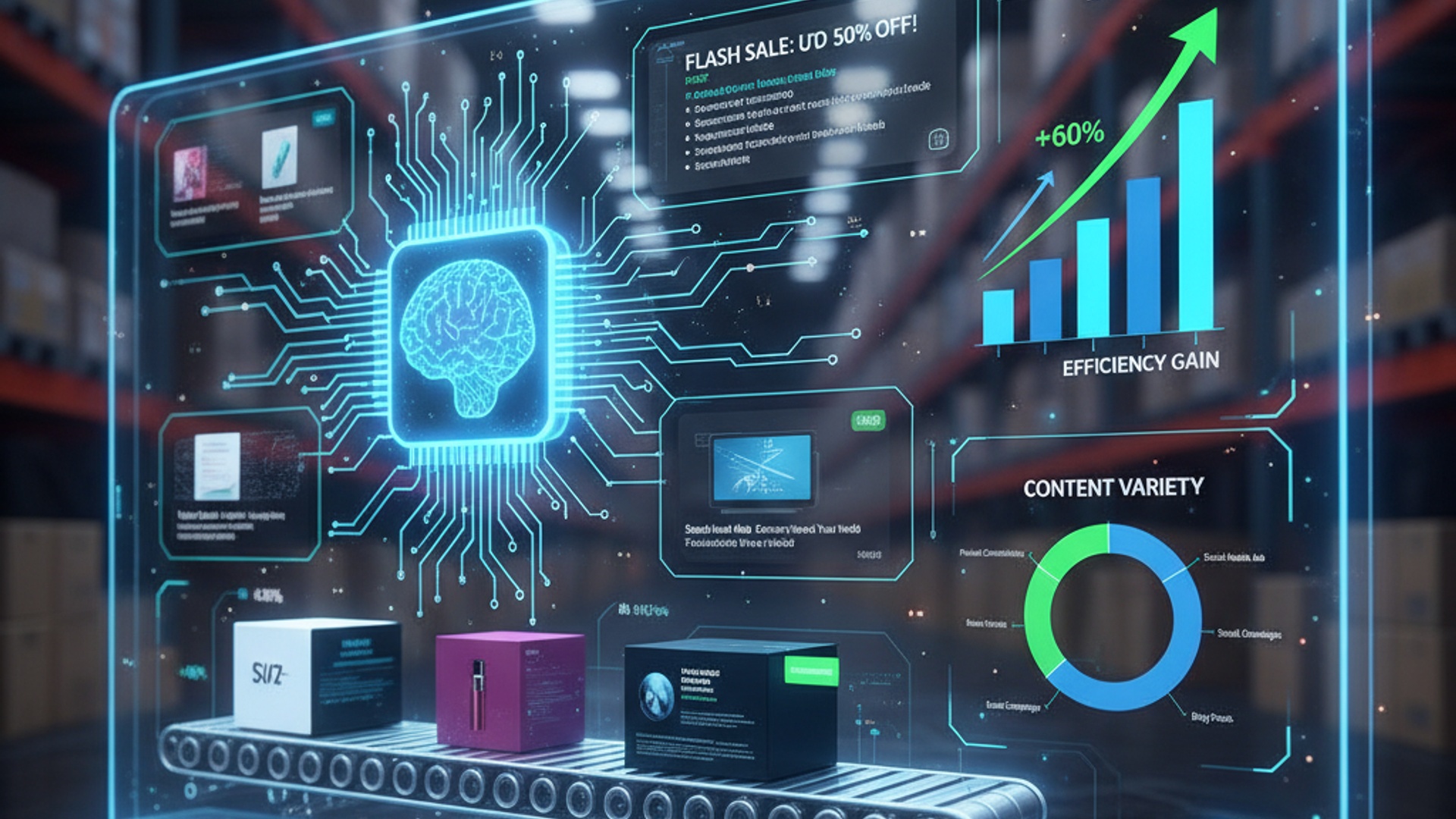
AI content automation for ecommerce helps businesses generate product descriptions, marketing content, and SEO copy at scale. With AI tools, online stores can streamline workflows, save time, and increase content production efficiency.
Quick Summary
-
Learn why integrating AI content automation for ecommerce is becoming essential for modern online stores.
-
Discover high impact content areas where automation can boost sales and improve operational efficiency.
-
Understand how to build scalable AI powered content workflows step by step.
-
Track performance and optimize AI generated content to maximize ROI and marketing impact.
At d2cbot, we help ecommerce brands scale faster by using advanced automation technologies. One of the most powerful transformations we’ve seen is the adoption of AI content automation for ecommerce.
Traditional content creation workflows often struggle to keep up with the demands of modern ecommerce. Product catalogs grow quickly, marketing campaigns require constant updates, and personalized customer experiences demand an enormous amount of content.
Manual content creation becomes a bottleneck that slows down marketing teams and reduces efficiency.
This guide explains how ecommerce brands can implement AI driven content automation to streamline operations, increase engagement, and drive consistent growth.
Why AI Content Automation for Ecommerce Is Becoming Essential
The ecommerce landscape is more competitive than ever. Online stores must constantly produce fresh, relevant content to attract customers and maintain visibility.
From product descriptions to social media posts, the amount of content required to run an ecommerce business continues to grow.
AI content automation for ecommerce solves this challenge by allowing businesses to generate and optimize large volumes of content quickly.
Instead of spending hours writing repetitive product descriptions or ad variations, AI systems can generate content automatically while maintaining brand consistency.
This allows marketing teams to focus on strategic tasks such as campaign planning, brand storytelling, and customer experience improvements.
The result is a more efficient content production process and faster response to market trends.
High Impact Areas for AI Content Automation
Some content types deliver faster results when automated. These areas usually involve repetitive tasks that require large volumes of similar content.
Product descriptions
Ecommerce stores often manage hundreds or even thousands of products.
Writing unique product descriptions for every item can take enormous time and effort.
AI tools can automatically generate optimized product descriptions that highlight key features, benefits, and keywords for search engines.
Advertising copy
Ad campaigns require multiple variations of headlines, descriptions, and calls to action.
AI tools can generate large numbers of ad creatives quickly, allowing brands to test multiple variations and identify the most effective messaging.
Email marketing campaigns
Automated email systems powered by AI can generate personalized messages for different customer segments.
Examples include:
-
abandoned cart reminders
-
promotional campaigns
-
product recommendations
Personalized email content often improves open rates and conversions.
Social media content
Maintaining an active social media presence requires frequent posting.
AI can assist with generating captions, hashtags, and post ideas that align with audience interests.
Blog and SEO content
AI tools can assist with generating blog outlines, topic research, and draft content that supports organic search growth.
Human editing ensures the final content maintains quality and brand voice.
Building an AI Content Automation Workflow
Successfully implementing AI content automation for ecommerce requires more than simply adopting new tools. A structured workflow helps ensure consistent results.
Step 1: Define content goals
Start by identifying which content types require the most time and effort.
Common goals may include:
-
increasing product page conversions
-
improving ad campaign performance
-
producing more SEO content
Clear goals guide the automation strategy.
Step 2: Choose the right AI tools
Different AI tools specialize in different types of content.
Look for platforms that integrate with your ecommerce systems and support scalable content generation.
Step 3: Integrate data sources
AI systems rely heavily on data. Connecting product catalogs, CRM data, and analytics platforms allows AI to generate more relevant and personalized content.
Step 4: Develop brand voice guidelines
Maintaining brand consistency is essential.
Create guidelines that define tone, style, and messaging rules so AI generated content remains aligned with your brand identity.
Step 5: Implement human review
AI generated content should always be reviewed by human editors before publication.
Human oversight ensures accuracy, quality, and alignment with marketing goals.
Measuring the Performance of AI Content Automation
To maximize the value of AI content automation for ecommerce, businesses must track the performance of automated content.
Key metrics include:
Conversion rates
Measure whether AI generated product descriptions or ad copy improve sales performance.
Engagement metrics
For social media and blog content, track metrics such as:
-
likes
-
shares
-
comments
-
time on page
Click through rates
Evaluate how well AI generated headlines and calls to action drive traffic.
Cost savings
Calculate the time saved by automation compared with manual content creation.
Customer feedback
Monitor user responses to ensure AI generated content remains helpful and authentic.
Tracking these metrics helps refine the automation strategy over time.
How to Implement AI Content Automation in Your Ecommerce Business
Ecommerce brands can begin integrating AI content automation for ecommerce by following a simple process.
Step 1: Identify bottlenecks
Determine which content tasks consume the most time and resources.
Step 2: Select AI platforms
Choose AI tools that support your specific content needs and integrate with your ecommerce systems.
Step 3: Create prompt templates
Develop standardized prompts that guide the AI to produce consistent and relevant content.
Step 4: Establish review processes
Ensure all generated content passes through a quality control process before being published.
Step 5: Analyze results and improve
Use analytics to refine your prompts, workflows, and automation strategy for better results.
Conclusion
Adopting AI content automation for ecommerce allows businesses to overcome one of the biggest challenges in online marketing: producing large amounts of high quality content quickly.
Automation enables brands to generate product descriptions, marketing campaigns, and social media content at scale while maintaining consistency and personalization.
However, successful implementation requires a balanced approach. AI should be viewed as a tool that supports human creativity rather than replacing it.
By combining automation with strategic oversight, ecommerce brands can increase efficiency, improve customer engagement, and create a scalable content system that supports long term growth.
About d2cbot
d2cbot stands as a leading innovator in the Automation & AI Tools space, specifically engineered to empower direct-to-consumer ecommerce brands. Our platform provides cutting-edge AI solutions that dramatically enhance content generation, product optimization, and marketing efficiency, establishing us as a trusted authority for businesses aiming to scale rapidly and intelligently.
More Articles
Create Stunning Ecommerce Banners Instantly with AI Tools
Unlock Stunning Product Photos and Boost Ecommerce Sales Using AI Tools
Why Bulk Product Optimization Ecommerce Is Essential for Modern Online Stores
9 Tips for High-Converting D2C Product Content
FAQs
What exactly is AI content automation for e-commerce?
It’s using artificial intelligence tools to automatically generate, optimize, and distribute various types of content for your online store. This includes product descriptions, marketing emails, social media posts, and blog articles.
How does AI content automation actually boost sales for an e-commerce business?
AI helps by creating highly personalized and engaging content that resonates with specific customer segments, leading to higher conversion rates. It also ensures consistent messaging across all touchpoints, building stronger brand trust.
And what about improving efficiency? How does AI help with that?
AI significantly reduces the time and resources needed to produce large volumes of high-quality content. It automates repetitive tasks like writing product descriptions, freeing up your team for more strategic work.
What kinds of e-commerce content can AI tools automate?
You can automate product descriptions, category pages, ad copy, email marketing campaigns, and social media updates. AI can also assist with blog posts and FAQs, making content creation much faster.
Is it difficult for someone without technical skills to start using AI for content automation?
Many modern AI content platforms are designed with user-friendly interfaces, making them accessible even for non-technical users. You can often start with simple templates and guided workflows.
Will AI content automation replace human writers for my e-commerce content?
No, AI is best seen as a powerful assistant that enhances human creativity and productivity. It handles repetitive tasks, allowing your human writers to focus on strategy, unique brand voice, and complex storytelling.
How can I pick the best AI tools for my specific e-commerce store’s needs?
The best way to choose is to evaluate tools based on your specific content needs, budget, and integration capabilities with your existing e-commerce platform. Look for features like personalization, scalability, and ease of use.