Product pages make or break ecommerce revenue. Great products fail when pages don’t convert.
The problem: most businesses guess at what works. They copy competitor layouts, follow outdated best practices, or rely on personal preferences.
AI product page optimization replaces guessing with data. It analyzes what actually drives conversions for your specific products and audience.
The tools track user behavior, test variations automatically, and optimize pages in real time without manual intervention.
Traditional optimization takes months. AI compresses that timeline to weeks while delivering stronger results.
Here’s how product page optimization AI increases sales and conversions measurably.
Why Traditional Product Page Optimization Falls Short
Manual optimization is slow. You create hypotheses, design variations, run A/B tests, wait for statistical significance, analyze results, then repeat.
That cycle takes 4 to 8 weeks per test. Most businesses run 6 to 12 tests annually. Progress is glacial.
Manual testing also misses interactions between variables. Changing headline copy might work differently depending on image placement, but traditional A/B tests can’t capture those relationships efficiently.
AI solves both problems. It tests dozens of variables simultaneously and identifies winning combinations faster than sequential manual testing.
Speed isn’t the only advantage. AI detects patterns humans miss by analyzing thousands of user sessions and correlating behaviors with conversions.
How AI Analyzes Product Page Performance
AI tracks everything visitors do on product pages.
It monitors:
- Scroll depth and attention patterns
- Time spent on each section
- Element interaction (buttons, images, tabs)
- Exit points and abandonment triggers
- Device type and screen size behavior
- Traffic source influence on conversion
This data reveals what actually influences purchase decisions versus what marketers assume matters.
AI identifies friction points automatically. Forms that confuse users. Images that don’t load fast enough. CTAs that get ignored. Trust signals that go unseen.
Traditional analytics show what happened. AI explains why and suggests fixes.
Dynamic Content Optimization
AI adjusts page content in real time based on visitor behavior and context.
First-time visitors see different content than returning customers. Mobile users see layouts optimized for smaller screens. High-intent visitors from paid ads see different CTAs than organic browsers.
Product descriptions adapt based on what the visitor has already viewed. Someone who looked at three similar products sees comparison details. Someone who just arrived sees benefit-focused messaging.
Pricing displays adjust based on cart value and browsing patterns. Bulk pricing appears for visitors adding multiple items. Free shipping thresholds appear for carts approaching that limit.
Dynamic optimization increases conversion rates by 15 to 35 percent compared to static pages.
Automated A/B and Multivariate Testing
AI runs tests continuously without manual setup.
Instead of testing one element at a time, AI tests combinations. Headline A with Image B and CTA C versus Headline D with Image E and CTA F.
The tool allocates traffic dynamically. Losing variations get less traffic. Winning combinations scale automatically. You don’t wait weeks for significance.
AI also accounts for external factors. Day of week, time of day, seasonality, and traffic source all influence conversion. AI adjusts for these variables instead of treating them as noise.
Most businesses using AI testing run 5x to 10x more experiments annually compared to manual testing programs.
Image and Visual Optimization
Product images drive conversion more than any other single element.
AI determines optimal image count, size, placement, and sequencing. It tests lifestyle images versus white background shots. It identifies which angles convert best.
Some AI tools automatically enhance image quality—adjusting brightness, contrast, and color balance to improve appeal without manual editing.
AI also tests image-loading strategies. Lazy loading versus immediate display. Thumbnail grids versus large hero images. Video integration versus static shots.
Optimized images typically improve conversion by 10 to 25 percent.
Personalized Product Recommendations
Generic “You might also like” sections perform poorly. AI personalizes recommendations based on individual behavior.
The tool analyzes:
- Browsing history across your site
- Products viewed in current session
- Cart contents
- Purchase history (for returning customers)
- Behavior patterns of similar users
Personalized recommendations increase average order value by 15 to 30 percent and improve conversion rates by 10 to 20 percent.
AI also determines optimal placement. Some visitors respond to recommendations above the fold. Others convert better with recommendations near checkout.
Trust Signal Placement and Optimization
Trust signals matter, but placement determines effectiveness.
AI tests where to display reviews, security badges, shipping information, and return policies. It determines which signals matter most for your specific audience.
High-consideration products often need trust signals early on the page. Impulse purchases convert with trust signals near the buy button.
AI also optimizes review display. Number of reviews shown. Star rating prominence. Verified purchase badges. Photo review visibility.
Proper trust signal optimization reduces abandonment by 20 to 40 percent for products where trust is a barrier.
Mobile-Specific Optimization
Mobile conversion rates lag desktop by 30 to 50 percent on average. Poor mobile experiences explain most of that gap.
AI identifies mobile-specific friction:
- Buttons too small for thumbs
- Text requiring zoom to read
- Forms with too many fields
- Images that slow loading
- CTAs below the fold
Mobile optimization isn’t about shrinking desktop layouts. It’s about redesigning for touch navigation, smaller screens, and different usage contexts.
AI automatically generates mobile-optimized variations and tests them against desktop-shrunk layouts.
Mobile conversion improvements of 25 to 50 percent are common after AI optimization.
Pricing and Promotion Display
How you show pricing affects conversion as much as the price itself.
AI tests:
- Original price display with discount shown versus final price only
- Percentage discount versus dollar savings
- Limited-time urgency messaging
- Free shipping threshold placement
- Bulk pricing display for multi-quantity offers
AI also determines which visitors need pricing incentives to convert and which purchase at full price. Showing discounts to everyone reduces margin unnecessarily.
Dynamic pricing display based on visitor behavior can increase conversion while protecting margins.
Product Description Optimization
AI analyzes which description elements drive conversions.
It tests:
- Feature lists versus benefit-focused narratives
- Short punchy descriptions versus detailed explanations
- Bullet points versus paragraph format
- Technical specifications placement
- Use case examples and scenarios
Some products need detailed technical information. Others convert better with minimal copy and strong visuals.
AI determines the optimal balance for each product category rather than applying one-size-fits-all templates.
Description optimization typically improves time on page and reduces bounce rates by 15 to 25 percent.
CTA Button Optimization
Call-to-action buttons seem simple, but small changes create big conversion differences.
AI tests:
- Button text (“Add to Cart” vs “Buy Now” vs “Get Yours”)
- Color and contrast levels
- Size and positioning
- Urgency language (“Limited Stock” vs “Order Now”)
- Multi-button layouts versus single CTA
The tool also tests sticky CTAs that follow users as they scroll versus static placement.
CTA optimization often delivers 10 to 20 percent conversion lifts with minimal effort.
Loading Speed and Performance
Slow pages kill conversions. Every second of delay costs sales.
AI identifies performance bottlenecks:
- Image file sizes that slow rendering
- Third-party scripts blocking page load
- Inefficient code impacting speed
- Server response time issues
Some AI tools automatically optimize images, implement lazy loading, and suggest technical fixes to improve performance.
Page speed improvements from 4 seconds to 2 seconds typically increase conversion by 20 to 30 percent.
Implementation Process
Product page optimization AI integrates directly with most ecommerce platforms.
Setup typically involves:
- Installing tracking code or platform plugin
- Setting conversion goals and KPIs
- Defining page elements to test
- Establishing brand guidelines and constraints
- Launching initial optimization campaigns
Most tools start delivering insights within 7 to 14 days as they collect baseline data. Optimization recommendations appear within 3 to 4 weeks.
Full implementation including testing and refinement takes 6 to 12 weeks depending on catalog size.
Measuring Results
Track specific metrics to validate AI optimization impact.
Key indicators:
- Conversion rate improvement
- Average order value changes
- Bounce rate reduction
- Time on page increases
- Add-to-cart rate improvements
- Cart abandonment reduction
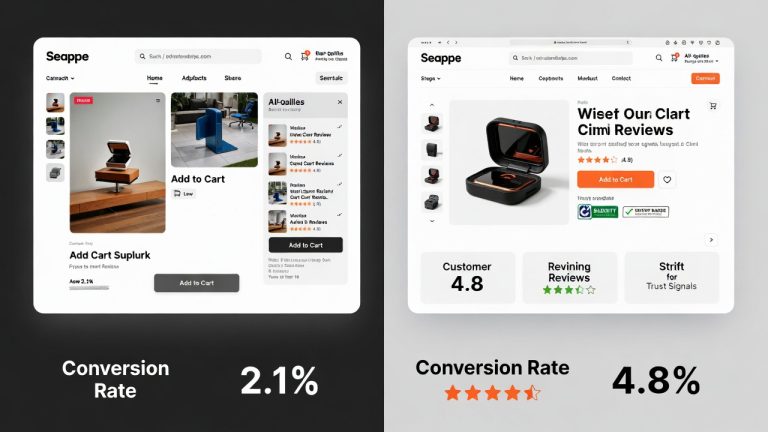
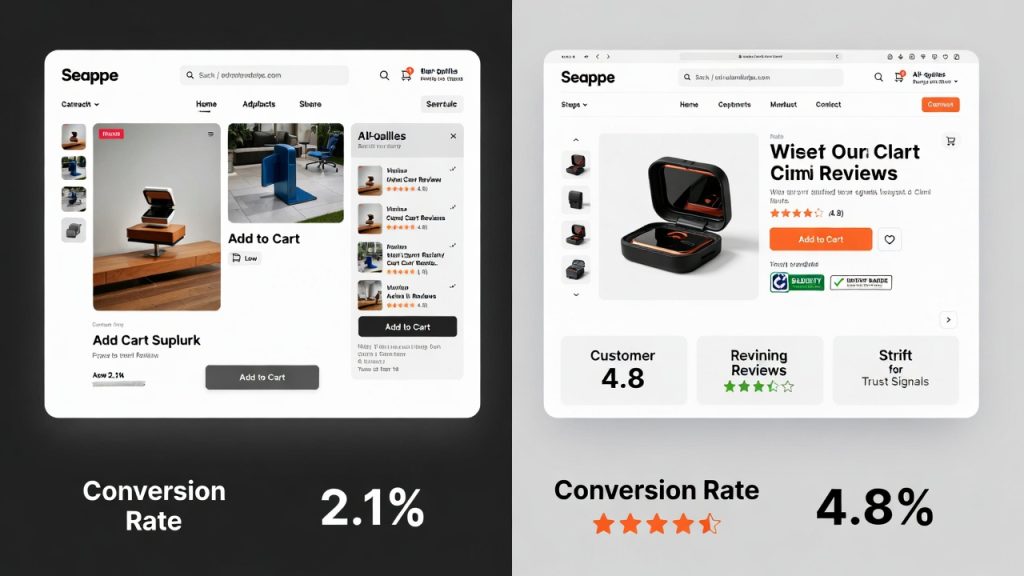
Most businesses see 15 to 40 percent conversion rate improvement within 90 days of implementation.
Document baseline performance before AI deployment. Compare results monthly to measure ongoing impact.
When Product Page AI Makes Sense
AI optimization delivers strongest ROI when:
- You have sufficient traffic (500+ visitors per product monthly minimum)
- Products have existing conversion data to analyze
- You’re willing to test continuously
- Technical resources support implementation
- Budget allows for tool subscription ($200 to $2,000 monthly)
Low-traffic sites struggle to generate enough data for AI to reach statistical confidence quickly. Manual optimization may deliver faster results for small catalogs.
Conclusion
AI product page optimization turns conversion growth from a slow guessing game into a repeatable system. Instead of relying on assumptions, brands can act on real behavioral data, prioritize high-impact changes, and improve performance continuously. The value is not just faster testing, but clearer decisions and better use of traffic you already have. AI does not replace strong fundamentals or human judgment, but it amplifies them by revealing friction points and opportunities that are easy to miss manually. For ecommerce brands focused on scaling revenue efficiently, AI-powered product page optimization is no longer optional.
Conclusion
AI product page optimization turns conversion growth from a slow guessing game into a repeatable system. Instead of relying on assumptions, brands can act on real behavioral data, prioritize high-impact changes, and improve performance continuously. The value is not just faster testing, but clearer decisions and better use of traffic you already have. AI does not replace strong fundamentals or human judgment, but it amplifies them by revealing friction points and opportunities that are easy to miss manually. For ecommerce brands focused on scaling revenue efficiently, AI-powered product page optimization is no longer optional.
Conclusion
AI product page optimization turns conversion growth from a slow guessing game into a repeatable system. Instead of relying on assumptions, brands can act on real behavioral data, prioritize high-impact changes, and improve performance continuously. The value is not just faster testing, but clearer decisions and better use of traffic you already have. AI does not replace strong fundamentals or human judgment, but it amplifies them by revealing friction points and opportunities that are easy to miss manually. For ecommerce brands focused on scaling revenue efficiently, AI-powered product page optimization is no longer optional.
FAQs
How much does product page optimization AI cost?
Tools range from $200 to $2,000+ monthly depending on traffic volume, number of products, and feature set. Most mid-market ecommerce brands spend $500 to $1,200 monthly. ROI typically justifies cost within 60 to 90 days.
How long before I see results from AI product page optimization?
Initial improvements often appear within 2 to 4 weeks as AI identifies obvious friction points. Sustained optimization continues over months. Most brands see 20%+ conversion improvement within 90 days.
Do I need developer help to implement product page optimization AI?
Most tools integrate via JavaScript snippets or native ecommerce platform apps requiring minimal technical knowledge. Advanced customizations may need developer support, but basic implementation is usually non-technical.
Will AI optimization hurt my brand image or user experience?
No, when configured with proper brand guidelines. AI tests variations within parameters you define. You approve changes before they scale. Poor results automatically revert to baseline, preventing negative impact.
Can I use product page optimization AI on Shopify, WooCommerce, or BigCommerce?
Yes, most AI optimization tools integrate directly with major ecommerce platforms through native apps or plugins. Platform-specific features may vary, but core functionality works across all major platforms.