Navigating today’s direct-to-consumer landscape requires far more than hustle. It demands operational intelligence. As competition intensifies and customer expectations rise, advanced D2C automation software has become a critical competitive advantage.
Modern brands are now leveraging artificial intelligence and machine learning to eliminate manual bottlenecks across the entire customer lifecycle. From hyper-personalized marketing journeys to predictive demand forecasting and proactive customer service, automation enables a shift from reactive operations to fully data-driven ecosystems.
The result is clear. Greater efficiency, lower operational costs, stronger customer loyalty, and scalable long-term growth.
The Imperative of Automation in the Modern D2C Landscape
In today’s e-commerce environment, D2C brands must balance rapid growth with operational precision. Without automation, scaling often leads to chaos: delayed responses, stock imbalances, inconsistent messaging, and fragmented data.
This is where smart D2C automation software becomes indispensable.
At its core, D2C automation refers to using technology to perform rule-based and repetitive processes without manual intervention. Instead of teams manually updating spreadsheets, sending follow-up emails, or routing orders, automated systems execute these workflows instantly and accurately.
As a result, teams can redirect their time toward strategy, creativity, and high-value customer interactions.
Core Components of D2C Automation Software
An effective automation ecosystem integrates multiple systems that work together seamlessly.
Customer Relationship Management (CRM)
CRMs centralize customer interactions, sales pipelines, and service requests. Automation within a CRM enables:
-
Lead scoring
-
Automated follow-ups
-
Personalized communication
-
Lifecycle segmentation
This ensures no opportunity or customer interaction is missed.
Email Automation Platforms
Modern email tools go far beyond newsletters. Automated sequences include:
-
Welcome flows
-
Abandoned cart recovery
-
Post-purchase nurturing
-
Win-back campaigns
Each trigger is based on real-time customer behavior, making engagement timely and relevant.
Enterprise Resource Planning (ERP) Systems
ERPs integrate operational processes such as:
-
Inventory management
-
Order fulfillment
-
Financial reporting
-
Supplier coordination
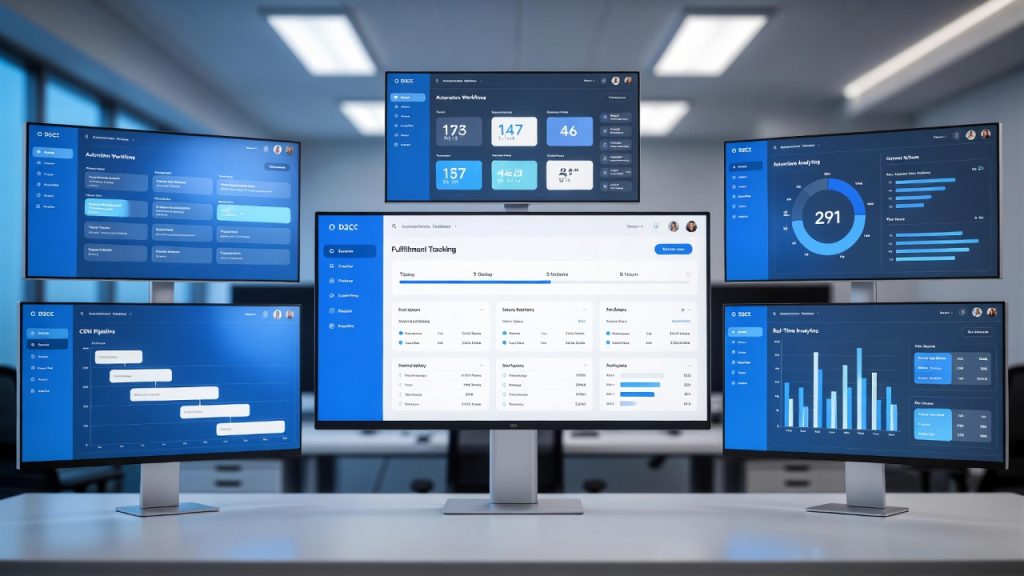
Automation ensures stock updates, shipping labels, and tracking notifications happen instantly without human intervention.
Customer Data Platforms (CDPs)
CDPs unify customer data across all channels. This enables:
-
Advanced segmentation
-
Cross-channel personalization
-
Consistent messaging
By consolidating behavioral and transactional data, brands can create highly targeted experiences.
AI-Powered Chatbots and Helpdesk Systems
Automation in customer support includes:
-
24/7 AI chat responses
-
Ticket routing
-
Automated FAQ handling
-
Self-service portals
This significantly reduces response times while maintaining service quality.
Real-World Applications of D2C Automation
Automation transforms the entire customer journey.
Customer Journey Automation
Imagine a D2C skincare brand:
-
A visitor browses a product page.
-
If no purchase occurs, an automated reminder email is triggered.
-
If items are abandoned in the cart, a timed recovery sequence activates.
-
After purchase, onboarding and education emails follow.
-
Later, re-engagement campaigns target inactive customers.
Each stage runs automatically while feeling personalized.
Inventory and Fulfillment Optimization
For an apparel brand:
-
Inventory levels update in real time.
-
Reorder alerts trigger automatically.
-
Orders route to optimal fulfillment centers.
-
Shipping notifications are generated instantly.
Advanced platforms also use predictive analytics to forecast demand based on seasonality, historical sales, and market trends. This reduces stockouts and overproduction.
Strategic Comparison of Automation Software Types
| Software Type | Core Purpose | Primary Benefit | Complexity |
|---|---|---|---|
| CRM | Customer management | Sales and lifecycle automation | Moderate |
| Email Automation | Trigger-based campaigns | Revenue recovery and retention | Low to Moderate |
| ERP | Operational integration | Inventory and financial automation | High |
| CDP | Data unification | Hyper-personalization | High |
| Helpdesk Automation | Customer service workflows | Faster resolution | Low |
Most D2C brands begin with e-commerce platform automation and expand into specialized tools as operations scale.
Implementing D2C Automation Successfully
Adopting automation requires structure.
1. Identify Bottlenecks
Determine where time, cost, or friction exists. Common areas include:
-
Abandoned cart recovery
-
Inventory tracking
-
Customer service response times
2. Map Current Workflows
Document how tasks are currently performed. Identify manual touchpoints that can be automated.
3. Select Scalable Solutions
Choose tools that integrate easily with your existing systems. API-first platforms provide long-term flexibility.
4. Test and Optimize
Automation should be monitored continuously. Review performance metrics, refine workflows, and iterate regularly.
Best Practices for Sustainable Automation
-
Start with high-impact workflows
-
Maintain clean, structured data
-
Train teams on automation benefits
-
Preserve human interaction for complex cases
-
Continuously analyze performance metrics
Automation should enhance relationships, not replace them.
The Future of D2C Automation
AI-driven systems are rapidly evolving. Future developments include:
-
Predictive lifetime value modeling
-
Dynamic pricing automation
-
Real-time personalization across devices
-
Autonomous inventory optimization
-
AI-generated customer insights dashboards
Brands that adopt automation early gain both operational efficiency and competitive agility.
Conclusion
D2C automation software is no longer optional. It is foundational.
By eliminating repetitive tasks, optimizing workflows, and enabling hyper-personalized engagement, automation transforms operational complexity into strategic clarity.
The key is to start deliberately. Identify one friction point. Automate it. Measure results. Then scale.
When implemented strategically, automation does not remove the human touch. Instead, it amplifies it, allowing teams to focus on innovation, brand storytelling, and meaningful customer relationships.
The brands that master automation today will lead tomorrow’s direct-to-consumer economy.
More Articles
Generate Engaging Product Descriptions Easily with AI Tools for Your Business
AI Workflow Automation Strategies for Business Efficiency and Growth
Unlock Higher Sales Essential Ecommerce Conversion Optimization Tips For Success
Boost Your D2C Sales and Streamline Operations with Automation Software
Create Compelling D2C Product Content That Truly Drives Sales and Engagement

FAQs
What exactly is D2C automation software and how does it work?
D2C automation software refers to a suite of tools designed to streamline and automate various operational and marketing tasks for direct-to-consumer businesses. It helps you automate everything from customer communication and marketing campaigns to inventory management and order fulfillment, making your business more efficient and effective.
How can smart automation actually help me sell more stuff directly to customers?
It boosts sales by automating personalized marketing campaigns, optimizing product recommendations, managing inventory better so you don’t run out. improving customer service responsiveness. All these things lead to a smoother customer journey, happier shoppers. ultimately, more purchases.
Is this only for big D2C brands, or can smaller businesses use it too?
Not at all! While big brands definitely benefit, many automation solutions are scalable and perfect for small to medium-sized D2C businesses. They can help level the playing field by giving smaller operations powerful tools without needing a huge team.
What kind of tasks can I automate with these solutions?
You can automate a ton! Think email marketing sequences, social media posting, inventory updates, order processing, customer support chatbots, personalized product recommendations, abandoned cart reminders. even data analysis for better decision-making.
Will implementing new software be a huge headache for my team?
While there’s always an initial learning curve, most modern automation software is designed with user-friendliness in mind. Many providers offer extensive support and training, making the transition smoother than you might expect. The long-term benefits usually outweigh the initial effort.
How quickly can I expect to see results after using smart automation?
It varies. many businesses start seeing improvements in efficiency and customer engagement within a few weeks to a couple of months. Sales uplift might take a bit longer to fully materialize as you fine-tune your strategies. the groundwork is laid fairly quickly.
What should I look for when choosing automation software for my D2C business?
Focus on ease of use, integration capabilities with your existing tools (like your e-commerce platform), scalability, the specific features that address your biggest pain points. good customer support. Also, check out reviews and consider a demo or free trial if available.