In today’s fast-paced digital landscape, the burden of repetitive tasks often stifles innovation and productivity. Embracing AI workflow automation offers a transformative solution, empowering professionals to reclaim valuable time by intelligently streamlining operations.
Leveraging recent advancements in generative AI and machine learning, tools can now autonomously handle everything from data entry and report generation to complex email triage and customer support interactions.
This intelligent delegation shifts focus from tedious execution to strategic oversight, enabling teams to concentrate on higher-value problem-solving and creative endeavors.
1. The Unseen Drain: Why Repetitive Tasks Cost More Than Time
In today’s fast-paced digital economy, time is arguably our most valuable commodity. Yet, a significant portion of our professional lives is often consumed by tasks that are, by nature, repetitive, predictable, and frankly, uninspiring.
From data entry and report generation to email management and routine customer inquiries, these tasks—while necessary—act as silent productivity killers. They not only monopolize valuable hours but also contribute to employee burnout, reduce job satisfaction, and divert attention from strategic, high-value initiatives.
The fundamental challenge lies in identifying these recurring bottlenecks and implementing effective solutions. This is precisely where the power of AI workflow automation steps in, offering a transformative approach to reclaiming precious time and enhancing operational efficiency across various sectors.
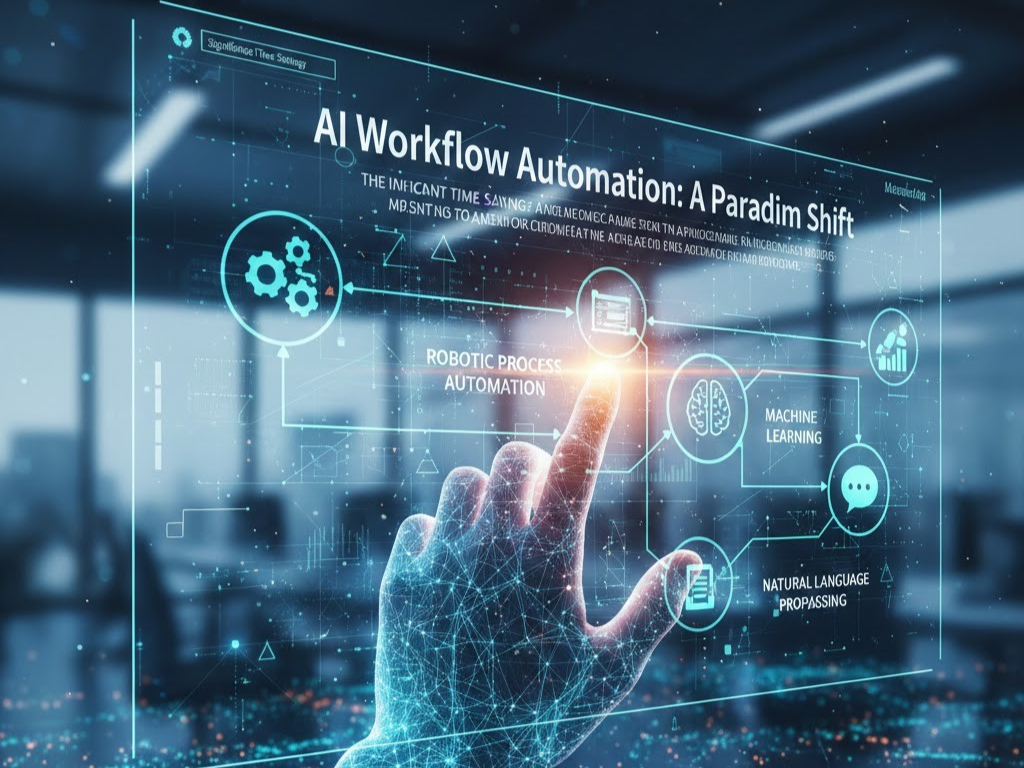
2. Understanding AI Workflow Automation: A Paradigm Shift
At its core, AI workflow automation refers to the application of artificial intelligence and machine learning technologies to streamline, optimize, and execute business processes with minimal human intervention.
Unlike traditional automation, which typically follows predefined rules and scripts, AI-driven automation possesses the ability to learn, adapt, and make decisions based on data, leading to a more intelligent and resilient system. It’s not merely about automating a single task, but about orchestrating entire sequences of operations, often across disparate systems, to achieve a specific business outcome.
Key Components:
-
Robotic Process Automation (RPA): Software robots that mimic human actions to interact with digital systems, often used for structured, rule-based tasks.
-
Machine Learning (ML): Algorithms that enable systems to learn from data, identify patterns, and make predictions without explicit programming—crucial for unstructured data.
-
Natural Language Processing (NLP): Allows systems to comprehend, interpret, and generate human language; essential for chatbots or document analysis.
-
Computer Vision: Enables AI to “see” and interpret visual details from images and videos, useful for quality control or identity verification.
-
Intelligent Document Processing (IDP): Extracts and processes data from invoices, contracts, and forms by combining OCR with ML and NLP.
3. The Tangible Benefits: Beyond Just Saving Time
Implementing AI for workflow automation yields a multitude of advantages that contribute to a more robust, agile, and competitive operational framework:
-
Significant Time Savings: Employees can redirect focus to strategic planning, creative problem-solving, and direct customer engagement.
-
Enhanced Accuracy: AI systems do not suffer from fatigue, dramatically reducing human error in data processing and calculations.
-
Cost Reduction: Substantial savings on labor costs and reduced operational expenses through optimized resource allocation.
-
Improved Scalability: Workflows can be scaled up or down rapidly to meet fluctuating demand without significant hiring.
-
Greater Compliance: Automated processes provide a clear, auditable trail of every action taken, simplifying regulatory adherence.
-
Increased Employee Satisfaction: Liberating staff from mundane tasks leads to higher morale and reduced turnover.
4. AI Workflow Automation in Action: Real-World Applications
The applicability of AI workflow automation spans across virtually every industry:
-
Customer Service & Support: AI chatbots handle routine inquiries and provide instant answers. Complex issues are escalated to human agents with pre-analyzed context, reducing resolution times.
-
Finance & Accounting: Tools process invoices, reconcile accounts, and flag suspicious transactions. IDP can extract data from various formats, ensuring accuracy in expense reporting.
-
Human Resources: AI assists with candidate screening, identifying top talent from thousands of resumes and automating onboarding documentation.
-
Healthcare: AI reduces administrative burdens by managing patient appointments, billing, and insurance claims, even pre-filling intake forms.
-
IT Operations: AI monitors system performance to identify potential outages before they happen and automates routine maintenance or support tickets.
5. Comparing Traditional vs. AI-Powered Automation
Understanding the distinction between these two is crucial for effective implementation:
| Feature | Traditional Automation (Basic RPA) | AI-Powered Automation (Intelligent) |
| Core Logic | Rule-based, deterministic, follows instructions. | Learns from data, adaptive, makes decisions. |
| Data Handling | Best with structured data (fixed fields). | Handles structured and unstructured (emails, voice). |
| Task Complexity | Repetitive, high-volume, predictable. | Complex, cognitive tasks requiring reasoning. |
| Adaptability | Requires reprogramming for process changes. | Adapts to changes and improves over time. |
6. Implementing AI Workflow Automation: A Phased Approach
Adopting AI is a strategic initiative that requires careful planning:
-
Identify Bottlenecks: Audit current processes for high-volume, time-consuming tasks prone to error.
-
Define Clear Objectives: Set quantifiable goals like reducing processing time or cutting costs.
-
Start Small, Think Big: Begin with a pilot project to gain experience and demonstrate “quick wins.”
-
Choose the Right Tools: Select platforms that align with your infrastructure, budget, and security needs.
-
Data Preparation is Key: Ensure your data is clean and accurate; AI thrives on quality input.
-
Integrate and Iterate: Seamlessly link AI with existing systems and continuously refine the models.
-
Upskill Your Workforce: Invest in training employees to work alongside AI and manage automated processes.
Technical Snapshot: AI-Driven Validation Workflow
// Pseudo-code for an AI-driven data validation workflow
function validateCustomerOrder(orderData) {
  // Step 1: Extract relevant fields using IDP
  let extractedData = IDP_Tool.extract(orderData.document);

  // Step 2: Validate customer ID against CRM (traditional automation)
  if (!CRM_System.customerExists(extractedData.customerId)) {
    return { status: "Error", message: "Customer ID not found." };
  }

  // Step 3: Use Machine Learning to check for unusual order patterns (AI intelligence)
  let orderRiskScore = ML_Model.predictFraudRisk(extractedData.orderHistory, extractedData.currentOrderValue);
  if (orderRiskScore > 0.8) { // Threshold for high risk
    return { status: "Review", message: "High fraud risk detected. Manual review required." };
  }

  // Step 4: Validate product availability in inventory system (traditional automation)
  if (!Inventory_System.checkAvailability(extractedData.productId, extractedData.quantity)) {
    return { status: "Error", message: "Product out of stock." };
  }

  // Step 5: Route order for approval based on value (rule-based with AI context)
  if (extractedData.orderValue > 10000) {
    Workflow_Engine.routeForApproval(extractedData.orderId, "Senior Manager");
    return { status: "Pending Approval", message: "Order routed for high-value approval." };
  }

  // Step 6: If all checks pass, process the order
  Order_Processing_System.processOrder(extractedData);
  return { status: "Success", message: "Order processed successfully." };
}
7. The Future is Automated: Embracing Intelligent Workflows
The trajectory of automation is clear: it is moving towards increasing intelligence, adaptability, and autonomy. As AI technologies continue to evolve, we can expect even more sophisticated capabilities, including self-optimizing processes, predictive decision-making at scale, and hyper-personalization in customer interactions.
Embracing AI workflow automation is no longer a luxury but a strategic imperative for organizations aiming to stay competitive and free up valuable human potential for tasks that require creativity, empathy, and complex reasoning. The journey to a more efficient, productive future begins with intelligently automating the repetitive today.
Conclusion
The era of endlessly battling mundane, repetitive tasks is truly behind us. By strategically integrating AI into your workflow, you’re not just saving minutes; you’re reclaiming hours, even days, that can be reinvested into creative problem-solving, strategic planning, or simply enjoying a healthier work-life balance.
I’ve personally seen how automating email categorization or initial content drafts transforms a cluttered workday into one brimming with focused opportunity. This isn’t about replacing human intelligence but augmenting it, enabling you to elevate your impact and pursue truly meaningful work. Consider where AI-powered content generation tools could streamline your marketing efforts, freeing your team for deeper campaign analysis and innovation. Start small, identifying just one or two tasks that consistently drain your energy—perhaps data entry, scheduling, or preliminary research. With the current accessibility of user-friendly AI platforms, the barrier to entry is lower than ever. Embrace this shift not as a technological hurdle, but as a profound liberation. The future of work isn’t just efficient; it’s intrinsically more human, allowing us to spend our valuable time on what truly matters.
More Articles
AI Content Creation Tools That Transform Modern Marketing Workflows
How AI Enhances Business Decisions for Smarter Outcomes
Boost Your Business with AI-Powered Decisions and Strategic Insights
Unlock Better Search Rankings Using AI Content Generator Tools Effectively
How AI product description tool helps D2C brands write better product copy

FAQs
What does ‘automating repetitive tasks with AI’ actually mean?
It means using smart computer programs, powered by Artificial Intelligence, to handle those routine, often mind-numbing jobs you do over and over. Think data entry, scheduling, report generation – AI can take these off your plate, freeing you up for more crucial, creative work.
How exactly does AI help me save time?
AI learns the patterns and rules of your existing tasks. Once it understands, it can perform those tasks much faster, with fewer errors. without needing breaks. This means you spend less time on grunt work and more on strategic thinking, problem-solving, or whatever truly needs your human touch.
Can you give some examples of tasks AI can automate?
Absolutely! Imagine AI sorting your emails, scheduling meetings, generating personalized customer responses, analyzing large datasets for trends, creating draft reports, or even updating records across different systems. If it’s rule-based and repetitive, AI can likely help.
Is it difficult to set up AI for my tasks?
Not necessarily! Many modern AI tools are designed with user-friendliness in mind, often featuring intuitive interfaces or pre-built templates for common tasks. While some complex automations might need a bit more setup, the goal is usually to make it accessible for non-technical users.
What’s the biggest perk of letting AI handle the boring stuff?
The biggest perk is definitely reclaiming your valuable time and mental energy. Instead of being bogged down by endless repetition, you can focus on innovation, strategy, building relationships, or anything else that truly requires human creativity and critical thinking. It boosts your productivity and job satisfaction.
Should I worry about AI replacing my job if it automates my tasks?
Generally, no! AI is best seen as a powerful assistant, not a replacement. It takes over the mundane, allowing you to elevate your role and focus on higher-value activities that AI can’t do. It augments human capability, making you more effective and valuable, rather than eliminating your need.
How much time can I realistically expect to free up?
That really depends on how many repetitive tasks you have and their complexity. Some individuals report saving several hours a week, while others, especially in roles heavy with data processing or customer service, might save days. Even small chunks of time add up quickly, making a significant impact over the long run!