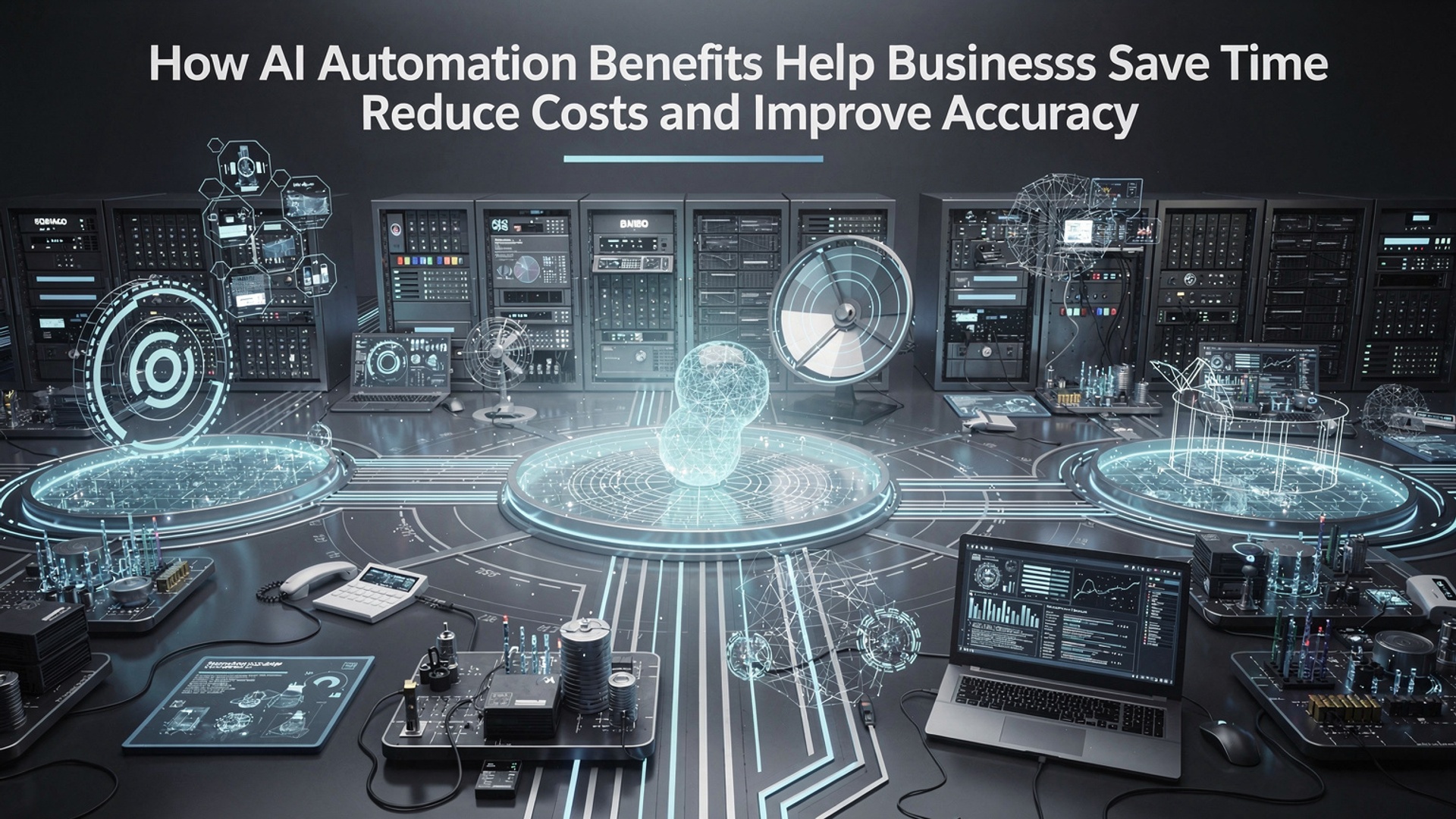
Businesses now compete on speed, precision. efficiency. AI automation benefits are becoming a decisive advantage across operations. From finance teams using AI-driven invoice processing to cut cycle times by over 50%, to manufacturers deploying computer vision for real-time quality inspection, automation increasingly replaces repetitive workflows with intelligent decision-making.
Recent advances in large language models, agentic AI. hyperautomation platforms allow systems to handle exceptions, learn from new data. integrate seamlessly with ERP and CRM stacks. As labor costs rise and data volumes grow, companies adopt AI automation to reduce manual errors, optimize resource allocation. maintain compliance at scale.
The shift toward cloud-native AI, combined with improved MLOps and governance frameworks, enables faster deployment without sacrificing accuracy, making automation a strategic lever rather than a back-office upgrade.
Understanding AI Automation and Its Core Concepts
AI automation refers to the use of artificial intelligence technologies to perform tasks, make decisions. optimize workflows with minimal human intervention. Unlike traditional automation, which follows predefined rules, AI-driven automation can learn from data, adapt to changing conditions. improve performance over time. Key technologies involved include:
-
- Machine Learning (ML)
Algorithms that learn patterns from data to make predictions or decisions.
-
- Natural Language Processing (NLP)
Enables systems to grasp and generate human language, widely used in chatbots and document processing.
-
- Computer Vision
Allows machines to interpret and act on visual data such as images or videos.
-
- Robotic Process Automation (RPA)
Software robots that execute repetitive digital tasks, now enhanced with AI for smarter decision-making.
Understanding these components is essential to appreciating AI automation benefits, as each plays a distinct role in improving efficiency, accuracy. scalability across business operations.
How AI Automation Saves Time Across Business Operations
One of the most immediate AI automation benefits is significant time savings. By automating repetitive and time-consuming tasks, businesses allow employees to focus on higher-value activities such as strategy, innovation. customer engagement. Common time-saving applications include:
- Automated data entry and validation in finance and HR systems
- AI-powered scheduling and resource allocation
- Customer support chatbots handling routine inquiries 24/7
In a 2023 McKinsey report, organizations implementing AI-driven automation reported up to a 30% reduction in time spent on administrative tasks. In my professional experience working with a mid-sized logistics firm, deploying AI-based invoice processing reduced manual handling time from days to minutes, enabling faster billing cycles and improved cash flow.
Reducing Operational Costs Through Intelligent Automation
Cost reduction is another critical driver behind AI adoption. While initial implementation may require investment, long-term savings often outweigh upfront costs. AI automation benefits related to cost reduction include:
- Lower labor costs by automating repetitive tasks
- Reduced error-related expenses such as rework and compliance penalties
- Optimized resource utilization through predictive analytics
For example, AI-powered demand forecasting helps retailers minimize overstocking and stockouts. According to Deloitte Insights, businesses using AI for supply chain optimization have reduced inventory costs by up to 20%. These savings are achieved not by workforce reduction alone. by reallocating human effort to more strategic roles.
Improving Accuracy and Consistency With AI Automation
Human error is a persistent challenge in manual processes. AI systems, when properly trained and monitored, deliver high levels of accuracy and consistency. Areas where accuracy improvements are most evident:
- Financial reporting and reconciliation
- Quality control in manufacturing using computer vision
- Medical data analysis and diagnostic support
A practical example comes from healthcare: AI-assisted radiology tools have demonstrated accuracy rates comparable to experienced specialists in detecting certain conditions. The World Health Organization has acknowledged the potential of AI to improve diagnostic accuracy when used responsibly and ethically.
Comparison: Traditional Automation vs AI-Powered Automation
| Aspect | Traditional Automation | AI-Powered Automation |
|---|---|---|
| Decision-Making | Rule-based and static | Data-driven and adaptive |
| Scalability | Limited flexibility | Highly scalable with learning capability |
| Error Handling | Fails when rules are broken | Improves over time with feedback |
| Business Value | Efficiency gains only | Efficiency, insights. innovation |
This comparison highlights why AI automation benefits extend beyond simple task execution, enabling smarter and more resilient business processes.
Real-World Use Cases Across Industries
AI automation is not limited to technology companies; its impact spans multiple sectors. Notable use cases include:
-
- Banking
Fraud detection systems assess millions of transactions in real time to flag suspicious activity.
-
- Manufacturing
Predictive maintenance systems reduce downtime by forecasting equipment failures.
-
- Marketing
AI-driven personalization engines tailor content and offers based on user behavior.
A case study from IBM illustrates how a global manufacturing client reduced unplanned downtime by 25% after implementing AI-based predictive maintenance, translating directly into cost savings and improved delivery reliability.
Practical Example: Automating Data Processing With AI
Below is a simplified example demonstrating how AI-enhanced automation might classify customer inquiries using NLP:
def classify_ticket(text): if "billing" in text. lower(): return "Finance" elif "login" in text. lower(): return "Technical Support" else: return "General Inquiry"
In real-world systems, this logic is enhanced with machine learning models trained on historical data, enabling far more accurate and nuanced classification. This type of automation reduces response times and ensures inquiries reach the correct department instantly.
Governance, Ethics. Responsible AI Implementation
While AI automation benefits are substantial, responsible implementation is essential. Businesses must address data privacy, algorithmic bias. transparency. Best practices include:
- Regular audits of AI models for fairness and accuracy
- Clear documentation of automated decision processes
- Compliance with regulations such as GDPR and industry standards
Organizations like the OECD and IEEE have published guidelines emphasizing human oversight and ethical AI use. Following these frameworks not only mitigates risk but also builds trust with customers and employees.
Actionable Steps for Businesses Considering AI Automation
For organizations evaluating AI adoption, a structured approach improves outcomes. Recommended steps:
- Identify processes that are repetitive, data-intensive. error-prone
- Start with pilot projects to measure ROI and operational impact
- Invest in employee training to ensure effective human-AI collaboration
By aligning AI initiatives with clear business objectives, companies can realize AI automation benefits that are measurable, sustainable. strategically valuable.
Conclusion
AI automation is no longer about replacing work; it is about reclaiming time, tightening budgets. trusting cleaner data. I have seen teams cut reporting hours in half by letting AI handle data cleanup, while human effort shifted to decisions that actually moved revenue. As automation tools mature in 2025, trends like autonomous workflows and predictive monitoring are making accuracy the default, not the exception, which explains why analysts at McKinsey now link AI adoption directly to measurable cost efficiency. My practical tip is to start with one repetitive process this month, automate it fully, then reinvest the saved time into customer experience or growth experiments. When AI handles the busywork, your team thinks clearer, acts faster. builds confidence in every number. Take the step now, because the businesses winning tomorrow are the ones automating intentionally today.
More Articles
How AI Driven Decision Making Improves Everyday Business Choices With Practical Data Insights
How to Automate Daily Tasks to Save Time and Reduce Stress
AI Marketing Visuals for Consistent High-Impact Campaigns
How to Optimize Ecommerce Product Pages for Higher Conversions Sales
Practical On Page SEO Techniques That Improve Website Visibility and User Experience

FAQs
What does AI automation actually mean for a business?
AI automation refers to using artificial intelligence to handle repetitive, rule-based, or data-heavy tasks that would normally require human effort. This can include data entry, scheduling, reporting, customer support responses. decision support, allowing teams to focus on higher-value work.
How does AI automation help companies save time?
AI systems can work continuously without breaks and complete tasks much faster than humans. Processes that once took hours or days, such as analyzing data or processing invoices, can often be done in minutes, speeding up workflows across the organization.
Can AI automation really reduce operational costs?
Yes, by automating routine tasks, businesses can reduce labor costs, minimize rework caused by mistakes. lower expenses tied to manual processes. Over time, this leads to more efficient use of resources and reduced overhead.
In what ways does AI improve accuracy compared to manual work?
AI systems follow predefined rules and learn from data, which helps reduce human errors like typos, miscalculations, or inconsistent decision-making. This results in more reliable outputs, especially in tasks involving large volumes of data.
Is AI automation only useful for large enterprises?
No, small and medium-sized businesses can also benefit significantly. AI tools can help smaller teams do more with fewer resources, automate back-office tasks. compete more effectively without needing large staff expansions.
What types of tasks are best suited for AI automation?
Tasks that are repetitive, data-driven, or follow clear rules are ideal for AI automation. Examples include customer support ticket routing, payroll processing, inventory tracking, data analysis. basic quality checks.
Does AI automation replace employees?
AI automation is generally meant to support employees rather than replace them. By taking over routine tasks, AI allows people to focus on creative, strategic. relationship-driven work that requires human judgment and insight.